Toilet Grid Interconnect Standards for Residential Homeowners
The interconnection standard governing how a home may back-feed the Municipal Fart Grid, with the electrical and gas-quality thresholds a residential contributor must clear.
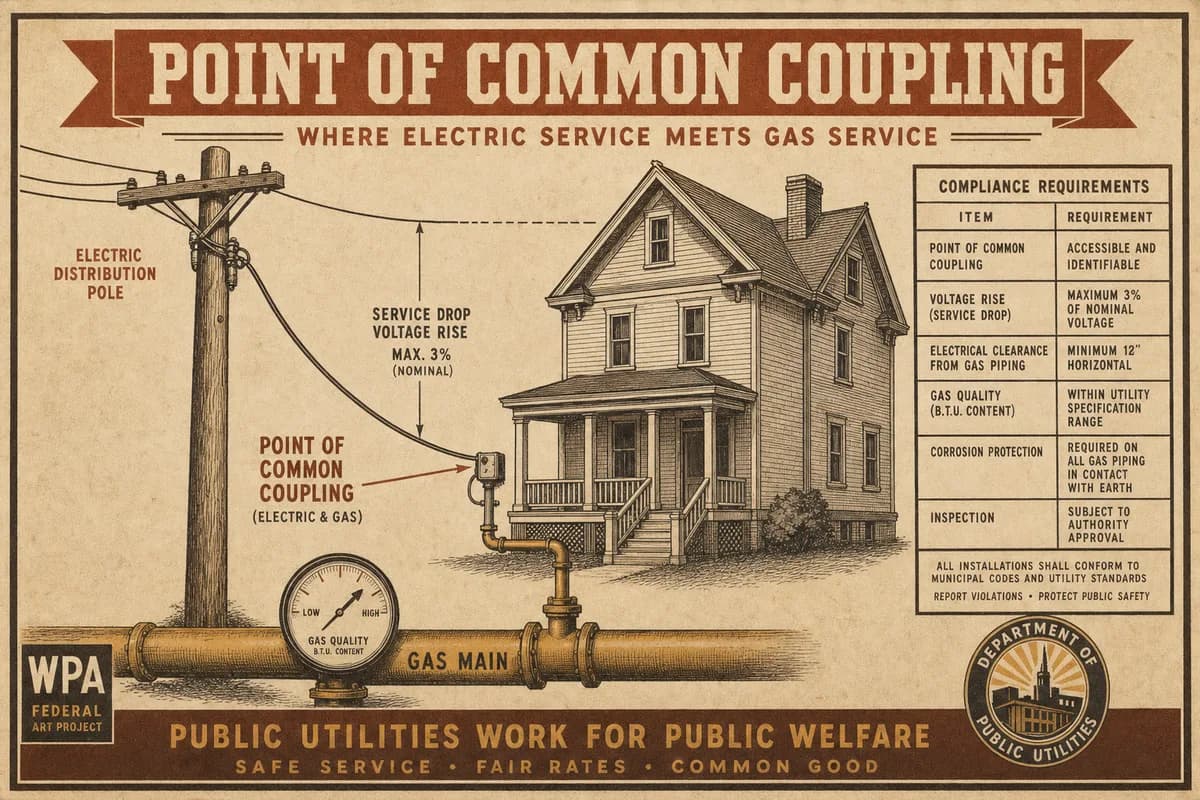
1. Scope
This standard governs the interconnection of a residential contributor to the Municipal Fart Grid at the point of common coupling, on both the electrical and the gas side. It defines the thresholds a home must clear to back-feed the grid, the conditions under which the contributor must disconnect, and the metering by which contribution is settled. It does not address generation the home consumes behind its own meter, which remains the homeowner's own affair.
2. The Point of Common Coupling
The point of common coupling (PCC) is the boundary where the home's service meets shared infrastructure — the service drop on the electrical side and the service tee on the gas side. Every requirement below is evaluated at the PCC, not at the appliance. A home may run a Dungester 5000 to any standard it likes inside the property line; the standard begins where the home's output becomes the neighbor's problem.
3. Electrical Interconnection
A home exporting through a biogas genset injects real power into a distribution circuit that was designed to deliver it, not receive it. Two quantities are checked.
Voltage rise. Injecting power at the end of a service drop raises the local voltage by approximately ΔV = P·R ÷ V. For a genset exporting P = 200 W at unity power factor through a service drop of R = 0.20 Ω at V = 240 V:
ΔV = (200 × 0.20) ÷ 240 = 0.17 V,
or 0.07% of nominal. The standard permits rise up to the ANSI Range A limit of ±5%. A single home therefore consumes about 1.4% of its allotted voltage-rise budget. The constraint is not binding, and it is not close.
Hosting capacity. The aggregate matters more than the individual. A 25 kVA residential transformer serving eight contributing homes sees, at full export, 8 × 200 W = 1.6 kW — or 6.4% of transformer nameplate, against a screening threshold of 15% (3.75 kW) above which an interconnection study is triggered. The entire street's toilet output musters 1.6 kilowatts — comfortably below the threshold that would require anyone to study it. Residential contributors therefore qualify under the simplified process, for the plain reason that the resource is too small to endanger anything.
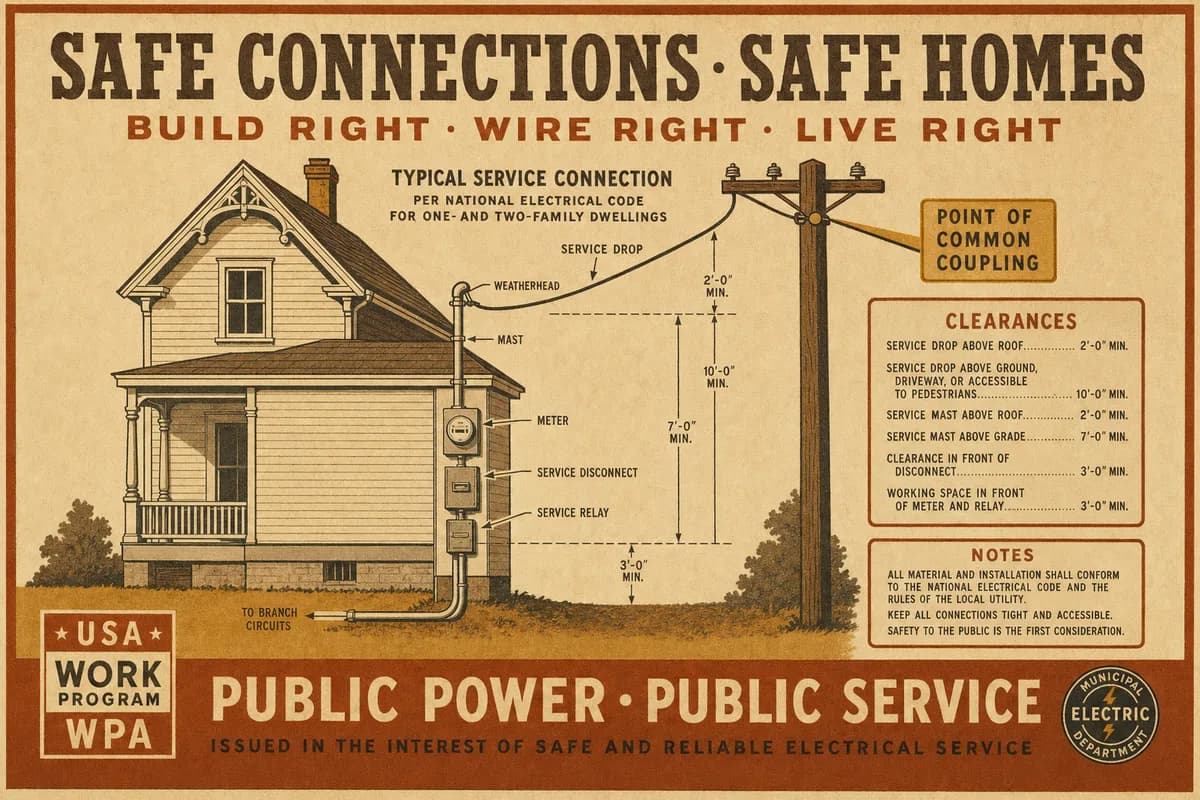
Anti-islanding. The one non-negotiable electrical requirement. On loss of the grid, the contributor must cease energizing the PCC within 2 seconds, and must trip on any voltage outside 88–110% of nominal or any frequency outside 59.5–60.5 Hz. A home may contribute to the grid; it may never energize a line the utility believes to be dead.
Figure 1 shows the interconnection the standard requires.
4. Gas-Quality Interconnection
The gas side is where residential interconnection is, in practice, denied. Injected gas must be interchangeable with the pipeline reference, and interchangeability is measured by the Wobbe index — the higher heating value divided by the square root of specific gravity.
Pipeline reference gas runs a Wobbe index near 50 MJ/m³ (39 MJ/m³ ÷ √0.60). Raw biogas at 60% methane carries a higher heating value of only 0.60 × 39.8 = 23.9 MJ/m³ and a specific gravity near 0.94, for a Wobbe index of:
23.9 ÷ √0.94 = 24.7 MJ/m³,
roughly half the reference. Interchangeability standards admit a few percent of deviation, not fifty. Raw digester gas is therefore rejected for direct injection; a home may inject on the gas side only after upgrading its output to biomethane of at least 95% methane, which no residential appliance in the Brown Home™ catalogue performs. Compounding this, residential gas service is delivered near 7 inches of water column (about 1.7 kPa), while a floating-drum digester holder produces roughly a third of that, so even conforming gas would require compression the home does not possess. The gas-side interconnection is, for the residential homeowner, a certificate one does not qualify for.
5. Metering and Settlement
Contribution is settled by a bidirectional meter at the PCC. Export is credited against the household's Residential Digestive Contribution Act obligation; there is no cash settlement at residential scale, both because the volumes are trivial and because the crediting mechanism was designed to encourage participation, not to enrich the participant.
6. Certification and Posted Signage
A home that clears the electrical requirements of §3 is issued a Certificate of Interconnection, to be displayed at the meter and produced on inspection. Metered facilities must additionally post the standard safety signage at the PCC, per the industrial-notice schedule:
Materials Referenced in This Bulletin

poster No. 103
Poster No. 103 — Please Remain Seated Until the Turbine Stabilizes
Authorized archival reproduction of the industrial safety notice posted beside metered municipal facilities. The gauge still climbs toward a stabilization value most turbines of the period never reliably reached. Retained on the grounds that it settles the queue.

poster No. 34
Poster No. 34 — Every Flush Counts
Authorized archival reproduction of the Demand Defecation drive original, Office of Civic Digestion, circa 1943. Reformatted for residential, commercial, and municipal-adjacent display. The lightly foxed condition of the source lithograph is not reproduced; structural soundness is.
Figure 2 reproduces the placard at actual size.

7. Conclusion
For the residential homeowner, the toilet-grid interconnection standard resolves to an asymmetry. The electrical side is permitted and trivial: the home may back-feed, but its contribution is so small that the elaborate machinery of voltage-rise and hosting-capacity analysis exists mostly to certify that there is nothing to analyze. The gas side is meaningful and forbidden: raw biogas fails interchangeability by a factor of two, so the home that most wants to contribute is precisely the home the standard turns away. The residential contributor is thus admitted through the door that leads nowhere and barred from the one that leads somewhere — which the standard regards, correctly, as a stable equilibrium.