Zeno's Paradox of the Bathroom Line
Zeno's paradoxes of motion, restaged in the bathroom line, expose why the standard calculus consolation fails exactly where the queue-stander needs it most.
From the series: Philosophers in the Bathroom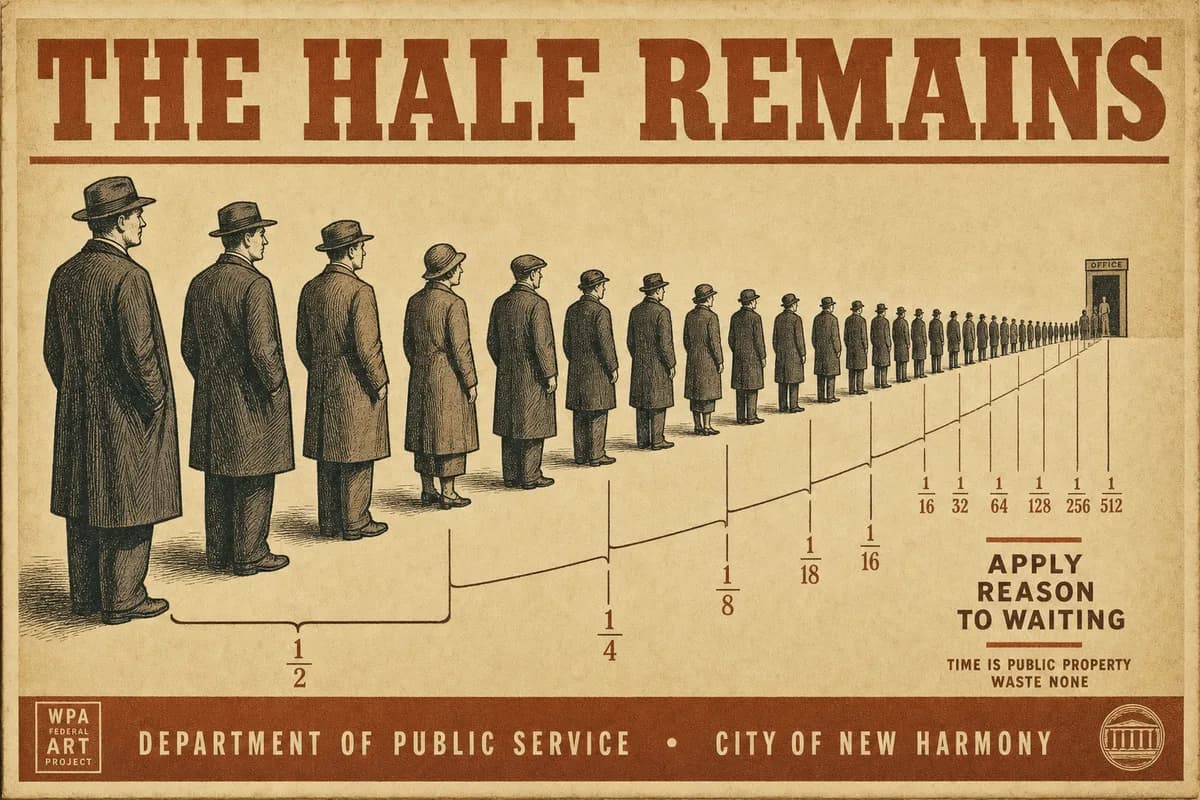
Zeno of Elea composed his paradoxes, Aristotle reports, to defend his master Parmenides by showing that motion and plurality, taken seriously, dissolve into contradiction (Aristotle, Physics VI.9, 239b). For two and a half millennia the arguments have been staged with runners, arrows, and tortoises. They were waiting for a better theater, and it is the line for a single bathroom, where motion toward the front is not a metaphysician's abstraction but a felt and grinding impossibility.
The Dichotomy at the Door
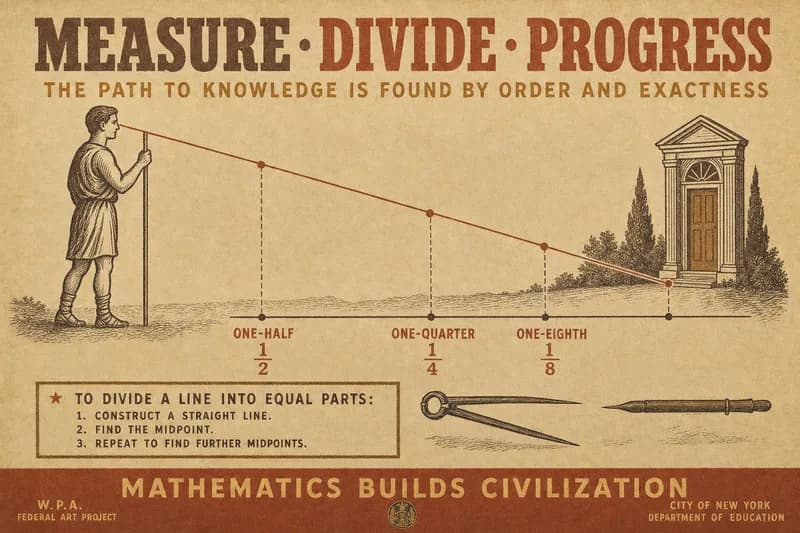
The first paradox, the Dichotomy, holds that to traverse any distance one must first reach its midpoint, and before that the midpoint of the near half, and so on without end — infinitely many sub- journeys to be completed in finite time, which Zeno declares impossible (Aristotle, Physics VI.9, 239b). The queue-stander performs the argument bodily. To reach the door he must first advance to the midpoint of the line; to reach that, the midpoint of the near half; and so through an unending nest of prior halves. He does not experience the line as a distance to be walked but as a hierarchy of thresholds, each of which conceals a nearer one, so that the front is always approached and never quite begun to be reached.
Achilles and the Tortoise
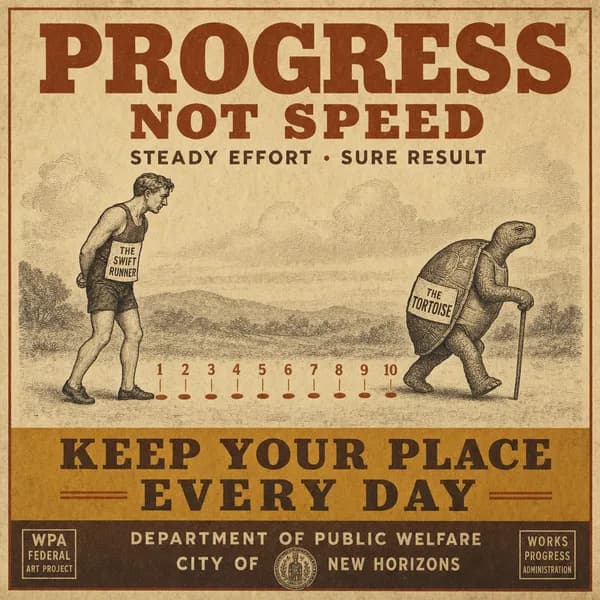
The second paradox sharpens the first. Swift Achilles can never overtake the tortoise he has spotted a lead, for by the time he reaches the tortoise's position the tortoise has crept a little further, and so on forever (Aristotle, Physics VI.9, 239b). The line reproduces this with cruel exactitude. Each time the stander advances to the spot the person ahead has vacated, that person has, in the interval, vacated it precisely by advancing to the next — so that the gap ahead is refilled at the very moment it is closed. He is always arriving where the front-runner just was, and the front-runner is always, maddeningly, just beyond.
The Standard Resolution
The mathematician's reply is well known and correct. The infinitely many sub-distances of the Dichotomy form a convergent geometric series: one-half plus one-quarter plus one-eighth, and so on, sums not to infinity but to exactly one. Because each successive half is crossed in proportionally less time as well as less space, the infinitely many intervals occupy a finite total duration, and the traversal completes. Aristotle had already sketched the escape — the infinity of the line is only potential, never actually enumerated (Aristotle, Physics VIII.8) — and the calculus of limits later made it rigorous. The runner arrives. The paradox, so posed, is solved.
Why the Resolution Fails Here
Here is the crux, and it is arithmetical, not rhetorical. The standard resolution converges only because the time to cross each sub-interval shrinks in step with the interval — halve the distance and you halve the duration. The bathroom line violates this premise at its foundation. The line does not advance by continuous motion whose speed is fixed; it advances in discrete jumps, one per occupant served, and each occupant consumes a roughly constant interval — call it t, some three to five minutes — regardless of how near the front the queue has crept. The gaps in space may halve; the gaps in time do not. A line of n people ahead therefore takes not a convergent sum tending to a tidy limit but n × t — a plain product that grows without bound in n and shrinks only when someone actually leaves. The consolation of the mathematicians is real, and it is the wrong consolation. It resolves the paradox of the shrinking gap and leaves untouched the paradox of the constant one.
The Arrow
A third paradox names the resulting experience. Zeno's Arrow holds that at any single instant a flying arrow occupies a space exactly equal to itself and is therefore, at that instant, at rest; and since time is composed of instants, the arrow never moves (Aristotle, Physics VI.9, 239b). Photograph the line at any instant and Zeno is vindicated on film: every figure occupies a space exactly equal to itself, no one is caught mid-step, the whole procession is at rest. Motion, if it is anywhere, is only in the intervals between the photographs — the intervals of length t, which do not converge, which the calculus cannot sum away, and through which the stander must actually, and finitely, and interminably, wait.
Conclusion
The bathroom line is thus the one arena in which Zeno wins on points. The Eleatic was wrong about the racecourse, where the shrinking of time with distance rescues motion and the sum comes cleanly to one. He was right, by accident, about the queue, where time does not shrink, the sum does not converge to a consolation, and the front is reached only by the brute subtraction of one constant interval after another. One does not solve the bathroom line. One survives its terms, which are Zeno's terms, honestly stated at last.
Works Cited
Aristotle. Physics. Trans. R. P. Hardie and R. K. Gaye. Books VI and VIII. Cited by Bekker number. Salmon, Wesley C., ed. Zeno's Paradoxes. Bobbs-Merrill, 1970. Grünbaum, Adolf. Modern Science and Zeno's Paradoxes. Wesleyan University Press, 1967. Ostrowski, P. Halden. "Non-Convergent Queues and the Failure of the Standard Resolution." Journal of Applied Aporetics 15, no. 3 (2021): 201–228.