Sartre: Hell Is Other People Waiting Outside
Sartre's account of the objectifying gaze finds its purest case in the single-occupancy restroom, where the line outside becomes the Look made architecture.
From the series: Philosophers in the Bathroom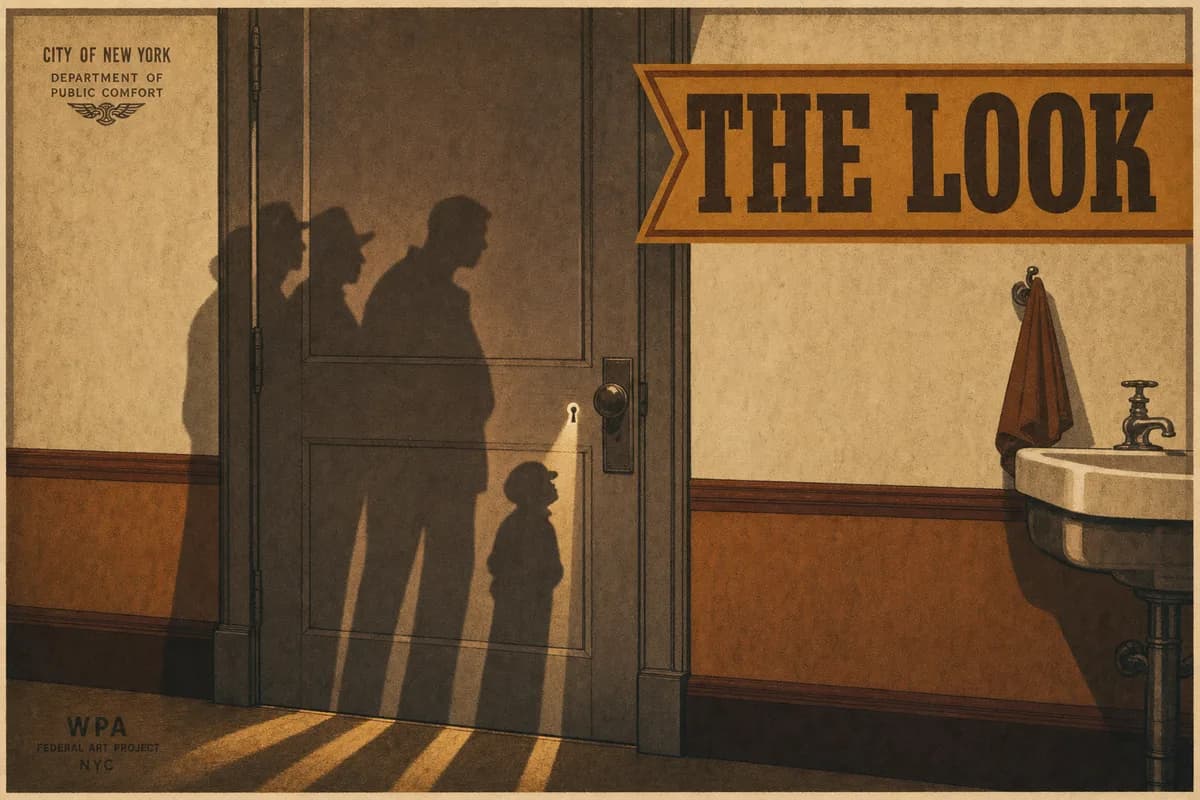
Sartre's most quoted line — l'enfer, c'est les autres, "hell is other people" — comes from the close of No Exit (Sartre 1944), and is almost always misheard. It is not the misanthrope's complaint that other people are unpleasant. It is a technical claim, worked out at length in Being and Nothingness (Sartre 1943): that in the presence of another consciousness I am dispossessed of myself, fixed from outside into an object I cannot control or refuse. The claim has been illustrated with cafés, park benches, and battlefields. Its cleanest instance is architectural and stands in every airport, café, and filling station: the single-occupancy restroom with a line outside the door.
The For-Itself, Alone
Alone in the locked room, the occupant is what Sartre calls a pour-soi, a being-for-itself: pure consciousness, free, unfinished, coinciding with no fixed nature. He is, for the moment, only what he is doing, from the inside, without remainder. This is the condition the restroom promises and the reason the door has a latch. Solitude here is not incidental comfort; it is the precondition of existing as a subject rather than a thing.
The Look
Then Sartre's decisive event: le regard, the Look. "I see myself because somebody sees me," he writes; under the gaze of another I am given "a nature," congealed into an object for a freedom that is not mine (Sartre 1943, Part 3). The line outside is the Look rendered as architecture. Its members need not see through the door — Sartre is explicit that the Look is not a matter of eyeballs but of being apprehended by another subject. The shuffling, the sighs, the tried handle: each is proof that beyond the panel a consciousness holds me in view, has already assigned me a nature (the slow one, the inconsiderate one, the one taking ages), and awaits my emergence into the account it has drawn up.
Shame
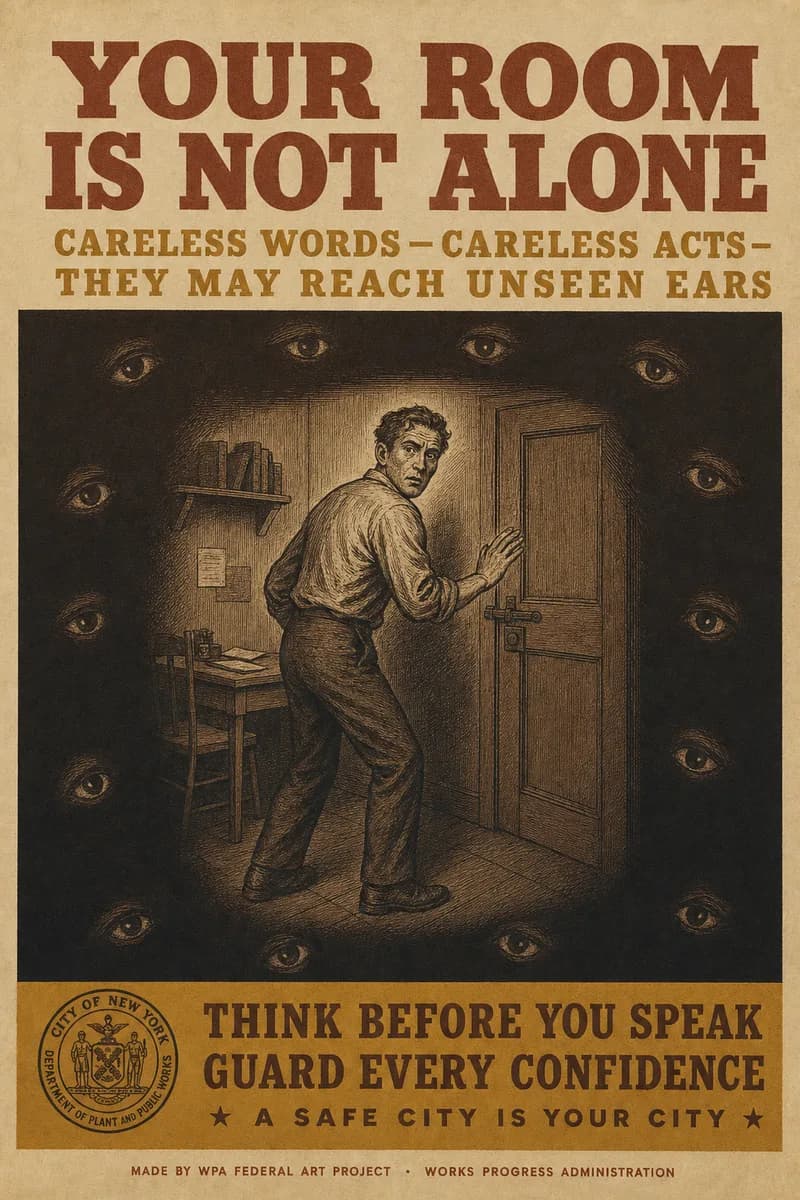
The affect that certifies the Look is shame, which Sartre calls "shame of self; it is the recognition of the fact that I am indeed that object which the Other is looking at and judging" (Sartre 1943, Part 3). Shame is not guilt at a deed; it is the sudden felt evidence that one has an outside, visible to another and beyond one's editing. The occupant who a moment ago was simply, freely about his business now discovers that he is also, and helplessly, a figure in someone else's scene — an object with a duration being timed, a body whose noises are received. The line does not merely wait for the room. It converts the room into a stage and its occupant into a performance he did not agree to give.
The Keyhole
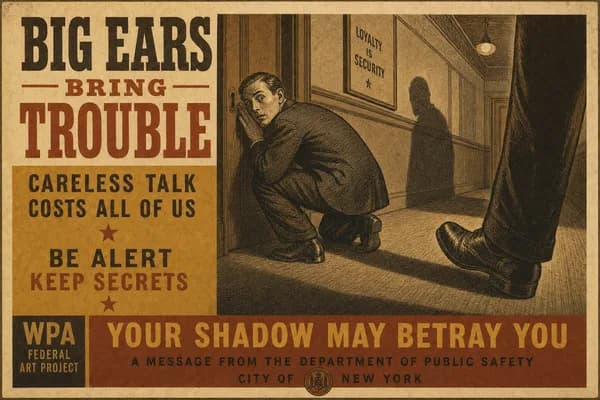
Sartre's most famous illustration belongs here by right, for he set it at exactly this kind of door. A man crouches at a keyhole, absorbed, jealous, wholly given over to what he spies — and in that absorption he is a pure for-itself, without an outside, "alone and on the level of a non-thetic self-consciousness" (Sartre 1943, Part 3). Then footsteps in the hall. All at once he is seen: he becomes a peeper, a figure with a shameful posture, an object with a name. Sartre's own scene requires a corridor, a door, and the arrival of another — precisely the corridor, door, and arrival that constitute the restroom queue. The occupant is the man at the keyhole; the person who joins the line is the footstep; the transformation is identical.
Bad Faith at the Sink
The occupant may attempt an escape Sartre forecloses in advance: mauvaise foi, bad faith. He performs unhurried ease — an extra, theatrical rinsing of the hands, a leisured gathering of effects — telling himself he is unbothered and the line unreal. But the performance is for the line; its very elaborateness confesses the audience it pretends to ignore. To flee the Look by staging a show of indifference to it is to affirm the Look in the act of denying it. Bad faith cannot dissolve the Other, because bad faith is a lie one tells to a consciousness the Other has already installed inside one's own.
No Exit
Which returns us to the line so often misquoted. Sartre's hell is a locked room, three people, no mirror, no sleep, no relief from mutual observation — a place where "hell is other people" because each inmate exists forever as the object the others perceive, with no exit into unwatched subjectivity. The single restroom stages the whole apparatus in under three minutes: the closed room, the vanished privacy, the freedom frozen into a thing under a gaze that will not lift. The door will open. The room is not, in the end, hell, because it grants what Sartre's hell withholds — an exit. But it charges admission in the coin of No Exit, and the toll, briefly and completely, is oneself.
Works Cited
Sartre, Jean-Paul. Being and Nothingness: An Essay on Phenomenological Ontology. Trans. Hazel E. Barnes. Washington Square Press, 1992 [L'Être et le néant, Gallimard, 1943]. Sartre, Jean-Paul. No Exit and Three Other Plays. Trans. Stuart Gilbert. Vintage, 1989 [Huis clos, 1944]. Sartre, Jean-Paul. Existentialism Is a Humanism. Trans. Carol Macomber. Yale University Press, 2007 [1946]. Cazenove, Étienne. "Le regard à la porte: The Queue as Objectifying Consciousness." Cahiers de Phénoménologie Appliquée 24 (2018): 61–89.