Plato's Cave, But It's a Porta-Potty
The Allegory of the Cave has always wanted a venue; the festival portable restroom satisfies its every structural demand.
From the series: Philosophers in the Bathroom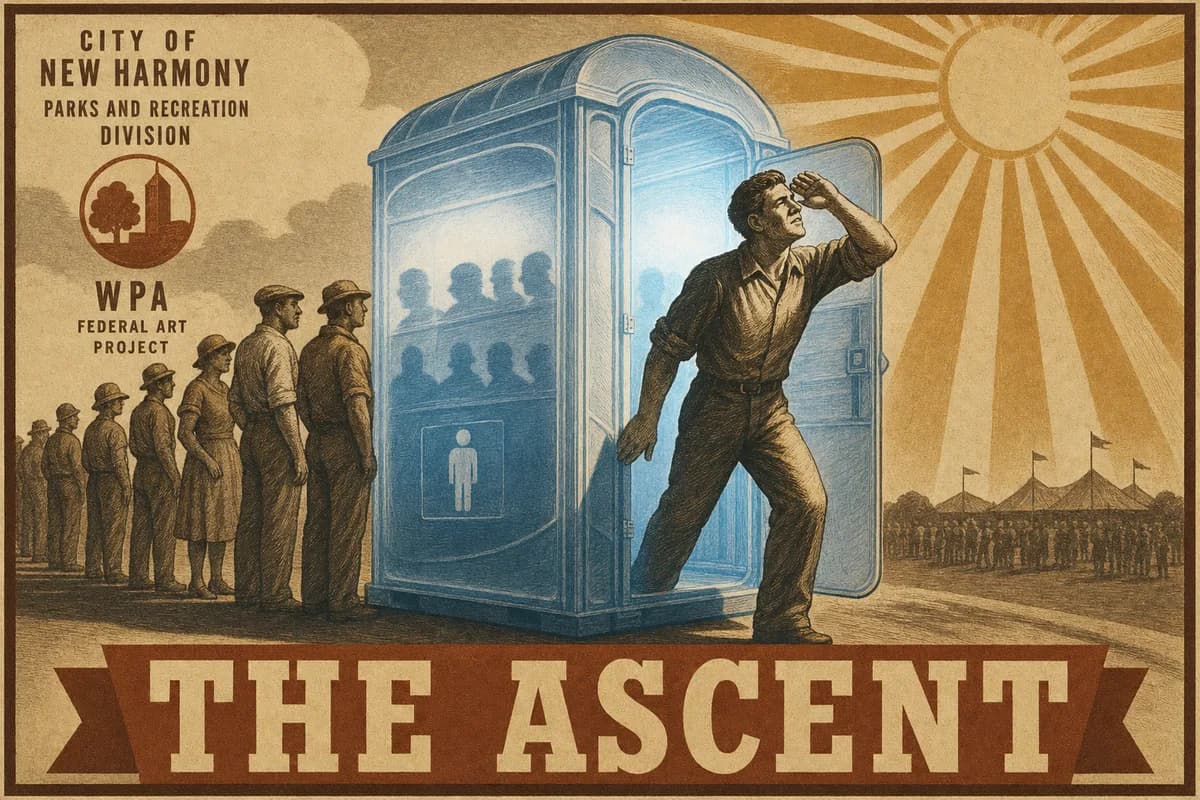
For two and a half millennia the Allegory of the Cave (Republic 514a–520a) has wanted a venue. Plato gives us prisoners chained before a wall, a fire behind them, shadows cast by objects they cannot turn to see, and a single arduous ascent toward a sun they are not prepared to bear. Every generation of readers supplies its own cave — the theater, the ideology, the screen. I wish to propose a candidate that answers the allegory's every structural demand with a fidelity the loftier readings cannot match: the portable event restroom, the porta-potty of the festival grounds.
The Chamber
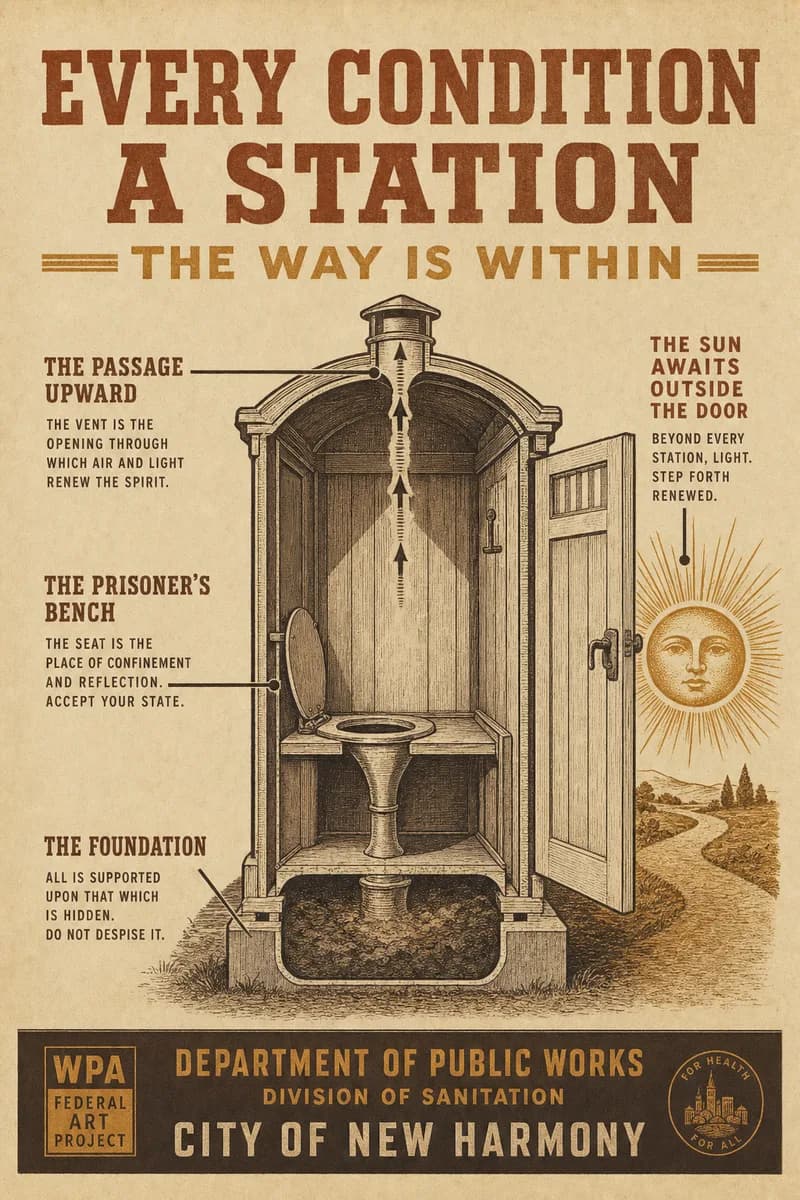
Consider the fit. The cave is a bounded enclosure, entered by a narrow passage, in which a single occupant is confined in enforced solitude and immobility. The porta-potty is precisely this. Its walls are translucent polyethylene, and here Plato's optics are honored exactly: the occupant does not see the world outside, but neither is he in darkness. He sees the world's shadows — the diffuse, sourceless silhouettes of the crowd and the sun thrown against the molded wall, "shadows of the things carried past" (515a), stripped of all detail, taken by the prisoner for the whole of the real. The queue outside, shuffling and murmuring, is the procession behind the fire.
The chamber is rendered in section below, its stations marked accordingly.
The Doxa on the Wall
Plato's prisoners honor one another for the swiftest recognition of the passing shadows, and award "prizes and praise" for fluency in appearances (516c). The interior wall of the porta-potty is the archive of this lower knowledge: the inscriptions, declarations, and rival testimonies of every prior occupant, the accumulated doxa of the festival, offered with total confidence and no access to the forms. To read these walls is to survey opinion in its purest state — assertion unchastened by dialectic. Blumenberg was right that the cave's deepest subject is the human preference for the administered image over the unmediated real (Blumenberg 1989); the marker-scrawled wall is that preference epigraphically confirmed.
The wall's testimony, as received from within, is rendered below.

The Blue Sun
A false light must be accounted for. In Plato's cave the fire is the counterfeit of the sun — an artificial source that casts real shadows and thereby sustains the whole regime of appearance. The porta-potty supplies its own: the votive blue of the tank, the engineered azure of the sanitizing fluid, glowing beneath the seat. It is a flawless Platonic fire. It is a light that illuminates nothing worth seeing, colors everything it touches, and is universally mistaken, by those who have known no other, for the natural condition of the world. The prisoner mistakes the blue water for the sky.
The Ascent
Then the release. The latch gives — always, Plato insists, against the prisoner's inclination — and the occupant is "dragged up the rough and steep ascent" into the light of the festival day (515e). The account is clinically accurate. One emerges from the chamber blinded, eyes streaming, "unable to see a single one of the things now said to be true" (516a), reaching for the guide-rope of the familiar dark. Heidegger read this passage as the drama of alētheia, of truth as an unconcealment wrested painfully from hiddenness (Heidegger 1997 [1931–32]); the festival-goer, staggering into the open with a hand raised against the sun, performs the wresting bodily. The light that is truth is, at the threshold, indistinguishable from an affliction.
The Return
Plato's philosopher does not remain in the sun. He is obliged to descend — to re-enter the cave, to sit again in the dimness among those who never left, and to govern (519d–520a). This is the allegory's hardest teaching and the one the porta-potty renders most faithful, for the festival admits no permanent ascent. The demand is structural. The peak-load modeling of large events describes a population cycling ceaselessly between the open ground and the chamber, each initiate returning to the enclosure so that the next may take his turn at the light. The enlightened do not escape the cave. They form the queue.
Conclusion
Irigaray objected that Plato's cave was always a chamber of one particular kind, an enclosure of confinement misread as a figure of the whole soul (Irigaray 1974); the objection only sharpens the fit. What the allegory finally describes is not a prison one class of person inhabits but a condition every festival-goer enters in turn — alone, briefly, and returns from changed, having glimpsed, through streaming eyes and past a haze of engineered blue, the intolerable brightness of the actual day. Plato feared we would kill the one who came back to tell us what he saw (517a). At the modern festival we are kinder. We simply do not believe him, and we wave him to the back of the line.
Works Cited
Blumenberg, Hans. Höhlenausgänge. Suhrkamp, 1989. Heidegger, Martin. The Essence of Truth: On Plato's Cave Allegory and Theaetetus. Trans. Ted Sadler. Continuum, 1997 [lectures of 1931–32]. Irigaray, Luce. Speculum de l'autre femme. Minuit, 1974. Plato. Republic, Book VII, 514a–520a.