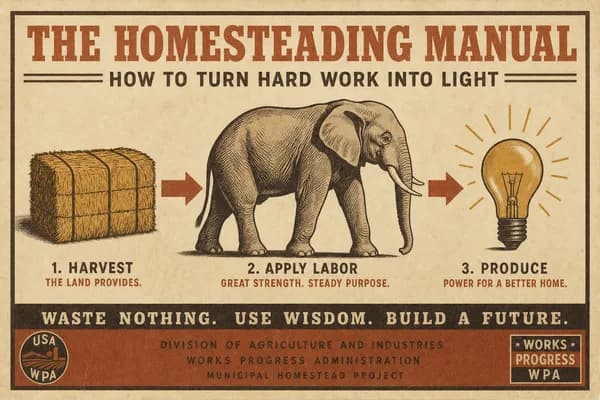
One Elephant Can Power a Tiny Home (But Also Requires an Elephant)
A single adult elephant produces enough dung to meet the daily electrical needs of a lean tiny home — provided you can meet the daily needs of a single adult elephant.
Overview
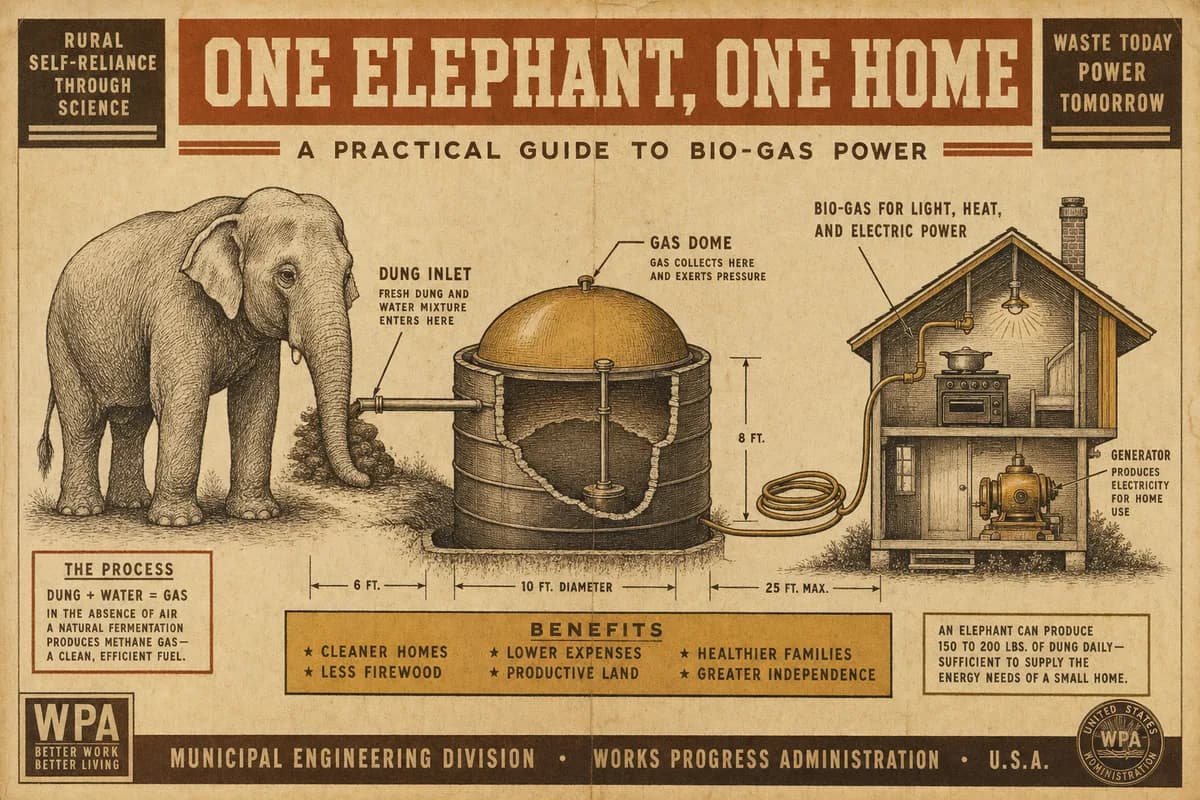
This guide sizes and runs a single-animal digester around the largest feedstock a homestead can practically keep: one adult elephant. The premise is honest and the payoff is real — an elephant's daily output, digested well, will meet the modest electrical load of a small, efficient dwelling. What this guide will not do is pretend the elephant is a battery. It is a living generator with its own appetite, and the whole exercise turns on whether that appetite can be fed. This is the same appliance the Brown Home™ catalogue lists as Elephant Mode, scaled up from the household Dungester 5000 to the animal that anchors it.
What you'll need
- One adult elephant in good health, producing roughly 100 kg of fresh dung per day. A younger or smaller animal produces proportionally less; size the rest of the system to the animal you actually have.
- A digester of roughly 5,000 L (5 m³) working volume — not a 55-gallon drum but a sealed tank about the footprint of a garden shed. At ~100 kg of dung diluted to a pumpable slurry (~200 L/day) and a 25-day retention time, this is the honest minimum.
- A floating gas holder or a large butyl gas bag sized to hold most of a day's production.
- A Fart Scrubber 3000, or a packed column of steel wool and biochar, to strip hydrogen sulfide before anything burns.
- A Farm-to-Fart Range for direct cooking, and/or a small biogas generator (a converted single-cylinder genset) if you want electricity.
- A Fecal Load Balancer to prioritize household circuits when production dips.
- A thermometer and a way to hold the vessel at 35 °C year-round.
- Feedstock the elephant itself requires but that is not optional to it: on the order of 150 kg of vegetation and 150 L of water per day, and the acres of range that implies.
Steps
- Confirm you may keep the animal. An elephant is not an accessory gas appliance, and no jurisdiction treats it as one. Expect exotic-animal permits, CITES paperwork, a keeper of record, veterinary retainer, and setbacks measured for a multi-ton resident, not a drum. File all of it before you build; a digester is easy to permit and an elephant is not.
- Size the vessel to the animal. Work from the daily dung figure, not the hoped-for wattage. One hundred kilograms of fresh dung, diluted about 1:1 with water, is roughly 200 L of slurry a day; at a 25-day retention that is a 5,000 L tank. Build the tank you need and no smaller — a starved-for-volume digester sours.
- Charge and inoculate. Fill to two-thirds with slurry and seed with active manure or borrowed digestate. Cap it, vent the first days of unburnable carbon dioxide, and wait two to four weeks at 35 °C for the culture to hold a flame.
- Plumb the gas train. Run gas through a condensate trap, then the Fart Scrubber 3000, then to the Farm-to-Fart Range or the generator. Test every joint with soapy water, never with a flame.
- Feed on the elephant's schedule, not yours. The animal sets the ration. Add its daily dung steadily; a digester rewards routine. Route any electrical output through the Fecal Load Balancer so essential circuits draw last when the gas runs thin.
- Draw off the digestate. Pull finished slurry from the outlet as you feed the inlet. It is a stabilized fertilizer, and at this scale you will have a great deal of it.
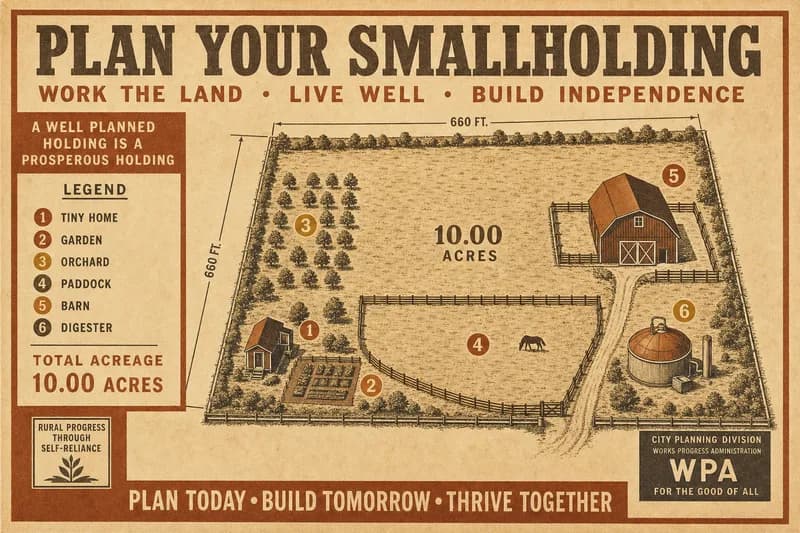
The site plan below lays out where each resident lives.
Sizing
Figures below are for one healthy adult elephant and a well-established mesophilic digester, stated net — after the gas burned to hold the vessel at 35 °C and, for the electrical row, a twenty-percent conversion in a small generator. Coarse herbivore manure yields less biogas per kilogram than pig or poultry waste, because so much of what an elephant eats passes through only lightly changed.
| Quantity | Value |
|---|---|
| Fresh dung | ~100 kg/day |
| Biogas yield (~0.04 m³/kg) | ~4.0 m³/day (4,000 L) |
| Gross energy in gas (~6 kWh/m³) | ~24 kWh/day |
| Gas after digester heating | ~3.2 m³/day |
| Direct-burn cooking heat | ~19 kWh/day |
| Net electrical (20% genset) | ~3.8 kWh/day |
Scaling is a matter of animals, not ambition. A second elephant is a second tank, a second permit, and a second appetite; it is not a bigger flame under the first.
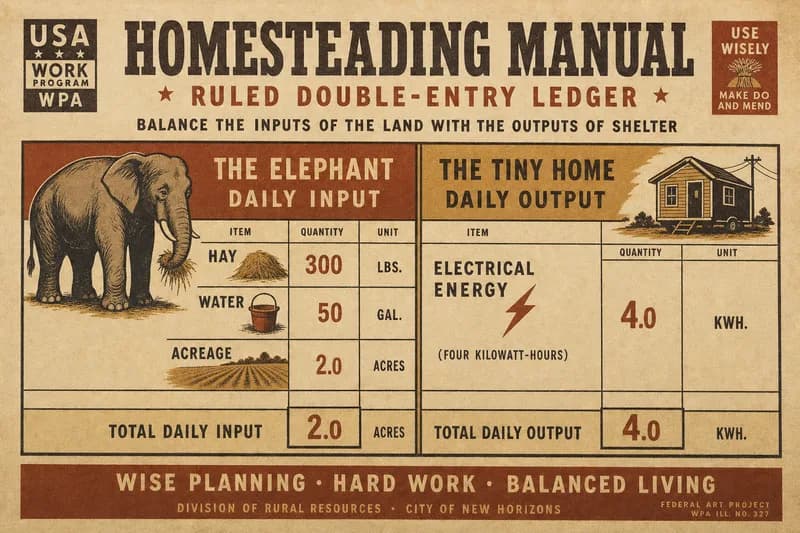
The ledger below sets both columns side by side.
Maintenance & safety
- Hold 35 °C. Below it the culture stops feeding, and a cold digester is just a very large sealed tank of everything you put into it. In winter the heating load can eat most of the yield; treat those months as maintenance rather than production.
- Mind the sulfide. Hydrogen sulfide is the real hazard, and it smells of rotten eggs at low concentrations and of nothing at all at dangerous ones. Keep the scrubber charged and work in open air.
- Respect the gas. Biogas and air are explosive across a wide range. Never store gas indoors, and never chase a leak with a lit match.
- Respect the animal. An elephant that is bored will investigate the digester, and an elephant investigates with its full weight. Fence the vessel as if the largest thing on your property might one day lean on it, because it will.
Expected output
On paper the result is quietly encouraging. A well-run elephant nets a little under four kilowatt-hours of electricity a day, or about nineteen kilowatt-hours of cooking heat if you burn the gas directly on the Farm-to-Fart Range. A frugal, well-insulated tiny home — lights, a laptop, a small refrigerator, a water pump, and a phone on the charger — lives comfortably inside that budget. By the narrow measure this guide set out to test, one elephant can indeed power a tiny home.
The honest homesteader stops there and reads the other ledger. The animal that produces one hundred kilograms of dung a day first eats about one hundred and fifty kilograms of vegetation and drinks about one hundred and fifty litres of water to do it. It needs range measured in acres, company measured in decades, and care measured against a lifespan of sixty or seventy years. A tiny home draws about four kilowatt-hours a day. A full-grown elephant draws a small farm.
Elephant Mode earns its place in the catalogue as exactly that — a mode, not a plan. An animal you already keep and already feed can, in a genuine emergency, be asked to keep the lights on for a while. As a primary power plant the elephant remains what it has always been: magnificent, hungry, and wholly unmoved by your load calculations. The arithmetic is sound. The elephant is the problem.
The conversion appears below, hay to elephant to bulb.