Locke's Theory of Property and the Occupied Stall
Locke's labor theory of property, applied to the occupied stall, resolves at last whether the sitting man owns the enclosure or merely borrows it.
From the series: Philosophers in the Bathroom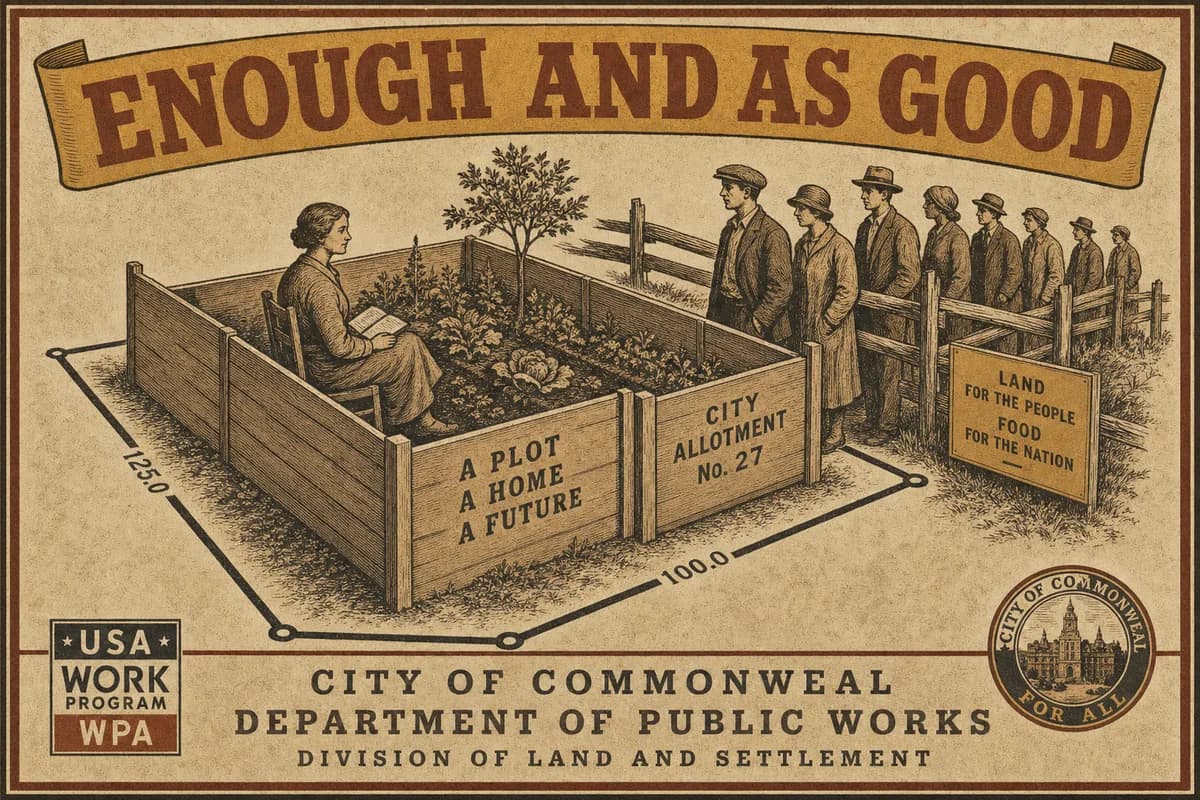
The Second Treatise of Government (Locke 1689) grounds all rightful ownership in a single motion: a person, who owns his own body and its labor, takes a thing from the common store and, by mixing his labor with it, makes it his. The doctrine has been asked to justify the fencing of fields, the felling of timber, and the settlement of continents. It has not, to my knowledge, been asked to justify the far humbler enclosure a man performs when he shuts a stall door behind him. I propose to ask it, because the occupied stall satisfies every clause of the Lockean account, including the two it is most often permitted to forget.
The Common
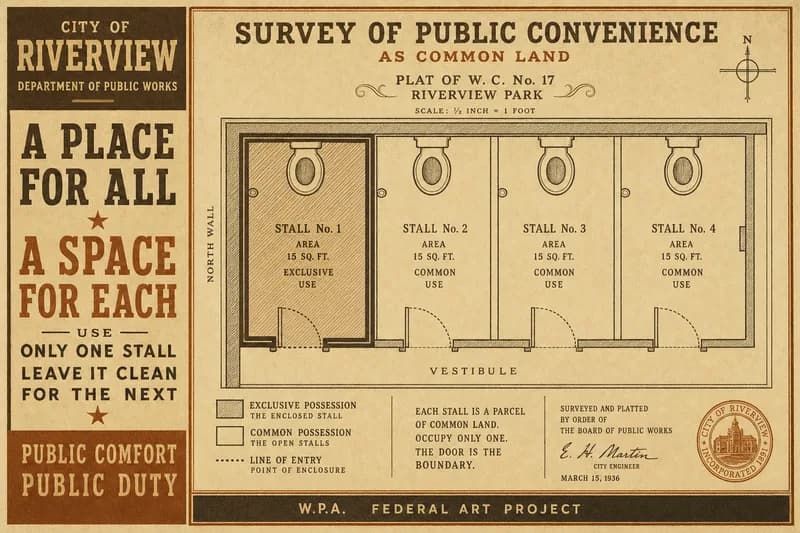
Locke begins in a world given "to mankind in common" (Locke 1689, §26). The public restroom is such a world in small: a bank of stalls held by no one, open to all comers, provided by an authority that reserves no particular cell for any particular user. Before entry, the row is pure commons — as much anyone's as anyone's. The question Locke forces is how any part of so common a thing could ever become, however briefly, the exclusive holding of one man.
The Mixing of Labour
His answer: "Whatsoever then he removes out of the state that nature hath provided and left it in, he hath mixed his labour with, and joined to it something that is his own, and thereby makes it his property" (Locke 1689, §27). The occupant does exactly this. He does not merely stand in the stall; he labors in it — he enters, latches, disrobes to the necessary degree, and applies himself to the work for which the enclosure exists. By this admixture of effort the common cell is, for the duration of the labor, removed from the commons and annexed to the laborer. He owns the stall in the only sense Locke ever means: he holds an exclusive right to its use, good against all the world, which the world acknowledges by rattling the door and retreating.
The Proviso
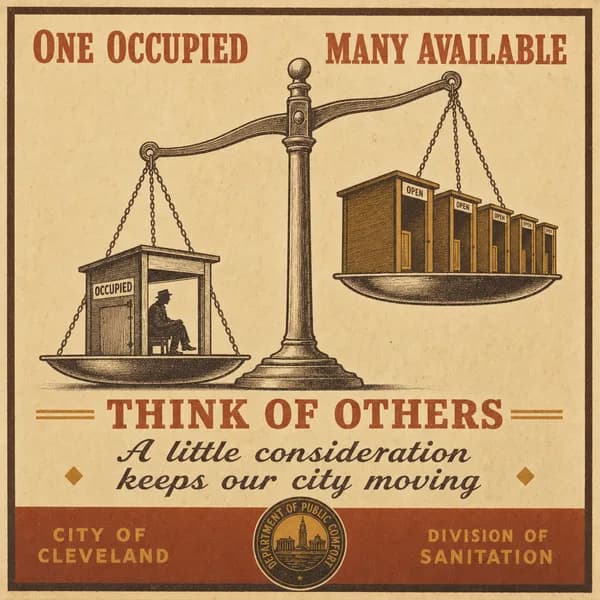
But Locke's grant is conditional, and the condition is the hinge of the whole matter. Appropriation is legitimate only "where there is enough, and as good, left in common for others" (Locke 1689, §27). This is the Lockean proviso, and it decides the stall precisely. In a bank of six stalls, one man's enclosure of one leaves five as good behind; the proviso is satisfied and his title is clean. In a single-occupancy restroom it is not satisfied at all. To appropriate the only stall is to enclose the entire commons and leave nothing as good for the next comer, who is not merely inconvenienced but excluded — dispossessed of a share he had every natural right to. A man may fence a portion of the commons by sitting in it, but he may not fence the whole commons by sitting in the only stall. The sole toilet is held under a permanently defective title, redeemed only by the speed of its surrender.
The Spoilage Limitation
Locke adds a second limit, less remembered and here decisive. Nothing was made by God "for man to spoil or destroy"; one may appropriate only so much as one can use before it spoils, and "whatever is beyond this is more than his share, and belongs to others" (Locke 1689, §31). The occupant who has concluded his labor and lingers — reading, scrolling, resting from no exertion — has crossed exactly this line. His continued tenancy is spoilage: the holding of a common good past the point of use, while it "spoils" in the only currency that applies, the mounting need of those shut out. By Locke's own rule, what he holds beyond his use is no longer his. His title, valid at entry, lapses the moment his labor ends, and the stall reverts to the commons though he has not yet risen from it.
Tacit Consent and the Rattled Latch
One puzzle remains: by what right does the community enforce any of this against a man on his own private business? Locke's answer is tacit consent — the traveler who uses the common highway "gives his tacit consent" to the government of the country he passes through, and is bound by its rules though he never signed them (Locke 1689, §119). The stall's user consents likewise. By availing himself of the provided commons he accepts its unwritten constitution: the proviso, the spoilage limit, and the jurisdiction of the queue, whose rattle of the latch is not trespass but a lawful demand that a lapsed title be surrendered. (Marx would later read the same enclosure as expropriation rather than consent — see the locus classicus on the issued key, which need not detain us here.)
Conclusion
The occupied stall is therefore genuine property, acquired by the mixing of labor and defended by the whole apparatus of natural right — but property of a peculiarly Lockean kind, hedged by both provisos its owner would prefer to forget. It is his while he uses it, his only where enough and as good remains for others, and no longer his the instant he holds it past his need. The man who understands this rises promptly, and thereby keeps his title clean to the end. The man who does not has, in the strict sense of the Second Treatise, begun to steal from a commons he mistook for his own.
Works Cited
Locke, John. Two Treatises of Government. Ed. Peter Laslett. Cambridge University Press, 1988 [1689]. Cited by section (§) from the Second Treatise. Macpherson, C. B. The Political Theory of Possessive Individualism: Hobbes to Locke. Oxford University Press, 1962. Waldron, Jeremy. The Right to Private Property. Oxford University Press, 1988. Threlkeld, M. Ives. "Enough and As Good: The Proviso in Single-Occupancy Commons." Review of Sanitary Jurisprudence 8, no. 1 (2020): 33–58.