Kant's Categorical Imperative to Replace the Roll
Kant's categorical imperative, applied at last to the person who exhausts the communal roll and departs, yields a perfect duty of replacement.
From the series: Philosophers in the Bathroom
The Groundwork of the Metaphysics of Morals (Kant 1785) proposes a single supreme principle from which every duty may be derived: the categorical imperative, a command binding on all rational beings without condition or exemption. Two and a half centuries of commentary have fed the imperative its test cases — the false promise, the neglected talent, the suicide of despair. I wish to submit one the literature has passed over, though it is enacted in offices, dormitories, and family homes many thousands of times a day: the maxim of the person who uses the last of the shared roll and leaves the empty tube in place.
The Maxim
Kant insists that moral assessment begins not with the deed but with its maxim — the subjective principle on which the agent in fact acts, stated in full. Ours may be given so: when I have exhausted the communal roll, I will leave the empty tube upon its spindle and depart, that I might be spared the small labor of replacement. The maxim is not monstrous. It is, in Kant's sense, merely convenient, and convenience is exactly the raw material the imperative was built to assay.
The Test of Universal Law
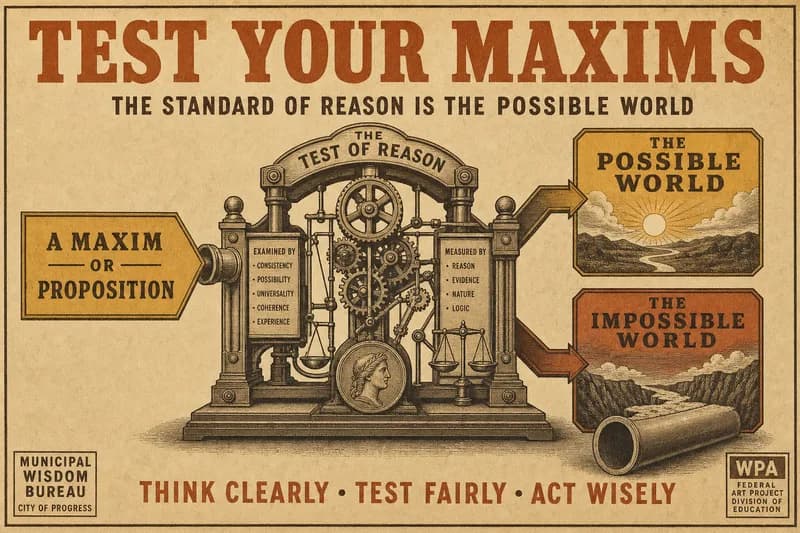
The first formulation is the Formula of Universal Law: "act only in accordance with that maxim through which you can at the same time will that it become a universal law" (Kant 1785, 4:421). We therefore universalize. Imagine a world in which every person, upon exhausting the roll, leaves the empty tube and departs. In that world the roll, once emptied, is never replenished, for each user is by hypothesis the kind of user who does not replenish it.
The Contradiction in Conception
Kant distinguishes two ways a universalized maxim may fail. Some maxims cannot even be conceived as universal laws without contradiction; others can be conceived but cannot be willed (Kant 1785, 4:424). The first failure grounds a perfect duty, the second an imperfect one. The lying promise is Kant's paragon of the first sort: a world of universal false promising abolishes the very institution of promising the liar means to exploit, so the maxim annihilates its own object (4:422).
The empty-tube maxim fails in precisely this way. It presupposes a stocked and ready roll — that is what makes departing without restocking a gain. Universalized, it guarantees that no roll is ever stocked. The maxim, universalized, saws off the branch it sits on. This is a contradiction in conception, not merely in the will, and it follows that the duty to replace the roll is a perfect duty — one that admits no exception in favor of inclination, haste, or the plausible belief that someone else will attend to it.
The Formula of Humanity
The second formulation supplies independent confirmation: "So act that you use humanity, whether in your own person or in the person of any other, always at the same time as an end, never merely as a means" (Kant 1785, 4:429). The one who leaves the tube treats his successor merely as a means — as a receptacle for the foreseen consequences of his own haste, a rational agent whose certain future need is registered and then used. The force lies in the word merely. The offender does not deny his successor's humanity in the abstract; he simply subordinates it, for the duration of one transaction, wholly to his own convenience. That subordination is the entire content of the wrong.
The Kingdom of Ends
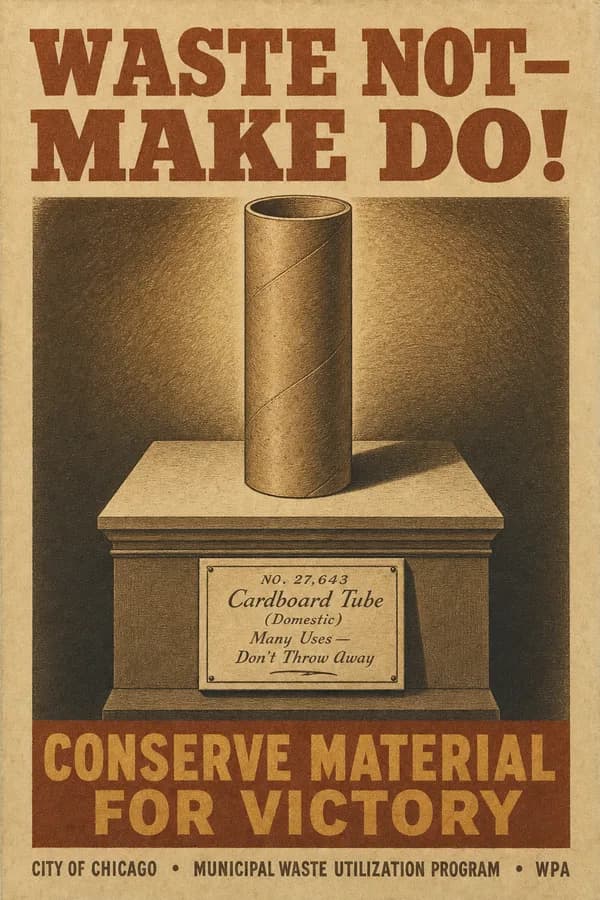
The third formulation gathers the argument. The Formula of the Kingdom of Ends bids us act as legislating members of "a systematic union of rational beings through common laws" that each both gives and obeys (Kant 1785, 4:433). The shared restroom is such a kingdom in miniature. Every user is at once a subject of the roll's condition and a legislator of the condition in which the roll is left. To restock is to enact, for the kingdom, the law to which one would gladly submit as a subject. To abandon the tube is to legislate one law for others and reserve another for oneself — to make of oneself an exception, which Kant identifies as the root form of all wrongdoing (4:424).
An Objection
It will be said that replacement is mere beneficence — an imperfect duty of wide latitude, dischargeable at one's own convenience, like charity. The objection fails on Kant's own distinction. Beneficence is imperfect precisely because no determinate act is owed to any determinate person. Here both are fixed: the act is determinate (restock this roll) and the beneficiary determinate (the next occupant, whose need is certain). The obligation therefore resembles the return of a deposit — Kant's own model of a perfect duty of justice (Kant 1788, 5:27) — and not the giving of alms (see also Rautenberg 2019, on the ready roll as a res deposita).
Conclusion
The empty tube is not a small rudeness to be waved off with a shrug at the offender's hurry. It is a maxim that cannot survive its own universalization, an act that treats a rational being merely as a means, and a private exemption from a kingdom of which the offender remains a citizen. Kant wrote that two things filled the mind with ever-increasing wonder: the starry heavens above and the moral law within (Kant 1788, 5:161). The literature has been slow to observe that the moral law within also governs the spindle at eye level, and issues, on the matter of the roll, a command as categorical as any it has ever given.
Works Cited
Kant, Immanuel. Groundwork of the Metaphysics of Morals. Trans. Mary Gregor. Cambridge University Press, 1998 [Grundlegung zur Metaphysik der Sitten, 1785]. Cited by Akademie pagination. Kant, Immanuel. Critique of Practical Reason. Trans. Mary Gregor. Cambridge University Press, 1997 [Kritik der praktischen Vernunft, 1788]. Cited by Akademie pagination. Korsgaard, Christine M. Creating the Kingdom of Ends. Cambridge University Press, 1996. Rautenberg, F. Aloys. "Perfect Duty and the Common Roll: A Deposit-Theoretic Account." Journal of Applied Deontology 12, no. 2 (2019): 144–169.