Could One Hippopotamus Run a Food Truck?
A field guide to powering a mobile kitchen on the biogas from a single adult hippopotamus, from digester sizing to the length of lunch service one animal can honestly sustain.
Overview
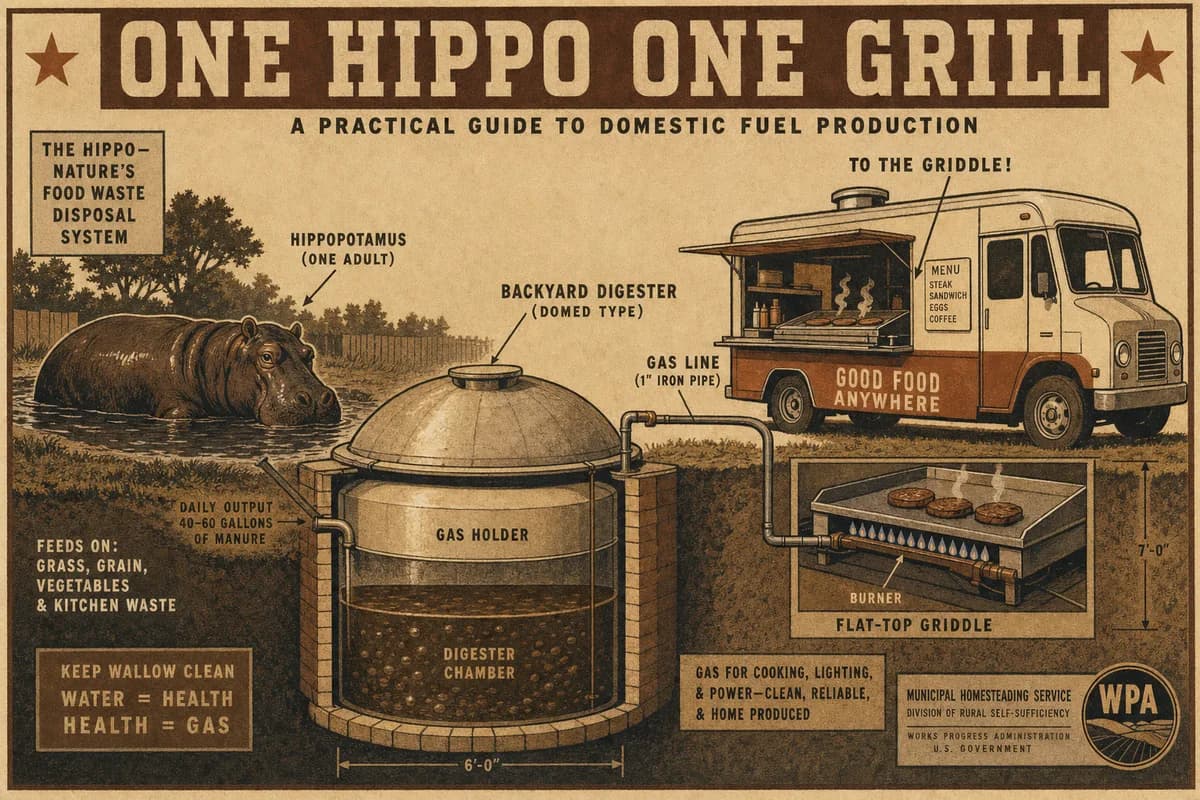
A single adult hippopotamus, fed and watered at a backyard wallow, produces enough manure to run a small anaerobic digester, and that digester produces enough biogas to fire the griddle of a food truck for about two hours a day. This guide covers the build, the sizing, and the honest limit: one hippo is a lunch rush, not a full service. If you want to serve dinner too, you will need more hippopotamus.
What you'll need
- One adult hippopotamus (roughly 1,500 kg), in good health and settled temperament. A single animal is sufficient for the loads in this guide; see Sizing before acquiring a second.
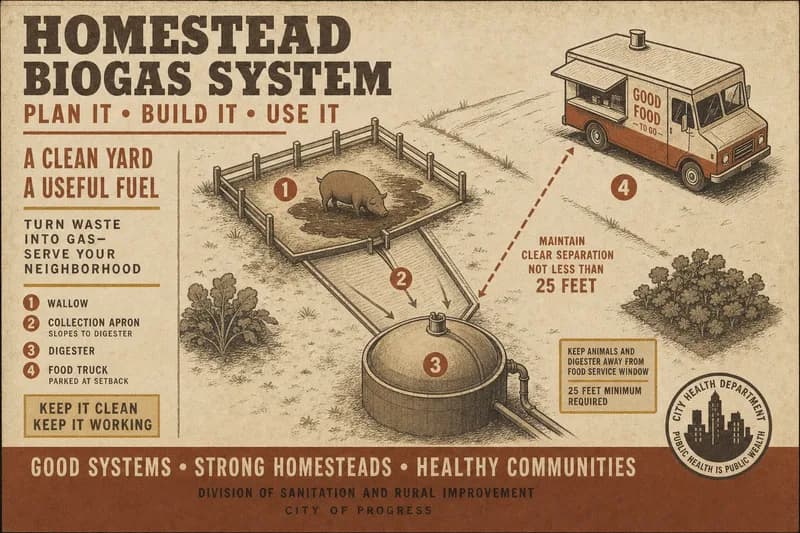
- A fenced wallow with a sloped, washable collection apron — the animal will not deliver to a bucket, so the ground must do the collecting.
- Forage, about 40 kg per day of grass and cut greens. The hippo eats less than its size suggests; it returns more than its diet suggests.
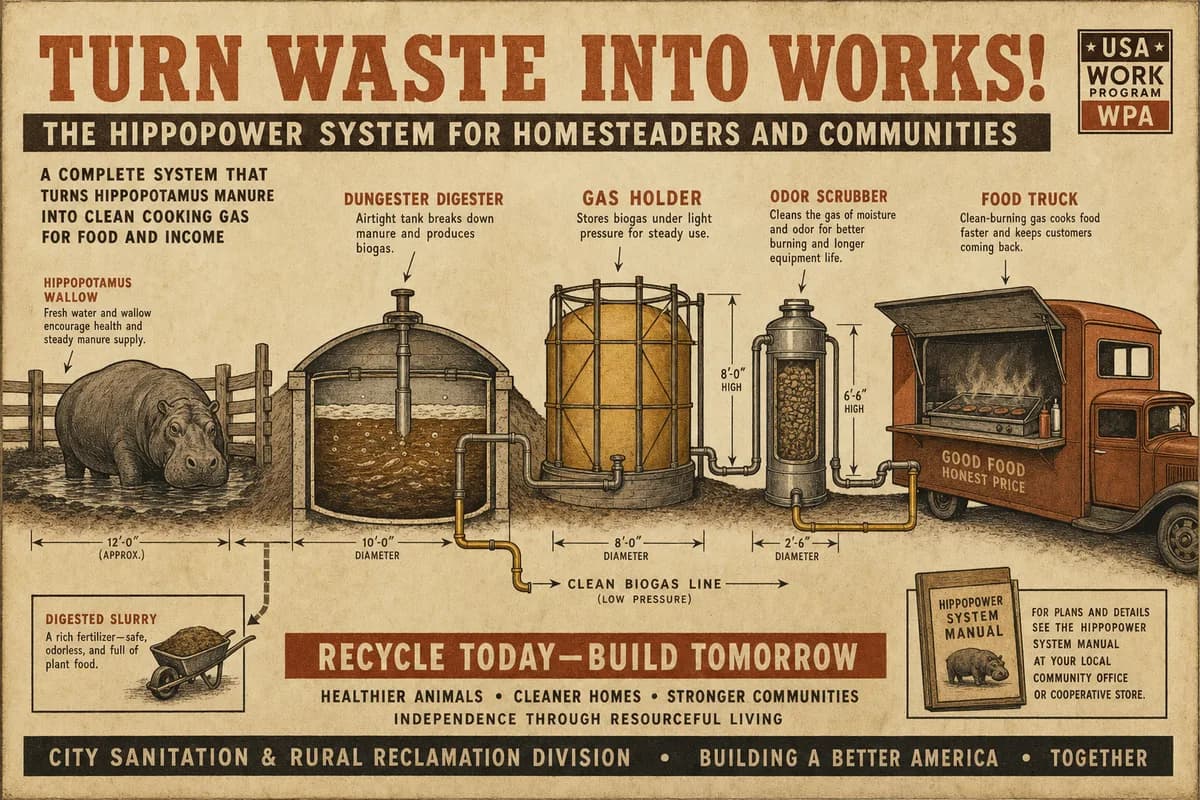
- A Dungester 5000 or equivalent fixed-dome digester, 6 m³ working volume — ample for one animal's daily charge.
- A gas holder (floating drum or bag) of at least 2 m³, so a day's gas can wait for the lunch rush rather than arrive during breakfast.
- A Fart Scrubber 3000 or equivalent steel-wool-and-biochar scrubber to strip hydrogen sulfide before the gas reaches the kitchen — biogas off raw manure is corrosive and rude to a burner.
- A Farm-to-Fart Range, or any commercial LP griddle re-jetted for biogas. Biogas burns cooler and slower than propane; the jets must be opened up or the griddle will sulk.
- A pressure regulator, flame arrestor, and a very understanding health inspector.
Steps
- Build the wallow to drain into the apron. Everything downstream depends on collecting what the animal produces; a wallow that drains to the lawn is a digester that starves.
- Charge the digester. Fill the Dungester with water and a starter of settled manure and let it establish for two to three weeks at 35 °C before you expect gas. A cold digester produces nothing but disappointment.
- Feed it daily. Sluice the apron's collection — about 50 kg of fresh manure a day — into the digester's inlet on a regular schedule. Anaerobic bacteria reward routine and punish surprises.
- Scrub, hold, and regulate. Route the gas through the scrubber, into the holder, and through the regulator to the truck. Never plumb raw digester gas straight to a food surface.
- Re-jet and light the griddle. Open the burner jets for biogas, purge the line, and light with the holder half full. Cook only on scrubbed, held, regulated gas.
Sizing
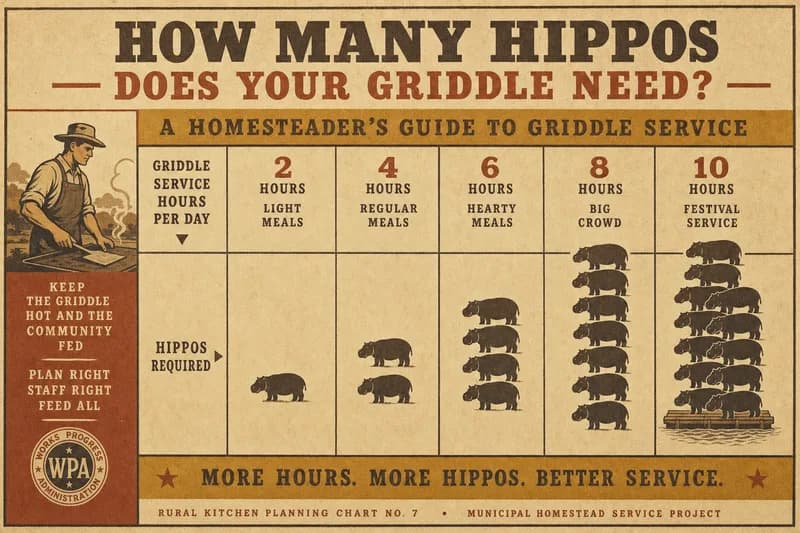
Begin at the animal and work forward to the griddle. One adult hippo delivers about 50 kg of fresh manure per day. At a herbivore-manure biogas yield of 0.04 m³ per kg, that is 2.0 m³ of biogas a day. Biogas carries roughly 22 MJ per m³, so the daily gas holds 44 MJ of cooking energy. A working food-truck griddle, averaged across its on-and-off duty cycle through a service, draws about 22 MJ per hour — which means one day's hippopotamus buys exactly two hours of griddle time. The result scales linearly, and is best read from the table.
| Service | Griddle-hours/day | Hippos required |
|---|---|---|
| Lunch rush | 2 | 1 |
| Half day | 4 | 2 |
| Full service | 8 | 4 |
| Weekend festival (two trucks) | 20 | 10 (a raft) |
The one-hippo line is the finding most readers came for: a single animal funds a two-hour lunch service and no more. A standard eight-hour service day requires four hippopotamuses, run continuously; a two-truck festival weekend requires ten, which is not a herd but a raft, and a raft is a different permit. The full system, animal to griddle, is drawn below.
Maintenance & safety
Keep the digester above 35 °C or gas production falls off and the lunch rush goes cold. Feed on schedule; a skipped day sours the culture for a week. Scrub the gas without exception — unscrubbed biogas corrodes the burner and taints the food.
And observe the separation on the site plan without exception. The hippopotamus is, by a wide margin, the most dangerous large animal it is legal to keep, and it does not distinguish between a customer and a threat. Site the wallow so that the animal and the service window never share a queue. The dotted line on the plan is the difference between a food truck and an incident report.
Expected output
Two honest hours of griddle heat a day, per hippopotamus: enough to feed a genuine lunch rush, provided the rush is brief and the animal is content. It will not serve breakfast and lunch and dinner; it will not run a festival alone; and it will remind you, on any day you skip its forage, exactly how much of your business depends on the goodwill of a two-ton hindgut fermenter. Within those limits, the griddle stays hot, the gas is free, and the arithmetic — drawn below by service length — is as sincere as the animal is large.