The Great Wet Wipe Turbine Failure
A post-incident engineering report on the nine-day failure of a Municipal Fart Grid reclamation turbine that ingested a mass of flushable wipes and seized.
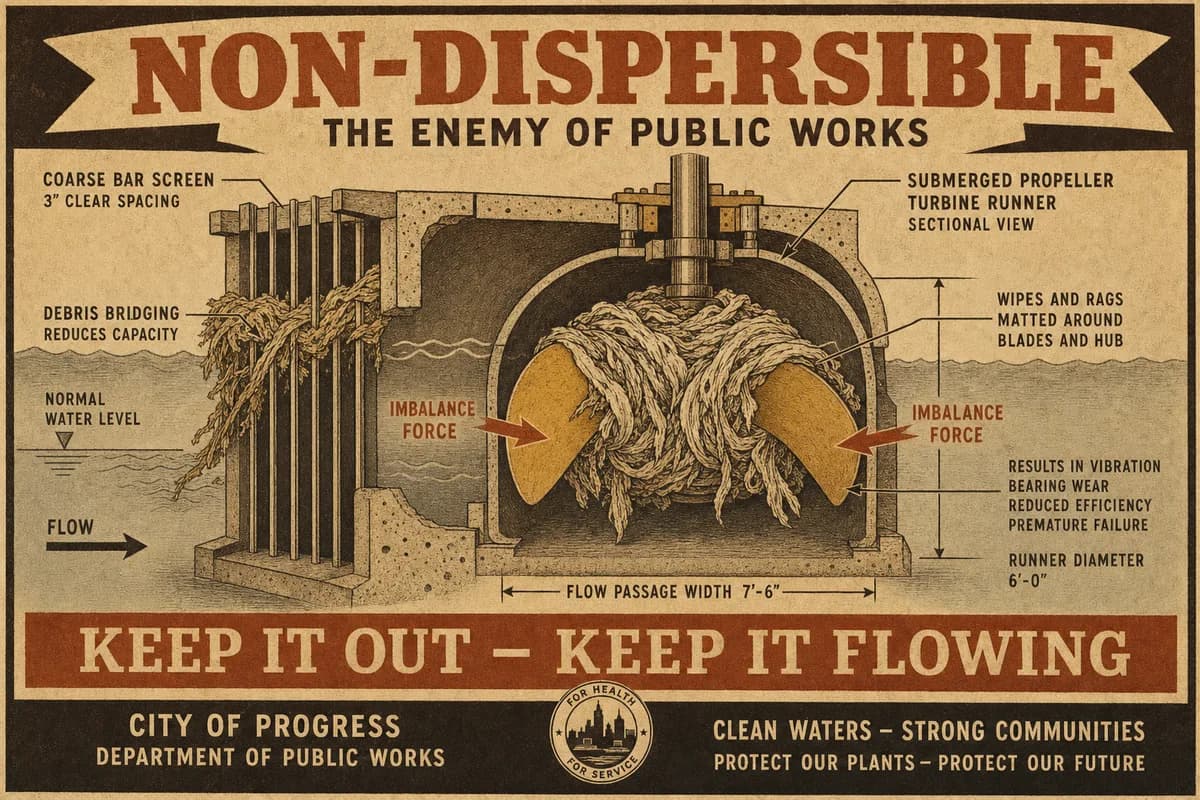
Incident Report OCD-QE / 2026-07 · Reclamation Turbine, Node 14 · Classification: Preventable, Recurrent
1. Executive Summary
On the dates recorded below, the reclamation turbine at Node 14 of the Municipal Fart Grid — a submerged micro-hydro unit that recovers energy from the effluent line feeding the lift station — suffered a progressive fouling failure culminating in bearing seizure and a nine-day forced outage. The initiating agent was not a mechanical defect, a control fault, or an operator error. It was an accreted mass of non-dispersible personal-hygiene wipes, marketed as flushable, which bridged the trash rack, detached as a single slug, and wrapped the runner. This office finds the failure preventable, finds it consistent with three prior events on the same class of unit, and states for the record the engineering fact the marketing obscures: "flushable" is a marketing term, not an engineering finding.
2. Installation Description
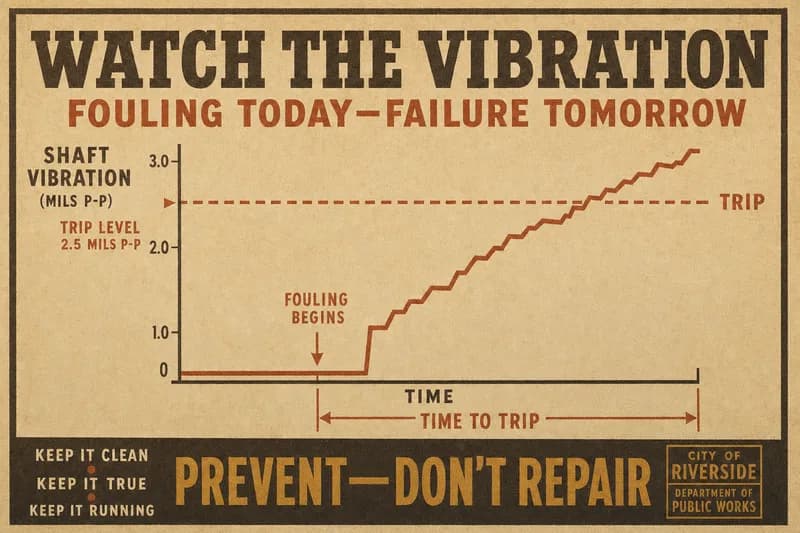
Node 14 recovers head from a 0.8 m³/s effluent line ahead of the lift station. The unit is a fixed-blade propeller runner turning at a nominal 600 rpm, protected upstream by a coarse 25 mm bar screen and monitored by a shaft-mounted vibration sensor set to trip at 11 mm/s RMS, per the standing plant standard. The screen spacing was selected, at commissioning, to pass a design debris profile dominated by settled organics and toilet tissue — a material that loses substantially all of its wet tensile strength within seconds of immersion and passes the runner as slurry.
3. Sequence of Events
- Day 1, 06:00 — Screen differential begins a slow climb above baseline. Consistent with normal rag loading; no alarm.
- Days 1–4 — Differential rises steadily. A mat of interwoven wipes, bound with grease into the accreted mass the trade calls a fatberg, builds across the lower third of the bar screen. Flow finds the reduced opening; velocity through the remaining gaps rises.
- Day 4, 19:40 — A section of the mat, roughly 40 kg wet, detaches under the raised velocity and passes the screen as a single coherent slug. Toilet tissue could not have done this; it would have dispersed at the rack. The wipes, retaining full wet strength, did not.
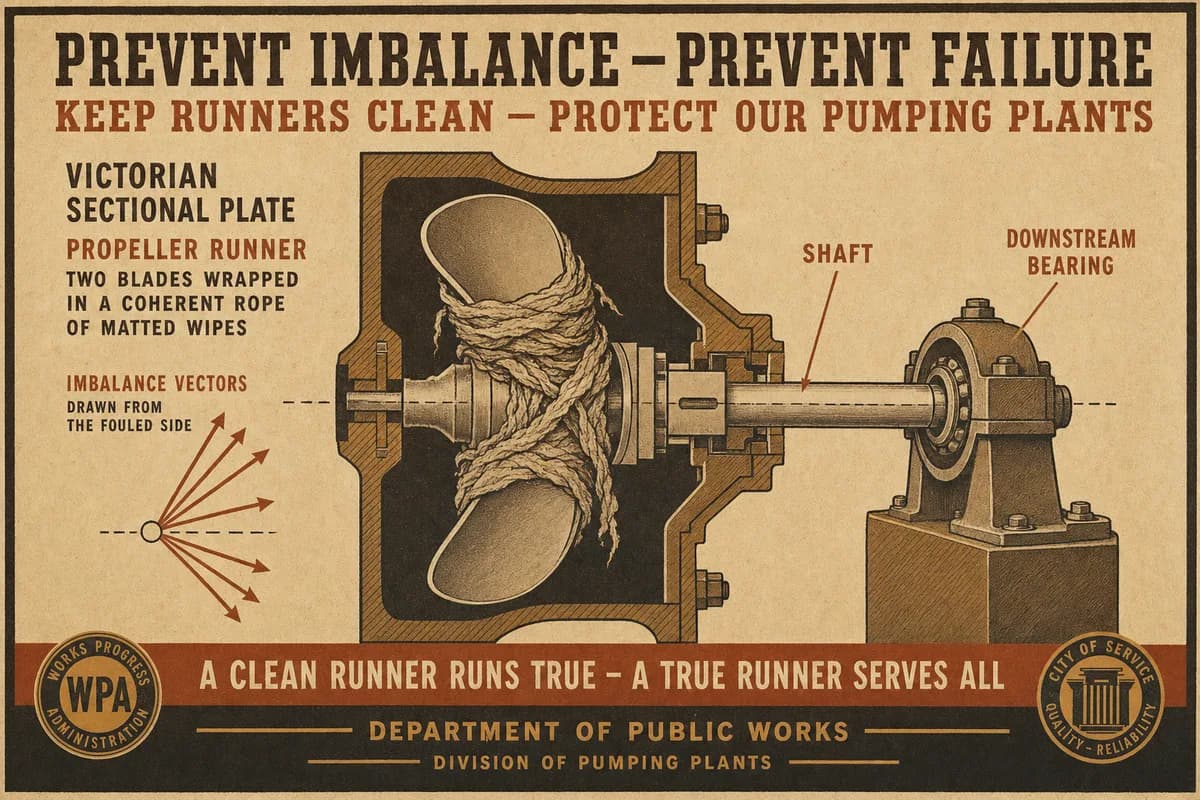
- Day 4, 19:41 — The slug reaches the runner and wraps two blades. Mass imbalance is immediate. Vibration steps from a nominal 2 mm/s to 9 mm/s.
- Day 4, 19:52 — Continued winding drives vibration past the 11 mm/s trip. The unit commands a shutdown. By this point the downstream bearing has already run eleven minutes in imbalance and is scored beyond its clearance.
- Day 4, 19:53 — Runner coasts down against a seized bearing. Shaft runout exceeds tolerance. The unit is offline.
4. Root-Cause Analysis
The root cause is the material, not the machine. "Flushable" describes only a product's ability to leave the bowl; it makes no claim, and supports no claim, about the product's behavior in the twelve metres of pipe and the screen and the runner that come after. The relevant property is wet tensile strength retained over time, and on that property the wipe and the tissue are opposite materials. Toilet paper is engineered to fail wet, and does, within seconds. A flushable wipe is a wet-strength nonwoven engineered not to fail wet — to survive a purse, a package, and a use — and it carries that engineered durability intact into infrastructure dimensioned on the assumption of a material that disintegrates. The screen at Node 14 did exactly what it was designed to do against the material it was designed against. The material changed; the screen did not.
5. Contributing Factors
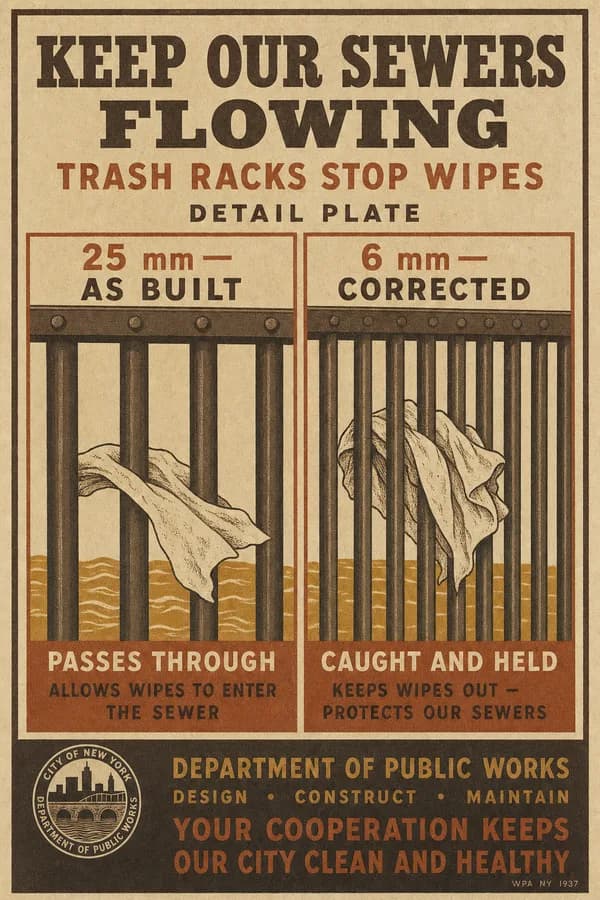
- Screen spacing. The 25 mm bar screen passes an individual wipe freely and only catches the accreted mat, which then fails as a slug rather than a trickle — the worst delivery geometry for the runner.
- No comminutor. The line has no macerator upstream of the screen to reduce a slug to passable fragments before it reaches the runner.
- Advisory reach. The Office of Civic Digestion's standing advisory on non-dispersibles is posted at the treatment works but not at the point of disposal, where the decision is actually made.
6. Damage and Downtime Assessment
One scored downstream bearing; one shaft requiring re-machining for runout; one runner cleared of 40 kg of recovered wipe mass, retained as evidence and, on inspection, still legible as individual intact wipes after four days submerged. Forced outage: nine days. Direct repair: $84,000. Lost generation over the outage was trivial by the standards of the wider grid and is not the point; the cost is in the bearing, the shaft, and the crew.
7. Corrective Actions
- Reduce screen spacing to 6 mm at Node 14 and its three sister units, converting slug capture to continuous capture that a rake can clear before a mat forms.
- Install an upstream comminutor sized to the 0.8 m³/s line.
- Extend the Office of Civic Digestion non-dispersibles advisory to the point of disposal, and post the standing turbine-node safety signage at the restored unit:
Materials Referenced in This Bulletin

poster No. 103
Poster No. 103 — Please Remain Seated Until the Turbine Stabilizes
Authorized archival reproduction of the industrial safety notice posted beside metered municipal facilities. The gauge still climbs toward a stabilization value most turbines of the period never reliably reached. Retained on the grounds that it settles the queue.
The bar-screen change is illustrated below at both spacings.
This office closes the report with its single operative finding restated, because it is the finding that will prevent the fourth event and the marketing that will cause it: a product that leaves the bowl has demonstrated that it leaves the bowl, and nothing else. Flushability is a claim about the first two seconds of a journey the wipe survives in full. The turbine meets the wipe at the end of that journey — intact, at 600 rpm — and the turbine is what gives way.