What Is the Aerodynamic Limit of a Flying Turd?
A feasibility study establishing the speed at which a formed specimen can no longer hold itself together against the air, and what that ceiling means for ballistic and pneumatic dispatch.
Abstract
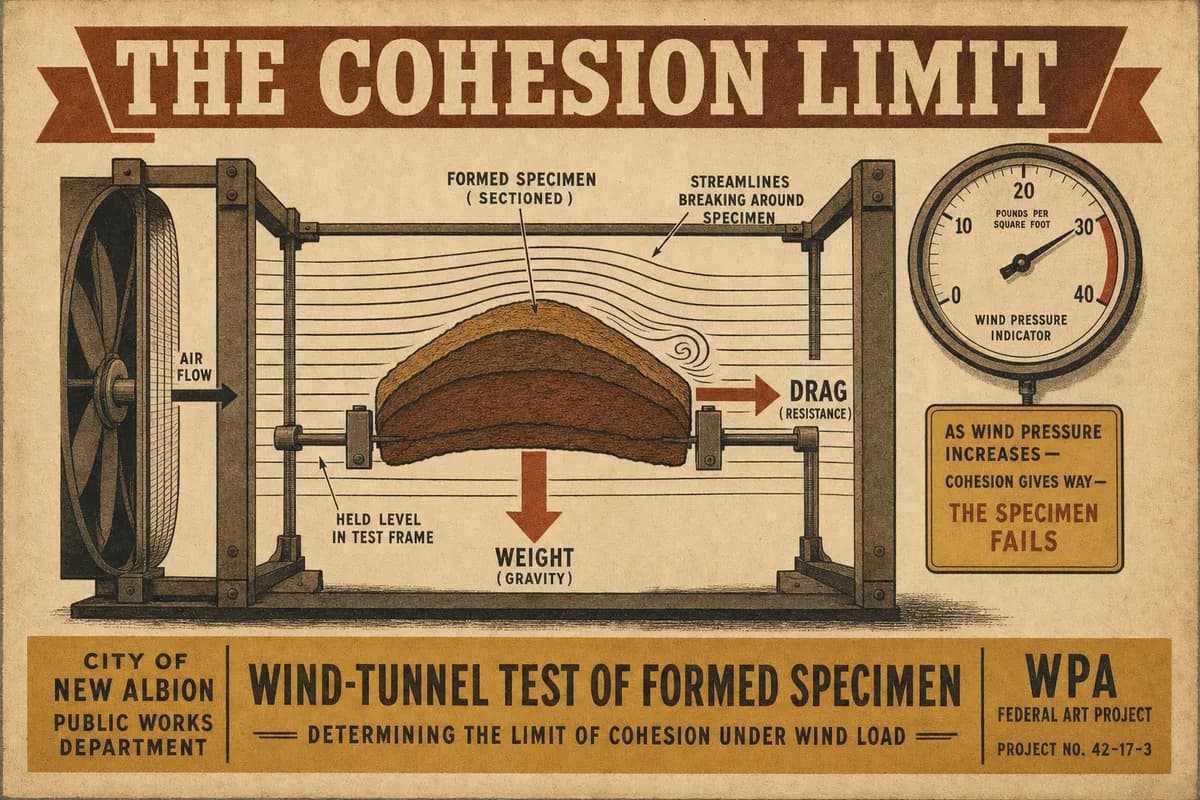
This paper establishes the aerodynamic limit of a flying turd: the airspeed above which a formed specimen can no longer resist the pressure of the air across its own face and ceases, abruptly, to be a specimen. We model a representative stool in free flight, compute its terminal velocity in both stable attitudes, and compare the resulting dynamic pressure against the material's yield strength. We find a cohesion limit near 90 metres per second — about 200 miles per hour — and note, without comment, that the specimen's nose-first terminal velocity falls only five metres per second below it. The limit governs the maximum safe velocity of pneumatic dispatch and forecloses the ballistic delivery of an intact package.
Assumptions
- The specimen. A representative formed specimen: 0.10 kg, roughly 25 mm across and 190 mm long, taken at the density of water-saturated tissue, 1,050 kg/m³. The geometry and the mass are consistent to within two percent; we do not defend the third significant figure.
- Yield strength. A firm, well-formed specimen yields in shear at a dynamic pressure of about 5.0 kPa. Softer classifications fail sooner and are outside the scope of a paper concerned with the upper bound.
- The air. Sea-level density 1.225 kg/m³, viscosity 1.81 × 10⁻⁵ Pa·s. We hold both flat; the honest reader may correct for altitude.
- Drag coefficients. Broadside, the specimen presents as a bluff cylinder, C_d ≈ 1.1. Nose-first, as a rounded slender body, C_d ≈ 0.45. Both are taken in the turbulent regime, which the Reynolds number below justifies.
The Calculation
The flow regime, established first. At 90 m/s the Reynolds number across the 25 mm dimension is ρvd/μ = 1.225 × 90 × 0.025 ÷ (1.81 × 10⁻⁵) ≈ 152,000 — fully turbulent, so a constant drag coefficient is defensible. The Mach number is 90 ÷ 343 = 0.26: the specimen fails long before it approaches the speed of sound. The limit is one of cohesion, not compressibility. There is no sonic turd.
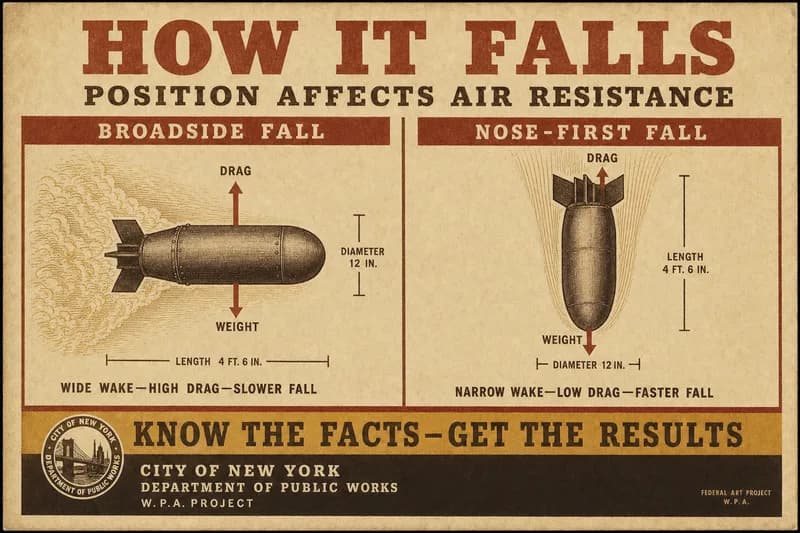
Terminal velocity depends entirely on attitude. Terminal velocity is reached when drag balances weight, at v = √(2mg ÷ ρ·C_d·A) — a body falls fastest when it presents its smallest face. Falling broadside, the specimen's frontal area is L × d = 0.19 × 0.025 = 0.00475 m², and 2mg is 2 × 0.10 × 9.81 = 1.962, so v = √(1.962 ÷ (1.225 × 1.1 × 0.00475)) = √306.5 ≈ 17.5 m/s — about 63 km/h, or 39 mph. Falling nose-first, the frontal area collapses to πr² = 4.91 × 10⁻⁴ m² and the drag coefficient more than halves to 0.45, so v = √(1.962 ÷ (1.225 × 0.45 × 4.91 × 10⁻⁴)) = √7,251 ≈ 85 m/s — about 307 km/h, or 191 mph. A tumbling specimen lives between the two; a nose-stable one approaches the higher figure. The two attitudes are drawn together below.
The cohesion limit. A body moving through air feels a dynamic pressure of q = ½ρv² pressing on its forward face. When that pressure exceeds the material's yield strength, the face gives way and the specimen sheds mass, blunts, and fragments. Setting q = ½ρv² equal to the 5.0 kPa yield strength gives the limiting airspeed directly: v = √(2·σ_y ÷ ρ) = √(2 × 5,000 ÷ 1.225) = √8,163 ≈ 90 m/s.
This is the aerodynamic limit of a flying turd: 90 m/s, 325 km/h, 202 mph. Above it there is no flight, because above it there is no turd — only a widening cloud of former turd, each fragment now small enough that its own terminal velocity falls back below the limit, which is why the disintegration is self-terminating rather than total. The three governing speeds are plotted to scale.
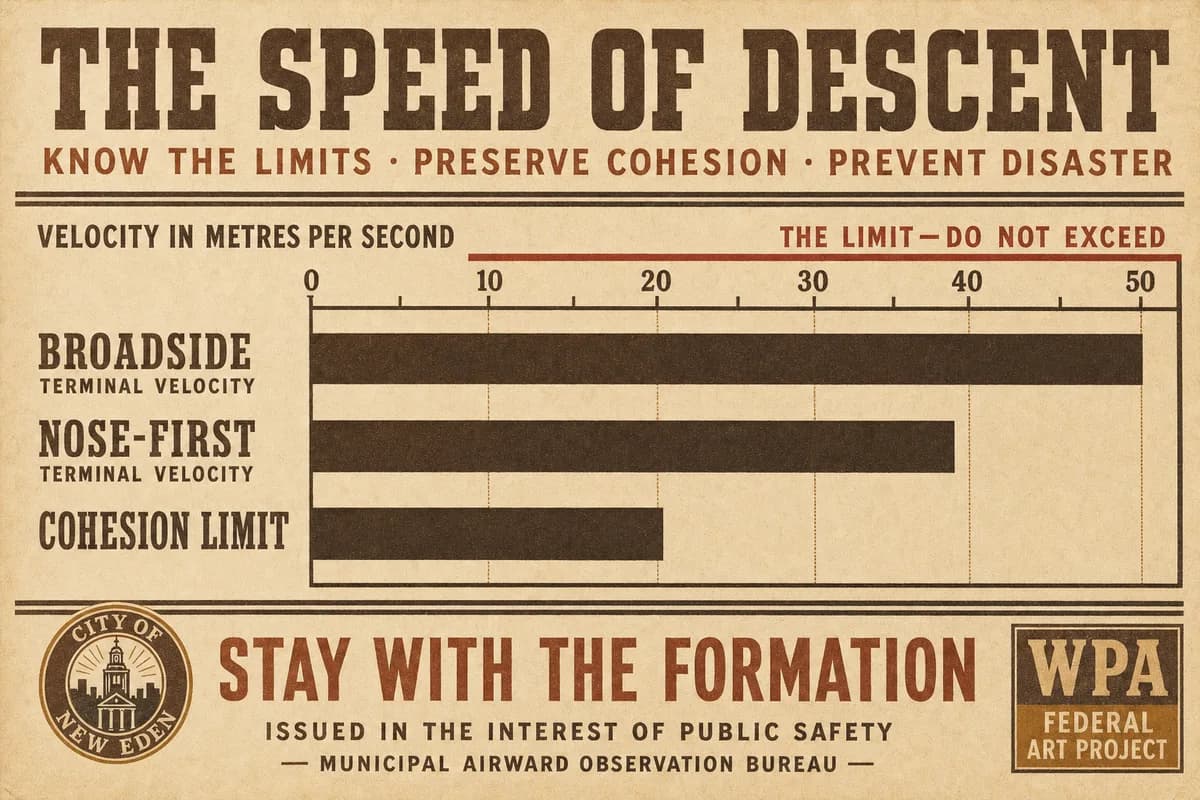
The result the plot makes plain, and the finding of this paper, is the gap: the nose-first terminal velocity (85 m/s) sits just five metres per second below the cohesion limit (90 m/s). A specimen in stable nose-first fall from any height accelerates toward self-destruction and stops, barely, short of it. The specimen is, to within five metres per second, exactly as strong as it needs to be, and no stronger. We report this without comment.
Operational Concerns
Free fall is safe; propulsion is not. Reaching the nose-first terminal velocity requires a fall of roughly a kilometre of clean, stable descent; from a residential height of ten metres a specimen reaches only √(2gh) = 14 m/s and lands intact and broadside every time. Nothing a household can drop approaches the limit. The limit is reached only by pushing — and any launcher fast enough to reach 90 m/s destroys its payload at the muzzle. A specimen fired at the limit clears the barrel as a dispersal. The vacuum range of an intact launch at 45° and just under the limit is v²/g = 8,100 ÷ 9.81 = 826 m as an absolute ceiling; drag and the onset of fragmentation reduce the delivered-intact range to a fraction of that. Ballistic dispatch delivers a cloud, not a package.
Pneumatic dispatch is the practical application. The Municipal Fart Grid's specimen dispatch trunks move formed material to the district digester by air, and the cohesion limit is their hard ceiling: a bore velocity above 90 m/s reduces every capsule to slurry before it arrives. Grid practice is to run the trunk at 80 m/s, a comfortable margin below the limit, which carries a specimen the length of a 5 km district trunk in 5,000 ÷ 80 = 62.5 seconds. Faster service is available only to households willing to receive their neighbours' output pre-atomised, which the Office does not recommend and the setback ordinances do not permit.

Compliance. Any residential apparatus that accelerates household output above walking pace falls under the Residential Digestive Contribution Act and must be declared. Pneumatic dispatch fittings tapping the Municipal Fart Grid require the accessory-appliance permit and a certified pressure relief set below the cohesion limit; a relief valve set above 5 kPa is not a relief valve but a fragmentation nozzle, and is cited as one.
Conclusion
The aerodynamic limit of a flying turd is approximately 90 metres per second — 202 miles per hour — set not by the speed of sound, which the specimen never approaches, but by the yield strength of the material against the pressure of the air. Below the limit the specimen flies; at the limit it disperses; and by an arrangement we decline to characterise, its own nose-first terminal velocity in free fall stops five metres per second short of the ceiling. For the engineer, the practical consequences are two: dispatch pneumatically and stay a margin below 90 m/s, or dispatch ballistically and accept delivery as a mist. We recommend the tube. The specimen was never built to be thrown.