Could America's Pet Dogs Operate the National Grid?
Scaling the household dog figure to all ninety million U.S. pet dogs, this study asks whether the harnessed national herd could carry any share of the grid.
Abstract
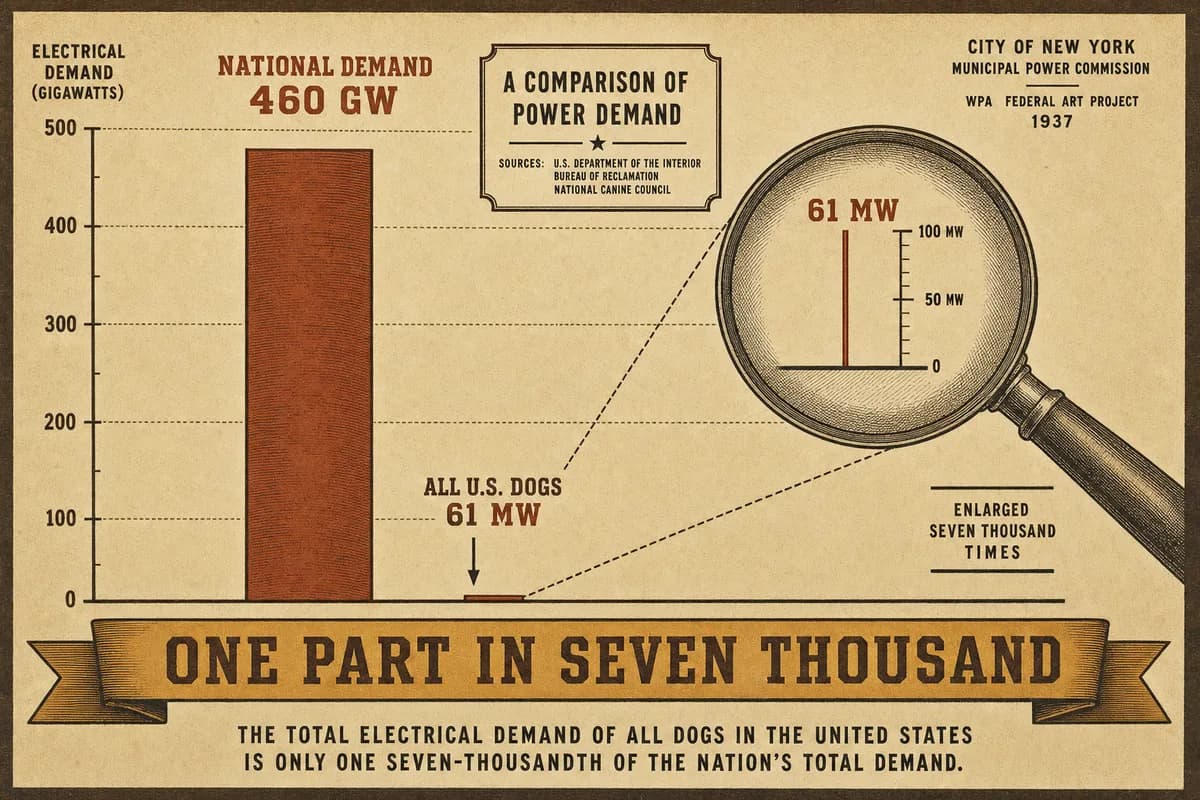
This paper scales the household dog result — sixteen watt-hours of net daily electricity per average animal — to the full United States pet-dog population of roughly ninety million and asks whether the herd, perfectly harnessed, could operate the national grid. It could not. The summed output is 61 megawatts of continuous power, a fraction of one part in seven thousand of national demand, and it arrives, moreover, as ninety million un-gatherable droplets, each below every threshold at which the grid will accept it.
Assumptions
- Population. Roughly 90 million pet dogs in the United States, kept across some 65 million households.
- Per-animal output. The average pet dog — larger than the dachshund of the companion study — produces about 0.34 kg of waste per day, yielding at 0.05 m³/kg and the standing conversion chain about 16 Wh of net electricity daily.
- National load. United States electricity demand averages about 460 gigawatts across the year — the continuous draw the grid actually operates against.
The Calculation
Ninety million dogs at 16.3 Wh each is 90,000,000 × 16.3 = 1,467 megawatt-hours per day. A grid is operated in power, not energy, so we spread that evenly across the day:
1,467 MWh ÷ 24 h = 61 megawatts of continuous output.
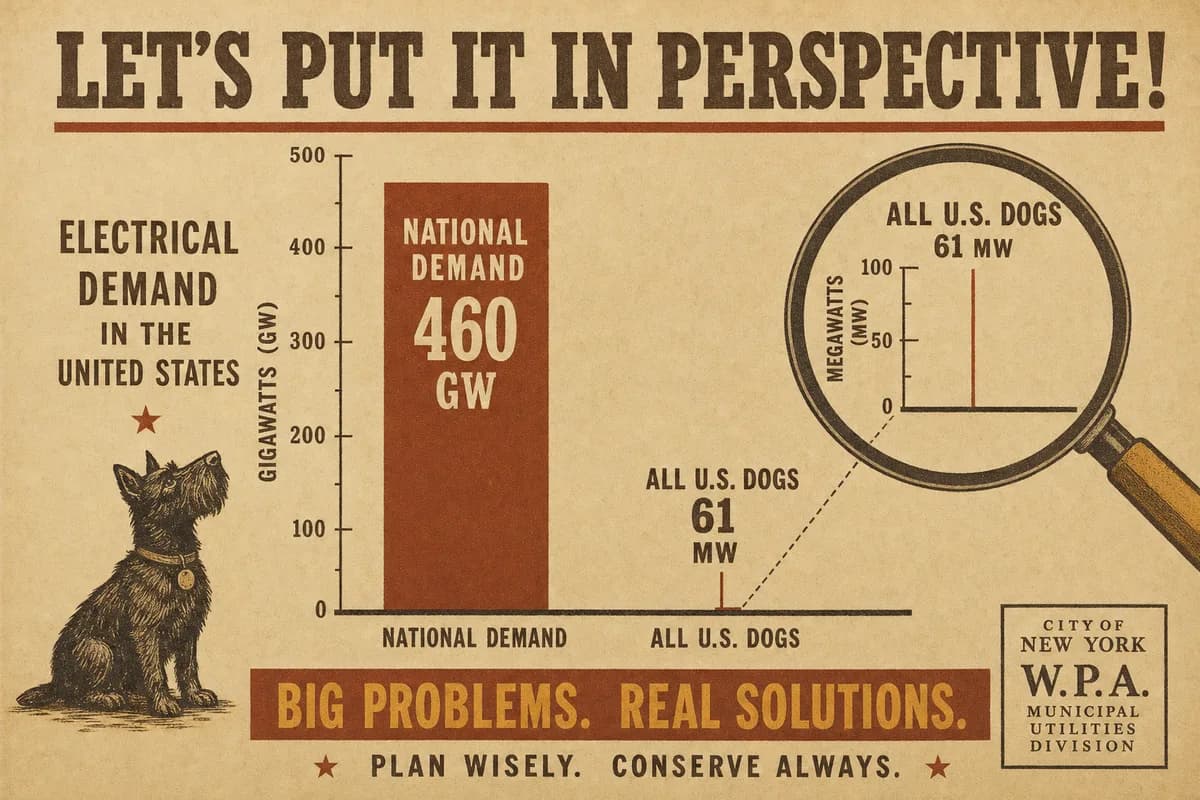
Against 460,000 megawatts of national demand, the national dog herd supplies 0.013% — about one part in seven thousand five hundred. Put in the units a utility feels, 61 MW is the honest minimum of a single small peaking plant, or enough to carry roughly fifty thousand average homes: real power, and a real plant's worth, and invisible at national scale. The grid does not run on the dogs. On its worst day the grid would not notice the dogs arriving or the dogs leaving.
Operational Concerns
The sum cannot be collected. The 61 MW is not sitting anywhere. It is ninety million dogs across sixty-five million households, each yard producing sixteen to thirty-three watt-hours a day — an output so small that the residential interconnection standard admits it through the electrical door as a formality and bars it at the gas door entirely, raw biogas failing pipeline interchangeability by a factor of two. To gather the herd's 61 MW you would first build sixty-five million micro-digesters, each below the hosting threshold that would even trigger a study, and then confront the fact that none of them may inject gas and each injects electricity too trivial to meter. The national figure is therefore not a resource; it is an accounting sum of resources that individually do not clear the bar to exist on the grid at all.
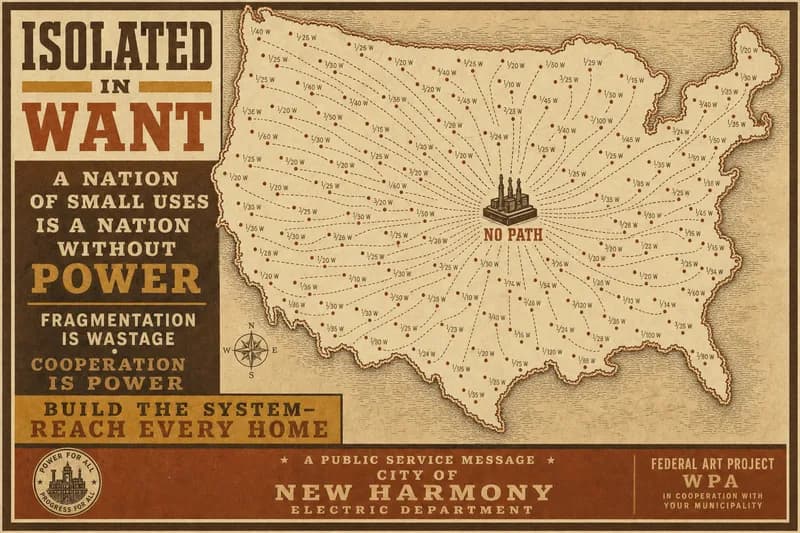
Correlation, for once, absent. Where the municipal chili cookoff fails as a grid asset by delivering one tightly correlated spike, the dog herd fails in the opposite direction: ninety million uncorrelated, unscheduled, trickle sources with no common signal, no dispatch, and no aggregator. A grid asset must be either large or coordinated. The herd is neither, and cannot be made either without building the coordination from scratch across a continent.
The upkeep ledger. As with every row of the livestock chart, the output column omits the input. Ninety million dogs eat first. The national herd consumes vastly more energy in kibble, veterinary care, and transport than 61 MW represents, and the honest national ledger, like the honest elephant ledger, is written in red.
Conclusion
America's pet dogs cannot operate the national grid, and the two reasons are independent and each sufficient. First, the arithmetic: the entire herd is 61 megawatts, one part in seven thousand five hundred of demand, a single small plant's worth of power distributed across a continent of backyards. Second, the plumbing: even that small sum cannot be gathered, because every dog that contributes to it does so below the threshold at which the grid will take the contribution. The herd is a power plant that has been finely ground and scattered across sixty-five million yards, and a power plant in that condition is not a power plant. It is a great many dogs.