Why Your Digester Has Stopped Bubbling
Troubleshooting a digester that has gone quiet: the common causes of a stalled drum, in order, and which are a quick fix and which a long wait.
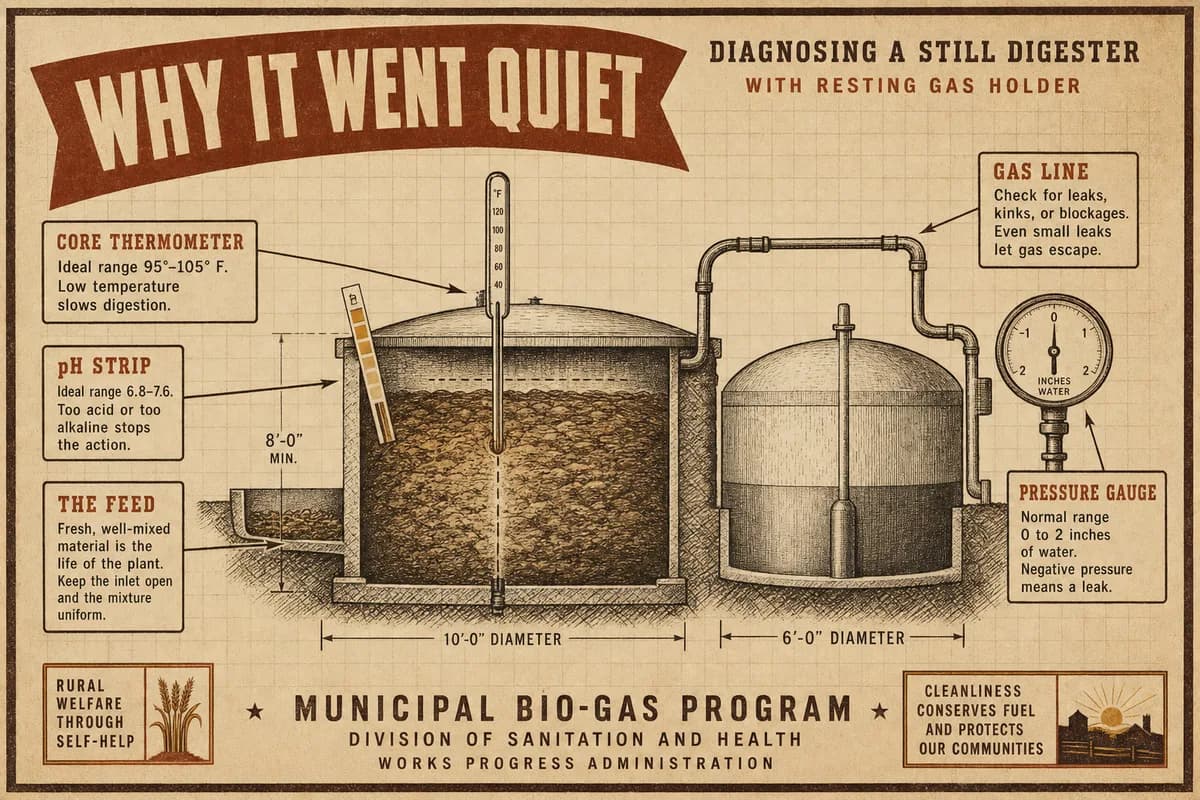
Overview
A digester that has gone quiet is trying to tell you something, and the trick is to read it in the right order. A drum that was bubbling and has stopped has a short list of causes, and they range from a false alarm you can dismiss in a minute to a stalled culture that will take weeks to recover. This guide walks that list from fastest to most serious. Work it in order, resist the urge to feed the drum harder, and in most cases the quiet is a symptom you can name and answer before the culture is lost.
What you'll need
- A core thermometer on the slurry — the single most useful reading, and the first cause to rule out.
- pH strips or a meter, to tell a healthy drum from a sour one.
- A low-pressure gauge or manometer on the gas line, to tell "no gas" from "gas with nowhere to go."
- A spray bottle of soapy water for leak-testing every joint — never a flame.
- Your feed log. Half of all stalls are explained by the last few things you put in.
- Patience, which is the actual tool for most of what follows: a stalled culture recovers on its own schedule, not yours.
Steps
- Check the holder before you panic. A gas holder already full has nowhere to put new gas, so the bubbling stops even though the drum is working perfectly. Burn some down and watch it resume. This is the most common false alarm.
- Read the core temperature. Below 35 °C the culture stops feeding and the drum goes quiet. If it has gone cold, the cause is almost always this, and the fix is heat, not feed.
- Rule out a leak — carefully. If pressure will not build and the holder never rises, the gas may not be missing but escaping. Soap-test every joint. A drum that stopped bubbling because it is leaking is the one dangerous case on this list; find it before you do anything else.
- Test the pH. A sharp, sour, vinegary drum has gone acidic from overfeeding — the acid-formers outran the methane-makers and the culture stalled. Stop feeding entirely and let it recover; do not "help" it with more input.
- Recall the last few feeds. A dose of something antibacterial — disinfectant, salt, a slug of citrus, manure from a recently medicated animal — can poison the culture. If the timing fits, the fix is dilution and time.
- Consider starvation last. A drum that was underfed or left too long on a spent charge simply has nothing left to digest. Resume a steady, moderate ration and give the culture room to build back.

Sizing
Not a sizing table so much as a fault table — the same honest diagnostic, laid out to be read at the drum. Work down it; the first row that matches is usually your answer.
| What you see | Likely cause | First check | Recovery |
|---|---|---|---|
| No bubbles, holder already full | Not a fault — gas has nowhere to go | Holder height | Immediate; burn some down |
| No bubbles, drum has gone cold | Temperature below 35 °C | Core thermometer | Days, once rewarmed |
| No pressure, holder never rises, faint gas smell | A leak | Soap-test every joint | Fix the leak before anything else |
| No bubbles, sharp sour smell, low pH | Acidosis from overfeeding | pH strips | Weeks; stop feeding |
| No bubbles, normal temp and pH, recent odd feed | Toxic or antibacterial input | Feed log | Slow; dilute and wait |
| Weak bubbles fading over weeks | Starvation or a spent charge | Feed log | Resume steady feeding |
The order of the rows is the order of the checks for a reason: the top two are a minute's work and explain most quiet drums; the leak row is third only because it is dangerous, not because it is common; and the bottom three are the ones that ask for patience rather than a wrench.

Maintenance & safety
- Check the leak case first, always. A digester that has stopped bubbling because it is leaking has not lost its gas; the gas is exactly where you are standing, which is why this is the one cause you check first. Ventilate, soap-test, and keep every ignition source away until the joint is found.
- Do not force-feed a stalled drum. Whatever the cause, more feed into a quiet digester makes things worse, not better. A sour drum sours harder; a poisoned one dilutes slower.
- Mind the sulfide while you work. Hydrogen sulfide smells of rotten eggs at low concentrations and of nothing at all at dangerous ones. Do your diagnosing in open air.
- Log the fault and the fix. A drum tells you the same thing twice if you let it. Write down what went quiet, what you found, and what brought it back.
Expected output
Most quiet drums come back. A full holder resumes the moment you burn it down; a cold one bubbles again within days of reaching 35 °C; even a soured culture usually recovers over a few weeks if you stop feeding it and let the pH climb. The causes that end a digester for good are rare, and they are almost always a poisoning that was fed in faster than it could be diluted out.
Read the quiet in order, then, and answer the fastest and most dangerous causes first. A digester that has stopped bubbling is not necessarily a digester that has stopped working — more often it is one waiting for you to notice what it is short of. Name the cause, apply the patience or the wrench it actually calls for, and the drum will find its voice again.