What Rome Understood About Toilets That Silicon Valley Forgot
A comparative infrastructure study of the communal latrine as civic forum against the optimized single-occupancy pod as monastic cell, and what each arrangement believes about the people it serves.
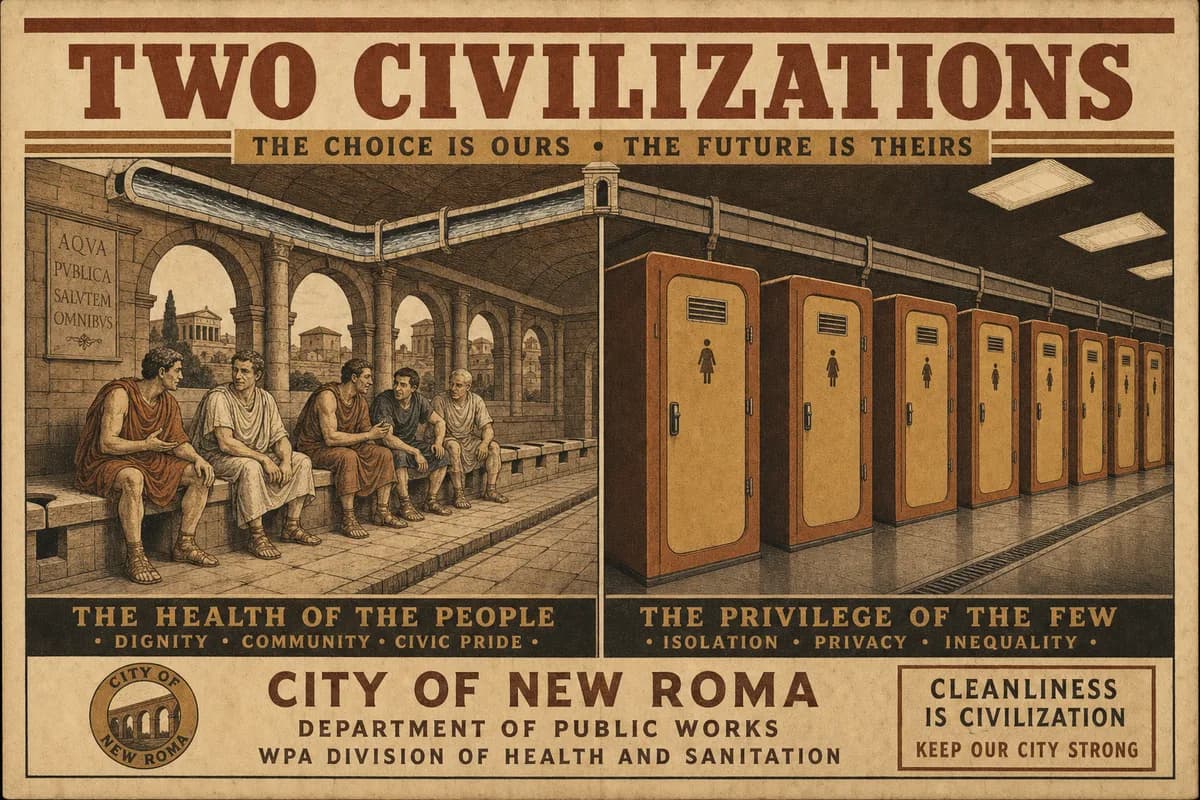
Two rooms, separated by nineteen centuries, are built for the identical bodily purpose, and believe opposite things about the person who enters them. The first is the Roman forica, the public latrine, of which the best-preserved examples at Ostia and elsewhere seat some twenty citizens shoulder to shoulder on a continuous stone bench, without partition, without privacy, and — by every indication of the record — without embarrassment. The second is the contemporary single-occupancy restroom of the optimized workplace, engineered at great expense to guarantee that its occupant will encounter no one at all. Between them lies not a difference of plumbing but a difference of anthropology. This essay asks what Rome understood, in stone, that the more recent civilization has spent a fortune to forget.
The Roman Bench
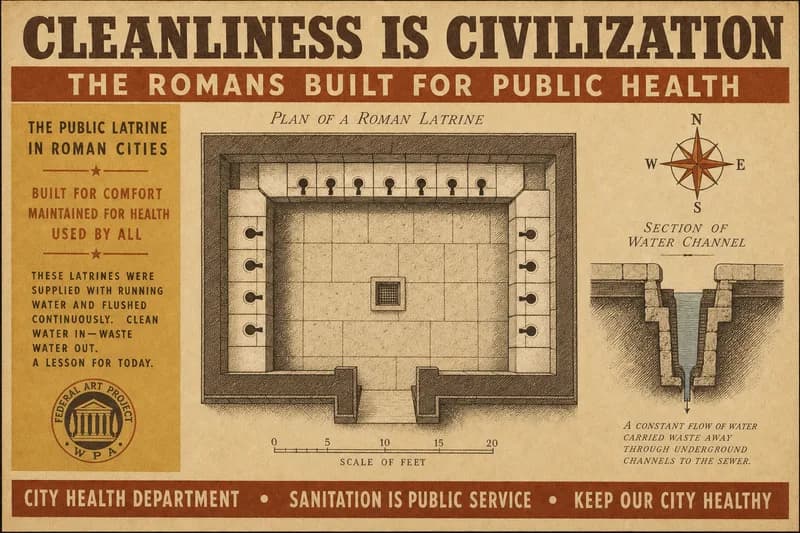
Begin with the fact that is hardest for the modern reader to hold steady: the Roman latrine was a place of conversation. The seating arrangement was not a regrettable consequence of primitive plumbing but a deliberate civic form, contiguous with the bench of the basilica and the tier of the theater. Citizens transacted business there, exchanged news, and — the graffiti attests — argued (Beard 2008). The room was continuous with the forum; it was, in the strict sense, part of the public realm, a space in which one appeared before equals and was seen. The shared channel of running water beneath the bench, and the shared tersorium, the communal sponge on its stick, were not failures of individual provision but its refusal on principle. To relieve oneself in Rome was to do a private thing in public, in company, under the mild obligation of one's neighbor's presence.
The Pod
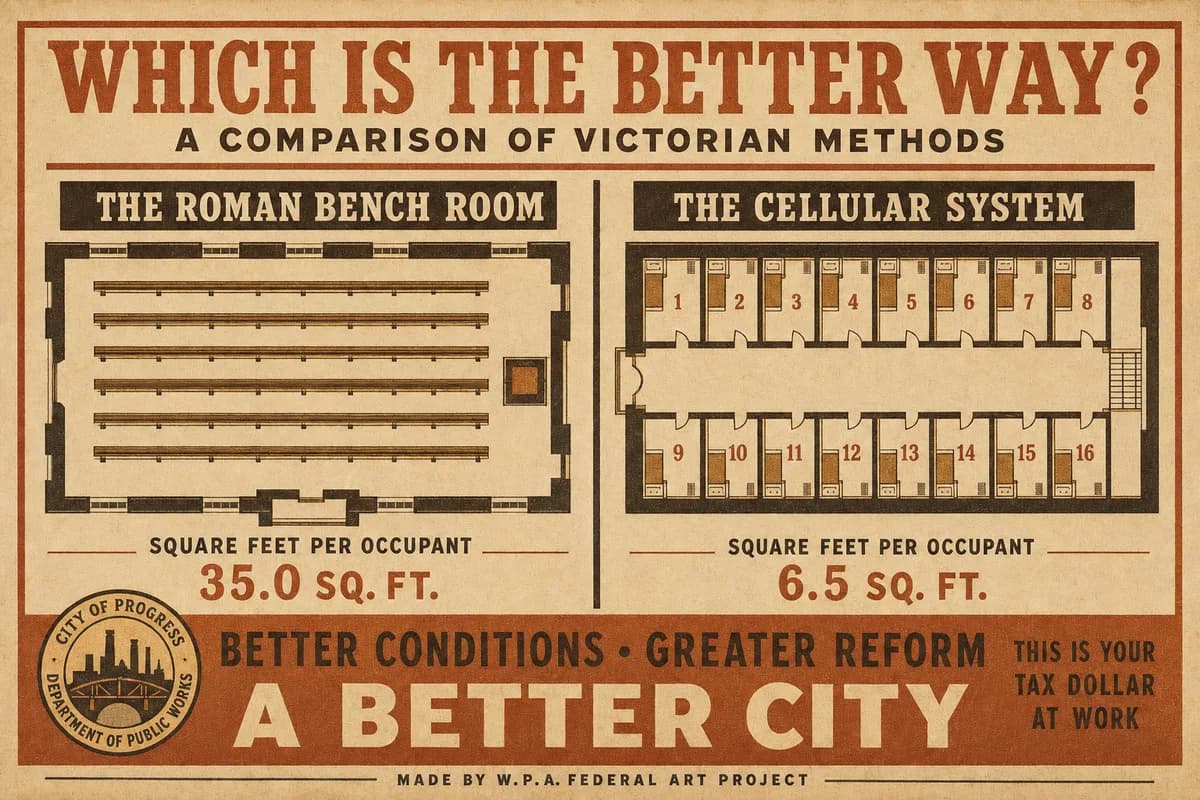
Now the corridor of pods. The contemporary workplace has invested its restroom design with a single overriding value, and that value is the elimination of the encounter. Floor-to-ceiling partitions replace the Victorian gap; occupancy sensors and vestibule buffers and staggered entries are deployed, at real cost per square foot, toward the one end of ensuring that no occupant is ever obliged to acknowledge another. The room is measured, tellingly, in privacy per occupant — the more square footage sealed around each body, the more advanced the installation is held to be (Koolmees 2017). The type it most nearly resembles is not the forum but the monastic cell: the enclosed, silent, single space designed for withdrawal from the community into a solitude understood as the higher condition. Silicon Valley did not invent the cell. It merely fitted it with a sensor and called the isolation a feature.
Two Anthropologies
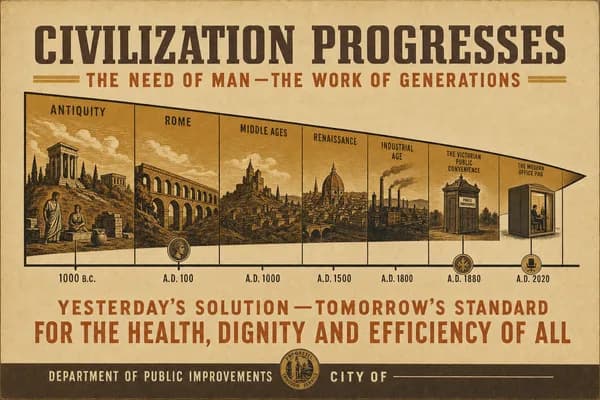
The two rooms encode two theories of the person. Arendt argued that the public realm — the space of appearance, in which one is seen and heard by others — is not a convenience of collective life but the very condition under which a human being becomes fully real to himself; and that the modern age's great achievement and great affliction has been the steady privatization of existence, the withdrawal of the individual into an interior where he is spared the others but also deprived of them (Arendt 1958). The Roman bench believed that a person is most himself in company, that even the humblest bodily business is an occasion of the shared world, and it built accordingly. The pod believes that a person is most himself alone, that the presence of others is an imposition to be engineered away, and it too builds accordingly. Sennett traced how the modern city has organized itself around exactly this recoil, designing its spaces to let bodies pass without touching, seeing, or being obliged to one another (Sennett 1994). The restroom is merely where the recoil is most fully capitalized. Rome built a room where you could not relieve yourself without meeting a neighbor's eye. We have built a room whose entire engineering is devoted to ensuring you will meet no one's.
Conclusion
It would be sentimental to wish the sponge and the stick back, and this essay wishes nothing of the kind. But the comparison exposes a cost that the optimized pod never enters on its ledger. In purchasing perfect privacy we have decommissioned a small daily rehearsal of the public — a homely, unglamorous, twenty-seat reminder that one shares a world, and a channel, with others one did not choose. Rome understood that a civilization is legible in what it is willing to do in company. The measure of ours is a room built, at considerable expense, so that we need never be in company again.
Works Cited
Arendt, Hannah. The Human Condition. University of Chicago Press, 1958. Beard, Mary. Pompeii: The Life of a Roman Town. Profile Books, 2008. Koolmees, Bartholomew. "From Bench to Cell: Square Footage as an Index of Civic Withdrawal in Sanitary Architecture." Journal of Infrastructure and Society 14, no. 1 (2017): 22–49. Sennett, Richard. Flesh and Stone: The Body and the City in Western Civilization. W. W. Norton, 1994.