The Walmart Air-Conditioning Question
Air-conditioning one Walmart supercenter through a July afternoon, restated as the contributing population, about a mid-sized city, required to hold it.
From the series: How Much Poop Would It Take?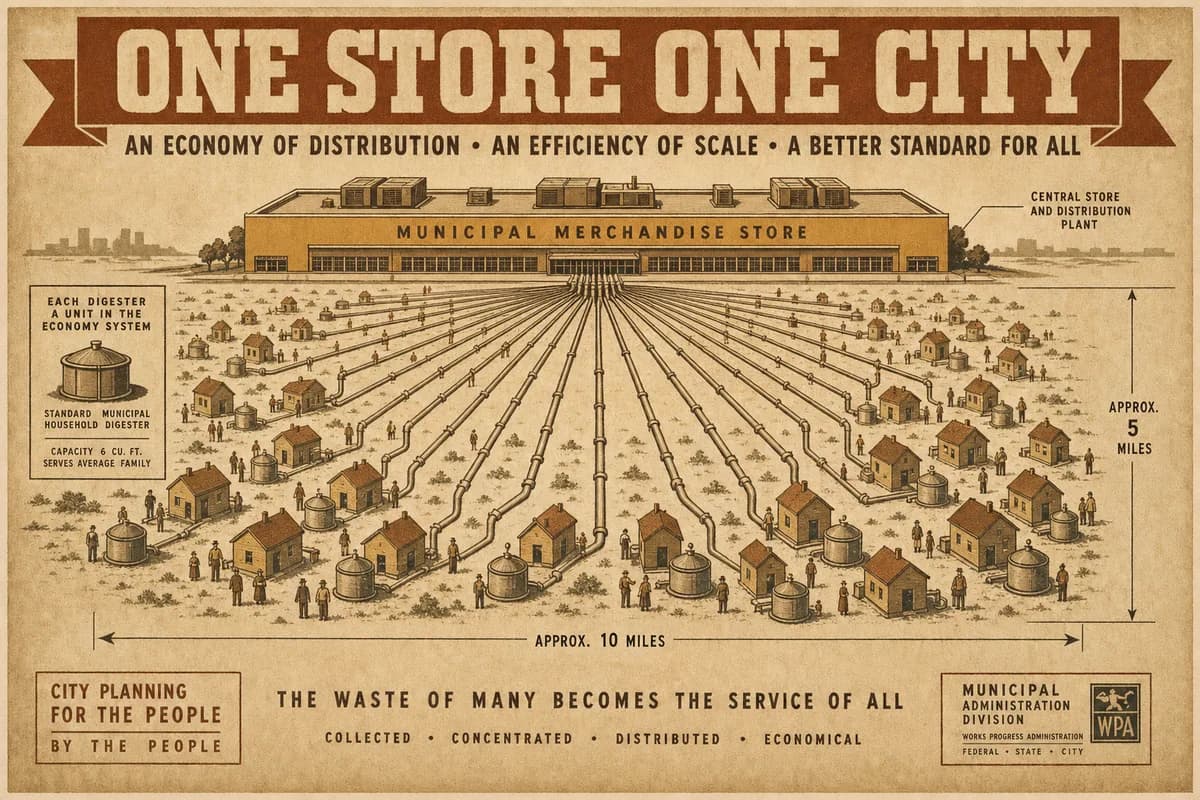
Abstract
This paper takes up a question the Bureau has fielded from three separate store managers: How much poop would it take to air-condition a Walmart? We size the cooling load of a representative supercenter across a July day, convert household digestive output to a continuous power rating, and determine the contributing population required to hold the store at temperature. We find that the afternoon peak demands the simultaneous output of roughly 600,000 contributors — a mid-sized city — and that the daily average, though lower, still requires a standing population of 360,000. The difference between the two is the paper's true subject.
Assumptions
-
The store. A representative supercenter with a peak mechanical cooling load of 1.25 MW on a design summer afternoon, operating 24 hours. Across the full day the cooling load averages about 0.75 MW, tracing the familiar hump: a low overnight base, a steep late-morning ramp, and a broad afternoon peak.
-
The standard daily contribution. One contributor yields 0.05 kWh of electricity per day by the series chain (0.5 kg wet, ~0.1 kg volatile solids, 0.3 m³ biogas per kg, 6 kWh per m³, 30% generator). Spread across 24 hours, that is a continuous rating of
50 Wh ÷ 24 h = 2.08 watts per contributor.
-
Simultaneity. Cooling is an instantaneous load. A contribution banked at breakfast does not cool the store at three o'clock unless it is held in a gas reserve until then, so the honest unit here is continuous watts, not daily kilowatt-hours.
The Calculation
At the afternoon peak the store calls for 1,250,000 watts. Supplied at 2.08 watts per contributor, that is
1,250,000 W ÷ 2.08 W = ≈ 600,000 contributors,
all producing at once, to hold the store through the hottest hour. Averaged across the whole day the load is 0.75 MW, or 18,000 kWh, which a standing population of 18,000 ÷ 0.05 = 360,000 contributors supplies. The store is thus a mid-sized city that cannot go shopping, because it is busy cooling the place it would shop.
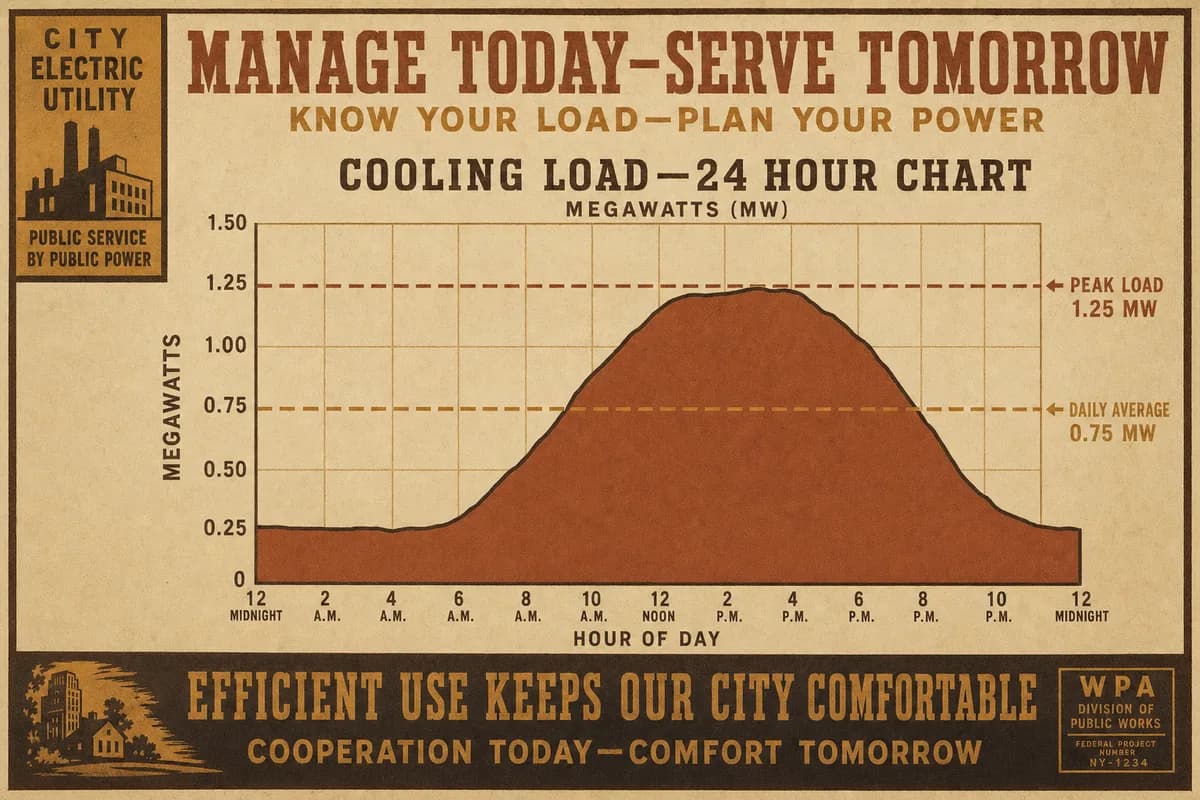
The gap between the two figures — 600,000 at peak against 360,000 on average — is a contribution reserve of 240,000, idle overnight and indispensable at three in the afternoon. No storage scheme fully closes it, because the afternoon is precisely when a contributing population is least disposed to contribute.

Operational Concerns
The peak. Meeting the afternoon ramp with base contribution alone leaves the store warm from one o'clock onward. The reserve must therefore be recruited on schedule, which is the intended function of a Demand Defecation event: the Office of Civic Digestion posts the afternoon target, the reserve population reports, and the store holds temperature until the dinner hour stands the event down.

Coincidence. A heat wave is the worst possible case, because the same afternoon that maximizes the store's cooling load also suppresses contributor output — appetites fall in the heat, and the reserve arrives thin on exactly the day it is most needed. The Bureau models this as a negative diversity factor and recommends against relying on it in any month containing the letter July.
Compliance. The store's feeder is a commercial interconnect under the Residential Digestive Contribution Act and draws on the Municipal Fart Grid rather than any single household. Managers should note that the grid does not distinguish a contribution made for air-conditioning from one made for any other purpose, and neither, in the end, does the store.
Conclusion
One supercenter, cooled honestly on household output, is a city standing at its digesters through the afternoon so that another, smaller crowd may stand comfortably in the dairy aisle. The peak demands six hundred thousand contributors at once; the day demands three hundred sixty thousand without pause; the reserve demands that a quarter-million of them treat three o'clock as a civic appointment. The Bureau's finding is that the store can indeed be cooled this way, and that the population required to cool it is, to within a rounding error, the population that would otherwise be inside it — which resolves the question of who the store is for.