The Urinal Divider as the Minimum Viable Society
The urinal divider, read through social-contract theory, is the smallest instrument of government yet devised — a Leviathan of frosted acrylic.
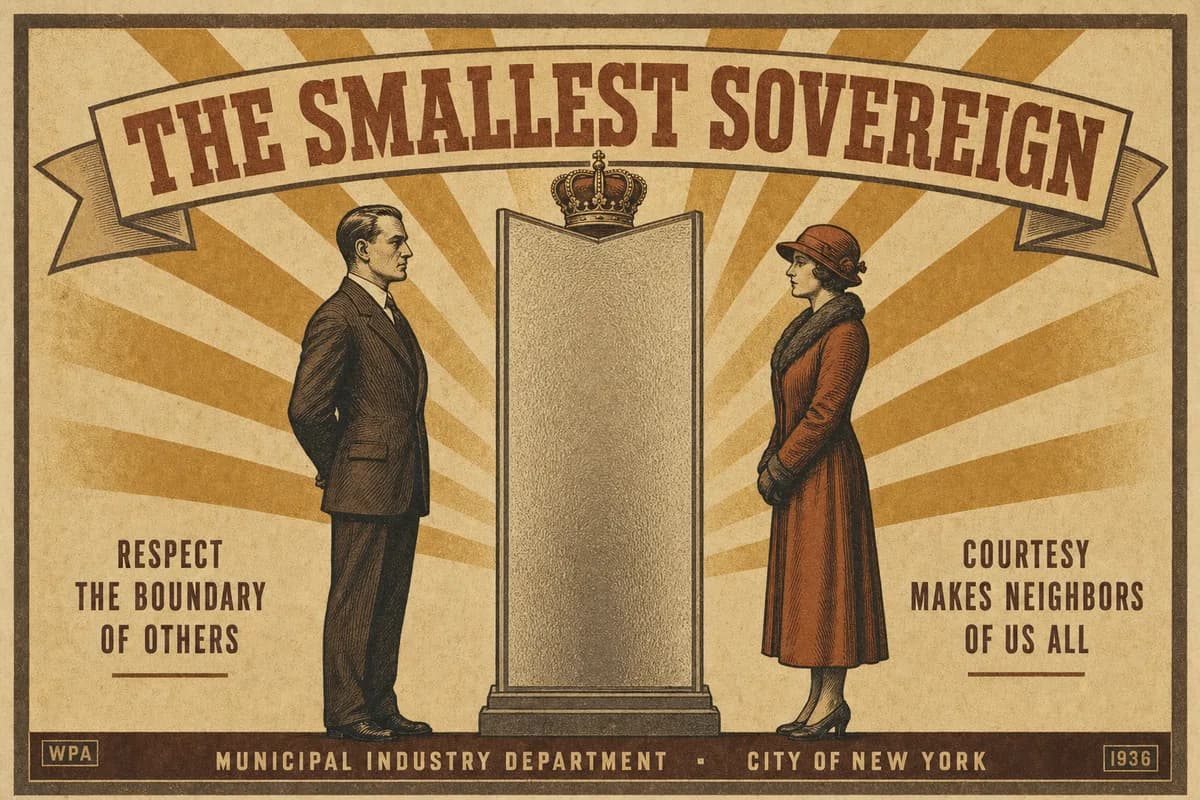
In software one speaks of the minimum viable product — the least thing that can be built which still performs the essential function, shipped before any refinement is added. Political philosophy has always sought the analogous object: the minimum viable society, the least government that can be instituted which still delivers the one good that government exists to deliver. The tradition has looked for it in constitutions and covenants. It has been hanging, all along, between two men at a wall: the urinal divider, a slab of frosted acrylic that is, I will argue, the smallest complete instance of the social contract in the built world.
The State of Nature
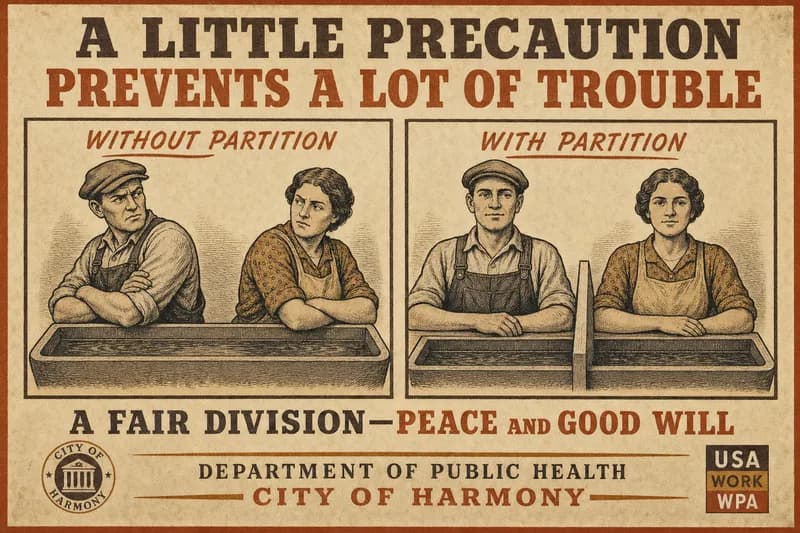
Begin, as the tradition does, before the partition. The undivided trough is the state of nature in its purest laboratory form. Two strangers stand in forced proximity, each aware of the other, each exposed, each possessed of what Hobbes called a natural right to all things and a rational fear of his neighbor. It is not war in the sense of blows, but it is war in Hobbes's precise sense: a "known disposition thereto," a condition of continual wariness in which no man may attend in peace to his own business (Hobbes 1651, ch. 13). The life of man at the open trough is, in the exact Hobbesian inventory, solitary, poor, nasty, and — one hopes — short.
The Covenant
The remedy Hobbes prescribes is the erection of a common power to overawe the parties and secure a zone of peace: the parties lay down a portion of their natural right and authorize a sovereign to maintain the boundary between them (Hobbes 1651, ch. 17). The divider is this erected power, reduced to its structural minimum. It overawes no one by force; it governs, as every legitimate sovereign finally does, by defining and holding a boundary. Behind it each man surrenders exactly one liberty — the liberty to observe, and to be observed — and receives in exchange the entire good of civil society: the ability to conduct his necessary business unmolested by the gaze and judgment of another. The covenant is wordless, instantaneous, and total.
Rousseau's Partition
Rousseau refines the account and the divider refines with it. For Rousseau the contract does not merely restrain us; it transforms us, converting the anxious natural creature into a citizen who finds, in the general will, a freedom he could not possess alone (Rousseau 1762, I.8). The general will at the fixture is the shared and unspoken understanding of mutual non-observation — a law no one authored and everyone obeys. Rousseau's most notorious formula applies without strain: the man who would peer over or around the partition, asserting his natural liberty against the common understanding, is rightly constrained by the arrangement; he is, in the phrase, "forced to be free" (Rousseau 1762, I.7). The divider forces upon both men the freedom that only their mutual blindness can supply.
The Night-Watchman Slab
How much state is enough? Nozick's minimal state — the "night-watchman state" of classical liberal theory — is limited to the narrow functions of protection against force and the enforcement of boundaries, and any state more extensive, he argues, violates rights (Nozick 1974, ix). The divider is the night-watchman state cast in acrylic. It provides no comfort, dispenses no benefit, redistributes nothing, improves no one's character; it patrols a single boundary and does not so much as suggest a second duty. It is the least government that will still do the one thing government is for, and not one panel more. Where the trough is anarchy and a fully partitioned stall is arguably the overreaching state, the divider holds the exact Nozickian mean: enough sovereign to secure the peace, too little to do anything else.
The Minimum, Demonstrated
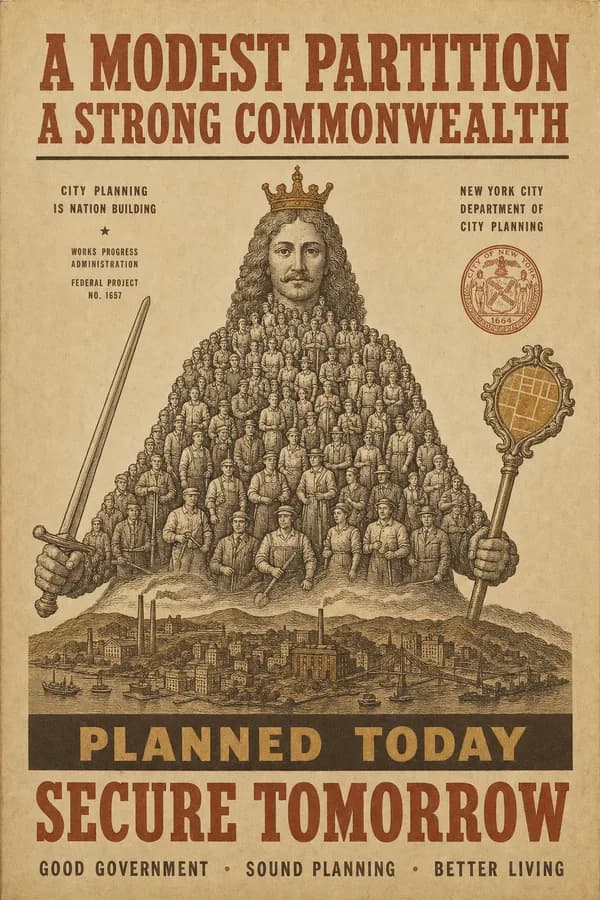
That the divider is genuinely minimal — that nothing smaller would serve — can be shown by subtraction, the method of the social-contract thinkers themselves. Remove it and the state of nature returns instantly and in full. Shrink it below the sightline and it fails of its one function, ceasing to be a sovereign at all. Add to it — a door, a roof, a lock — and one has left the genus entirely and built a stall, a more extensive government answering a different need. The divider sits at the unique point where a single further reduction restores the war of all against all and a single addition overshoots into fuller statehood. It is, in the strict engineering sense the political philosophers were always reaching for, the minimum viable society: shipped, in every public washroom, without refinement, and performing the essential function flawlessly.
Conclusion
We are accustomed to seek the origins of civil order in grand documents and founding assemblies. But the whole argument of the contract theorists — that peace is an artifact, erected by agreement, at the cost of one surrendered liberty, to secure one indispensable good — is legible in miniature at the fixture, where two strangers who have exchanged no word have nonetheless instituted a commonwealth between them, appointed a frosted sovereign to keep its single law, and stepped, for ninety seconds, out of the state of nature and into society. It is the smallest polity ever founded. It has never once fallen.
Works Cited
Hobbes, Thomas. Leviathan. Ed. Richard Tuck. Cambridge University Press, 1996 [1651]. Rousseau, Jean-Jacques. The Social Contract. Trans. Maurice Cranston. Penguin, 1968 [Du contrat social, 1762]. Nozick, Robert. Anarchy, State, and Utopia. Basic Books, 1974. Vandersloot, C. Barre. "The Night-Watchman Slab: Minimal Sovereignty at the Fixture." Journal of Applied Political Theory 41, no. 2 (2022): 88–115.