Tomorrow's Cities Will Run on Yesterday's Lunch
On metabolic urbanism, and the discovery that a city can only ever power itself on its own digested past — never on the present, always on the meal of the day before.
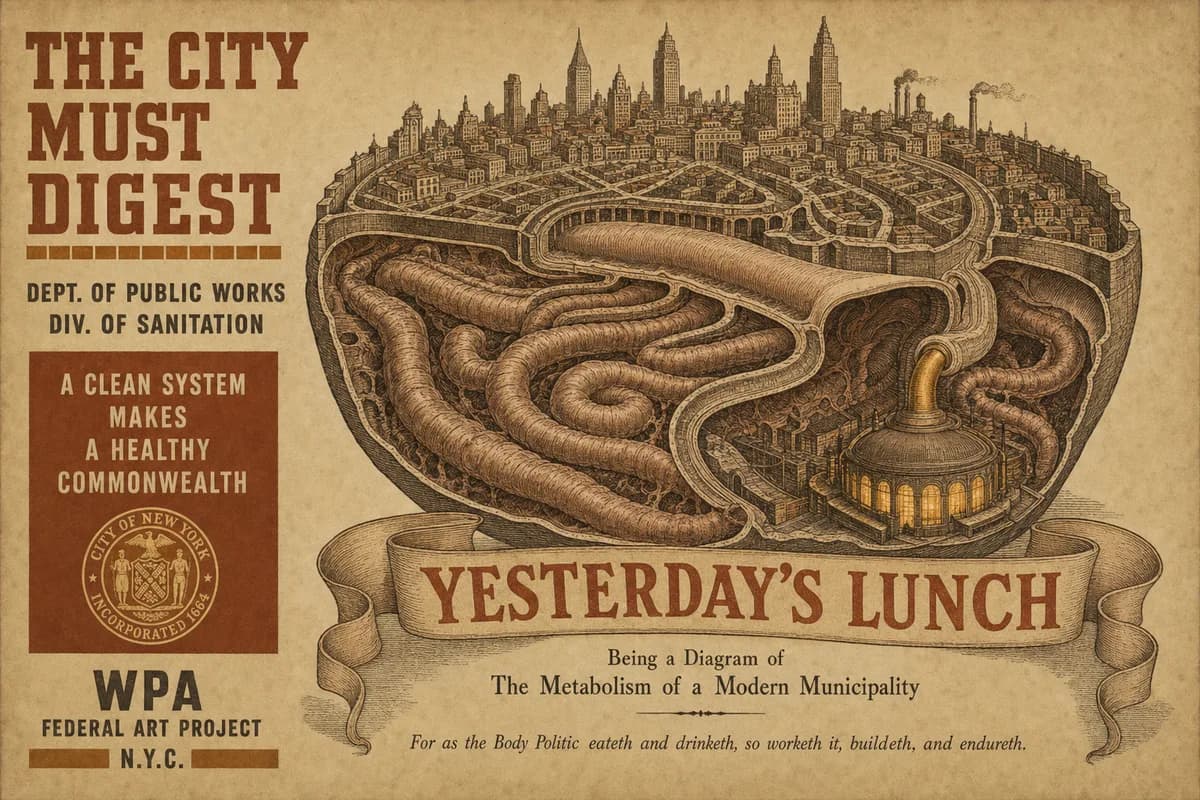
The prophets of the renewable city speak always in the future and the present tense — the sun that will fall on the array, the wind that is turning the blade. They have mistaken the tense of the problem. The city is not a solar organism or an aeolian one. It is a digestive one, and a digestive organism has only one tense available to it. It runs on the past. This essay argues that the metabolic city — the city understood as a single alimentary body — can never be powered by the meal it is presently eating, but only by the meal it has already finished, and that this temporal displacement, far from a defect, is the deep structure of civic energy and the proper subject of urban thought.
The city as a single organ
That a city digests is not a metaphor but a measurement. Consider the settled unit of the field: a contributing citizen produces some 128 grams of fresh material daily, which the drying yards and the anaerobic digesters of the Municipal Fart Grid reduce to roughly 32 grams of dry fuel. A metropolis of a million citizens is therefore, considered metabolically, an organ that ingests at one end and delivers, at the other, thirty-two tonnes of dry fuel every day — a bolus the size of a civic obligation, moving through the body of the city on a schedule as reliable as the tides.
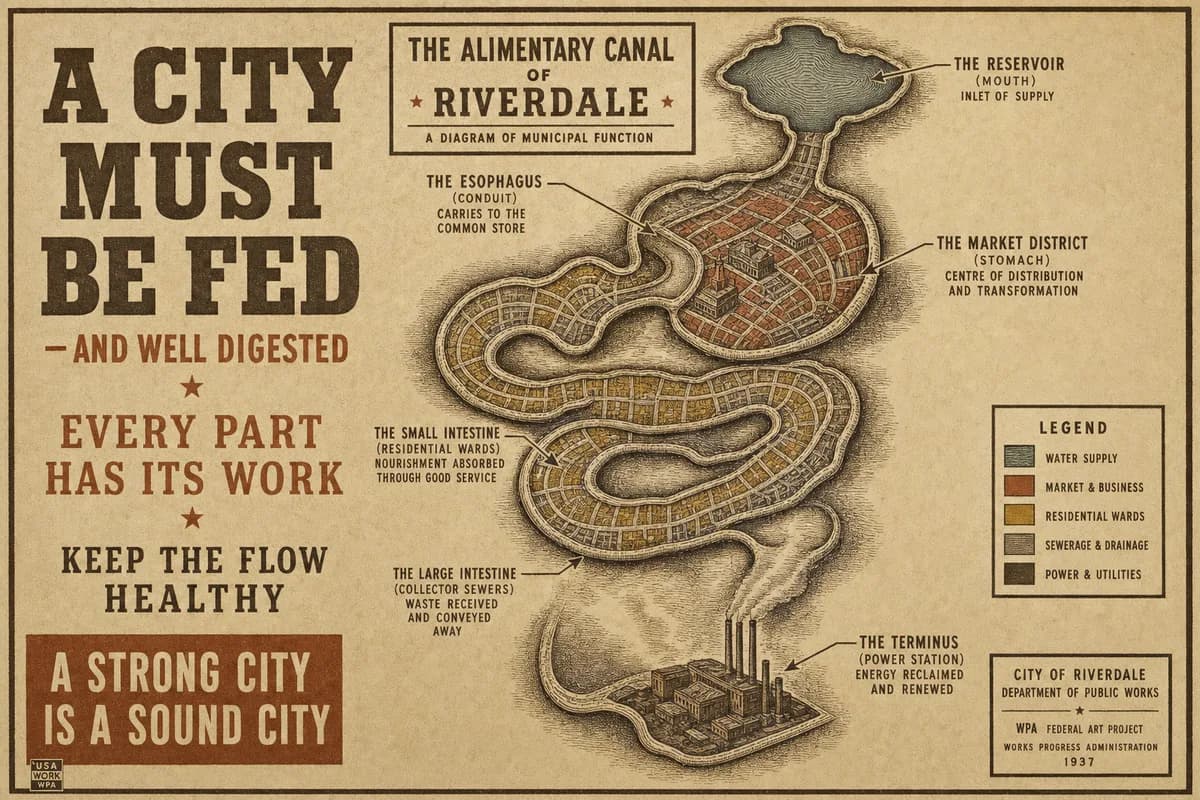
The older urbanism could not see this because it drew the city as a machine: inputs here, outputs there, waste a thing to be removed. The metabolic turn — associated with Vellichor's Toward an Alimentary Polis (Chair of Civic Digestion, 1974) and refined in the pages of the Journal of Metabolic Urbanism ever since — insists instead that the city has no waste, because the city has a terminus, and the terminus is a power station. The map redraws itself accordingly.
The luminous ward
What does the organ return? Thirty-two tonnes of dry fuel, at the field's standard heating value of 17 megajoules per kilogram, liberate 544 gigajoules of heat each day. A municipal solid-fuel plant, converting at a sober 25 percent, delivers of that some 136 gigajoules as electricity — about 37.8 megawatt-hours, enough to light roughly thirteen hundred households at the American daily average. A city of a million powers, on its own output, a single luminous ward: a district of thirteen hundred homes kept bright entirely on the memory of the city's own lunch, while the other three hundred thousand households draw their light from elsewhere.
The disappointed reader will call this a small number. The metabolic philosopher calls it a sincere one. The luminous ward is not the city's whole electricity; it is the city's whole honesty — the exact and unembellished quantity of light a body can make from what has passed through it. Every other watt the city burns is borrowed from a sun it did not eat. Only the ward is truly the city's own.
The tense of the grid
Here is the discovery that governs everything. The material lit in the ward tonight is not tonight's meal. It is yesterday's. Between the civic table and the civic terminus lies the mean transit of the metabolic city — the passage through the body and the days settling in the digester, call it a day and more — so that the grid is always running a full meal behind the mouth. The city eats today and is lit tomorrow night. A city cannot be powered by the meal it is presently eating. It can only ever be lit by the one it has finished.
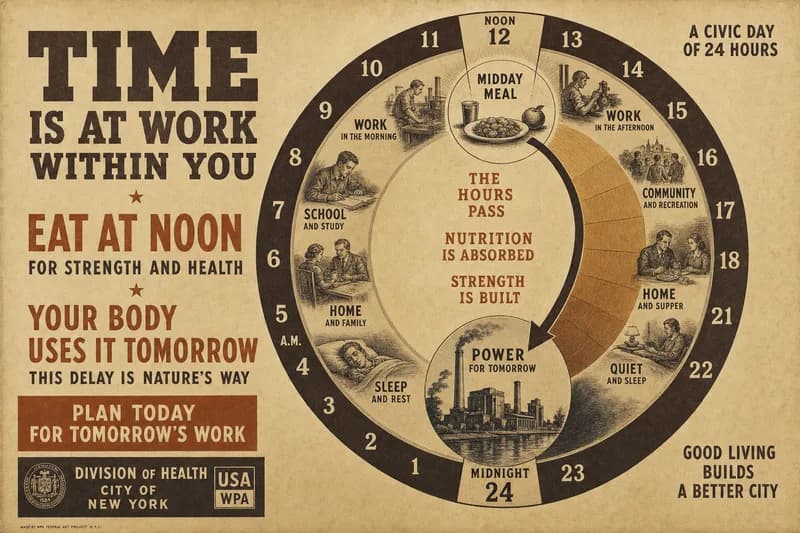
This is why the tense of renewable rhetoric is wrong. The solar city lives in the present tense of the falling photon; the metabolic city lives, and can only live, in the perfect tense of the completed meal. Its future is not ahead of it. Its future is behind it, already eaten, moving slowly toward the plant. Tomorrow's light is a settled fact today — it is already in the body, a day from the plant — and this is the strange consolation of metabolic urbanism: the city's tomorrow is not a hope but a digestion already in progress. One need not pray for it. One need only wait for transit.
Coda: the meal we owe the future
The ethical consequence follows without strain. If tomorrow's city runs on yesterday's lunch, then every meal is a deposit against a light not yet lit, and every citizen dines, whether they attend to it or not, on behalf of a ward twelve hours downstream. Soup Night is not a festival. It is a generation event, and the city that understands itself metabolically eats the way a prudent people saves: soberly, regularly, and with a decent regard for the district that will be bright because of it. The renewable future was never solar. It was always alimentary, and it was always yesterday's. We have only now learned to read the clock.