The Maggot Battery: Kitchen Scraps to Chicken Feed to Eggs
A closed black-soldier-fly loop that turns household scraps into chicken feed and, a few steps later, eggs — with honest yields for a single homestead.
Overview
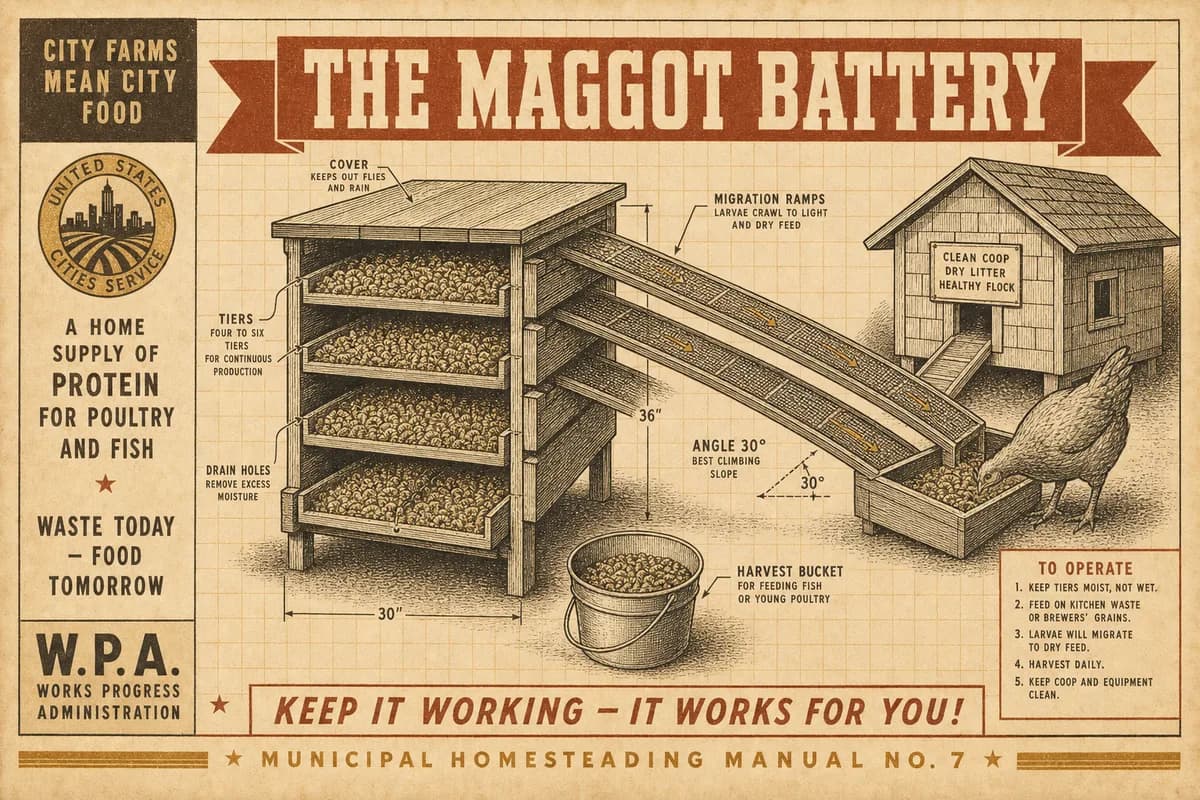
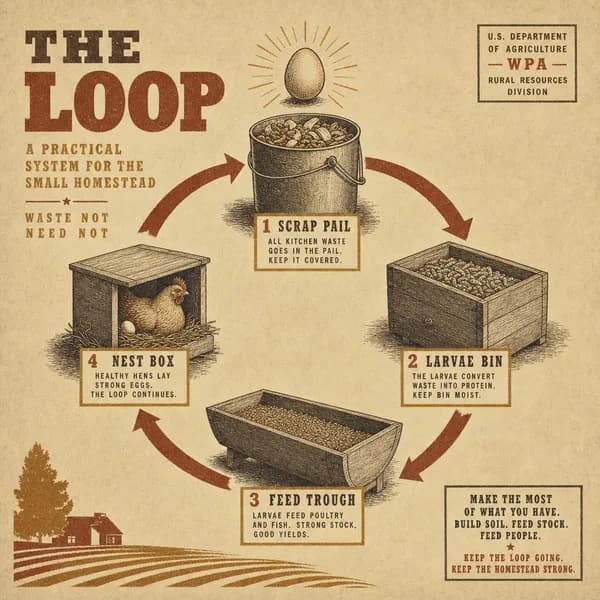
The Maggot Battery is the loop that closes the last gap in a homestead's kitchen waste. Where the Dungester 5000 takes what will digest, the black soldier fly takes what will not — the greasy scraps, the spoiled leftovers, the trimmings your compost pile only sulks over — and turns them into larvae your hens will chase across the run. The larvae eat what you cannot, the hens eat the larvae, and four stations later the whole thing comes back to you as eggs. This guide covers a two-bin conversion loop sized for one household and a small laying flock. It will not feed your birds by itself. Worked steadily, it turns a standing share of the feed bill into protein you were otherwise bagging up for the curb.
What you'll need
- Two stackable bins with lids — a food-grade tote or a purpose-built tray works. One is the active nursery; the second receives it when you rotate.
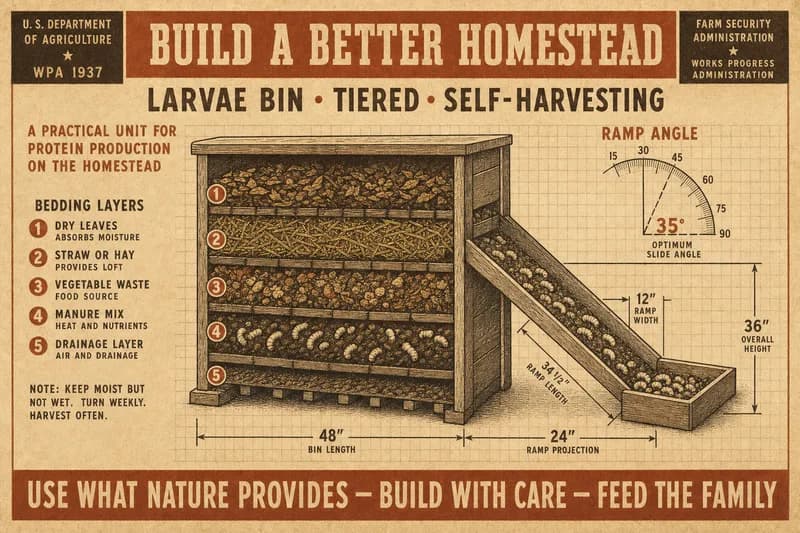
- A self-harvesting ramp: a sloped board or molded channel set at 35 to 40 degrees, with a lip at the top that drops climbers into a collection bucket. This ramp is the whole trick of the design, and its angle is not a suggestion.
- A collection bucket, drilled for drainage, hung under the ramp lip.
- Bedding: a few inches of spent coconut coir, aged sawdust, or dry leaves to keep the mass aerated and the moisture in check.
- A thermometer. Black soldier flies work fastest between 27 and 35 °C and stall below about 15 °C; below 10 °C the colony simply stops.
- A starter culture: a handful of larvae from a neighbor's running bin, or a bought cup of them to seed the first generation. Wild flies will find an open bin in warm weather on their own, but a seeded bin starts a week ahead.
- Feedstock: your kitchen's daily scraps — the fats, dairy, and cooked leftovers a cold compost pile refuses; spent brewing grain; and, in a good week, the overflow from a neighborhood Soup Night, which arrives pre-softened and disappears in a day.
- A small laying flock and their nest boxes, downwind and within a short carry of the trough.
Steps
- Site the bins. Put them in shade, out of standing rain, downwind of the house, and within an easy carry of the coop. The bins should be warm but never baking; direct afternoon sun will cook a shallow tray.
- Bed and seed. Lay a few inches of bedding, add a first ration of scraps, and introduce the starter larvae. Keep the mass damp as a wrung sponge, never soaked — a wet bin goes anaerobic and turns on you.
- Feed on a rhythm. Add scraps daily in a thin layer rather than a weekly dump. The larvae process roughly their own weight in a day when warm; bury nothing deeper than they can work before it sours.
- Let them harvest themselves. As larvae mature into prepupae they stop eating, empty their guts, and crawl toward a dry place to pupate. The ramp is their only way up and out, and it delivers them, clean and self-selected, into the bucket. You collect; you do not dig.
- Feed the harvest to the hens. Scatter the day's bucket across the run or tip it into the trough. The birds do the rest. Larvae are a supplement, not the ration — offer them alongside a balanced laying feed, never in place of it.
- Return the residue. The frass left in the bin is a fine soil amendment, and the wettest bottom sludge the larvae could not finish belongs in the Dungester 5000. Nothing here is waste twice.
Sizing
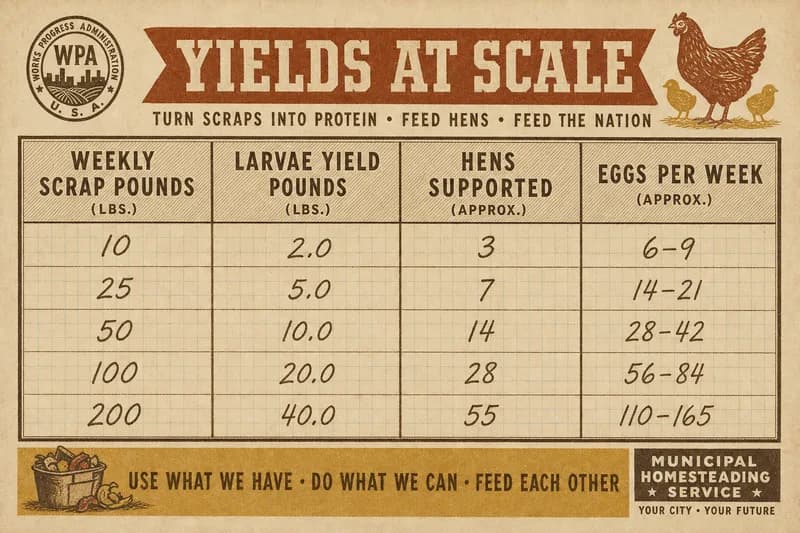
Yields below are for a warm, well-established bin and are stated honestly: fresh larvae run about a seventh of the wet scrap weight you put in, and a hen will take roughly a third of a pound of larvae a week as her supplement without tipping her diet toward fat.
| Household scraps (lb/week) | Fresh larvae (lb/week) | Hens supplemented | Eggs (per week) |
|---|---|---|---|
| 5 | ~0.7 | 2 | ~11 |
| 10 | ~1.4 | 4 | ~22 |
| 15 | ~2.1 | 6 | ~33 |
Scaling up means a third bin and a fourth, not a deeper one; a bin worked past its surface area heats, sours, and stalls. Plan the flock first, then the trays that feed it.
Maintenance & safety
- Keep it warm and keep it damp. Below 15 °C the larvae slow to nothing, and a cold bin is just a covered tote of everything you put in it. In a real winter, move the bins into a shed or park them against a Turd Furnace and borrow the heat.
- Watch the moisture. A sour, ammonia smell means the bin has gone too wet and airless; add dry bedding and back off the feed until it recovers.
- Mind the supplement. Larvae are a supplement, not the ration. Too many, too often, and your hens carry fat, lay soft-shelled eggs, and slow down. The loop rewards restraint.
- Harvest daily. A prepupa that finds no ramp will find a gap. Empty the bucket and the colony stays where you built it.
Expected output
A faithfully fed two-bin loop for a household of four keeps two to four hens in protein and returns something like a dozen to two dozen eggs a week that you can honestly credit to your own kitchen scraps. That is not the whole egg basket, and the Maggot Battery does not pretend to be. It closes the loop one turn tighter: the scraps that used to leave in a bag now leave as breakfast, and the only thing that ever crosses the property line is the smell of a well-run coop, which is to say, not much.