Would Synchronized Flushing Damage the Electrical Grid?
An assessment of whether a nationally synchronized flush could destabilize the electrical grid, once the water network's pumping load and storage are counted.
1. The Question
The scenario is specific: a single national moment — the end of a broadcast, a countdown, a halftime — prompts a large share of the country to operate a toilet within the same brief window. The question filed with this office asks whether the resulting synchronized flush could destabilize or damage the electrical grid. It could not. The flush's only path to the electrical grid runs through the water utility's pumps, and that path is small, slow, and heavily buffered — the near opposite of the one genuine precedent for a synchronized national appliance surge, which we take up first because it is real.
2. Prior Art: The Television Pickup
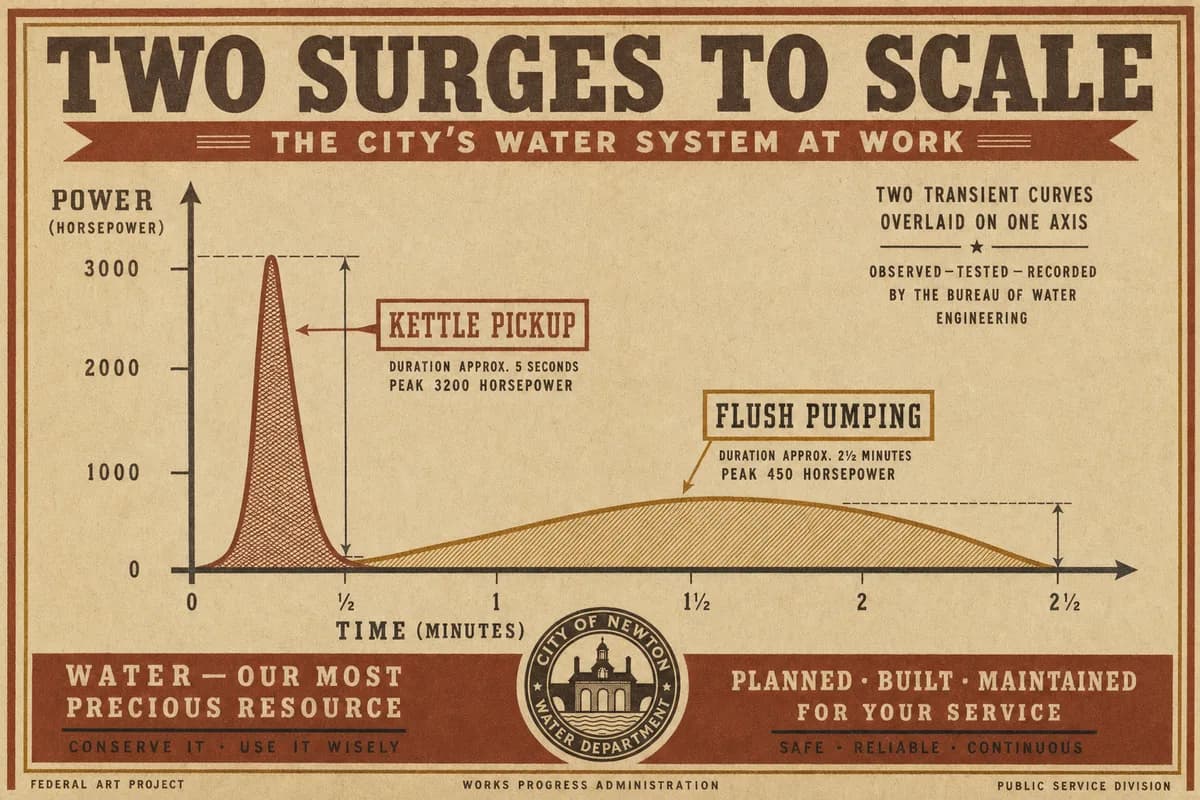
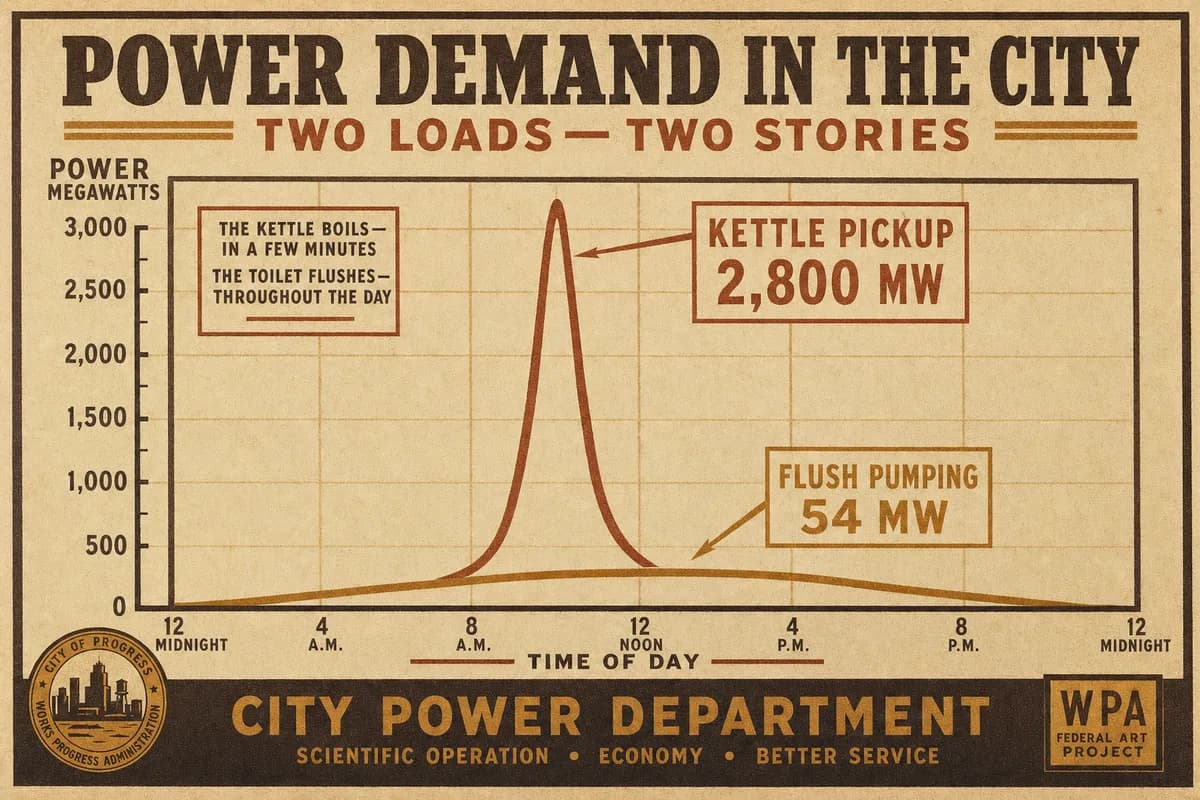
The United Kingdom grid has managed a synchronized-appliance surge for decades under the name TV pickup. At the end of a widely watched broadcast, on the order of a million electric kettles switch on within a few minutes; at roughly 2 kW each, the grid sees a demand step of about 2,800 MW in under five minutes — the celebrated figure from a 1990 World Cup semi-final. This is a serious event and the grid treats it seriously: operators watch the broadcast schedule and pre-arm fast reserve, notably the Dinorwig pumped-storage station, which can deliver on the order of 1,800 MW within seconds of the kettles landing.
The television pickup is dangerous precisely because it couples directly. A kettle is a resistive load; a million of them switching on is 2,800 MW appearing on the grid with no intermediary and no buffer. The synchronized flush, tested against this benchmark, couples through nothing so direct.
3. The Electrical Coupling of a Flush
Consider a large synchronized event: 20 million flushes within a 90-second window. At six litres each, that is 120 million litres — 120,000 m³ — displaced and demanded almost at once. A flush draws no current itself; its entire electrical footprint is the pumping the water system does to restore what was drawn — pressure recovery on the supply side and lift-station pumping on the wastewater side, together on the order of 0.3 kWh/m³. The whole event's incremental pumping energy is therefore 120,000 × 0.3 = 36 MWh.
Two features render that harmless to the grid. First, its size: even collapsed into the roughly forty minutes over which pumps refill storage, 36 MWh is about 54 MW of additional load — roughly one-fiftieth of the television pickup, and against national demand a rounding error. Second, and decisively, its shape. The water network is a low-pass filter the electrical grid does not have. Elevated tanks, reservoirs, and wet wells absorb the 90-second hydraulic pulse and release it to the pumps as a gentle refill over the following hour. The grid never sees a step; it sees, at most, a soft ramp it cannot distinguish from a warm evening.
4. The Hazard Is Hydraulic, Not Electrical
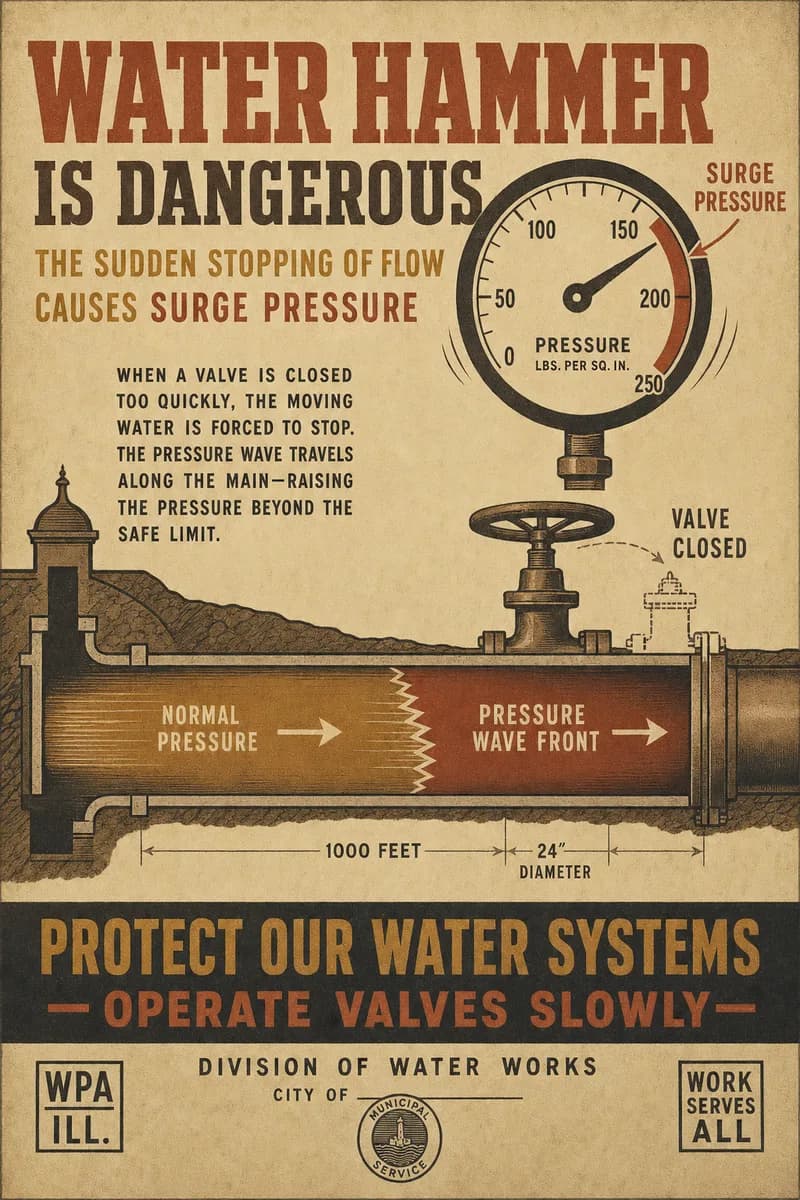
If the synchronized flush threatens any infrastructure, it is the water main, and the mechanism is water hammer — the pressure transient a pipe suffers when a moving column of water is checked. The Joukowsky relation sets the surge:
ΔP = ρ · a · Δv,
with water density ρ = 1000 kg/m³, a pressure-wave speed a ≈ 1200 m/s in a rigid main, and a velocity change Δv. A sudden Δv of just 1 m/s gives ΔP = 1000 × 1200 × 1 = 1.2 MPa — about 174 psi of transient over-pressure, layered on top of the working pressure and propagating through the distribution network at better than a kilometre a second. A synchronized demand pulse does not slam a single valve, and real flush valves close over seconds rather than instantly, which blunts the worst case; but the aggregate first-fill demand of 20 million near-simultaneous refills is exactly the sort of correlated draw a distribution engineer designs surge protection against. The exposure is real. It simply belongs to the water utility's pipes, not the electricity grid's frequency.
5. Verdict
Synchronized flushing would not damage the electrical grid. Its only electrical coupling is the water system's pumping load, which is roughly one-fiftieth of a television kettle surge to begin with and is then smeared by the water network's storage into a slow refill the grid cannot feel. The television pickup remains the genuine article — a direct, fast, unbuffered demand step that the grid arms pumped storage to catch — and the flush is its mirror image: indirect, slow, and absorbed before it arrives. What danger the synchronized flush carries is hydraulic, not electrical, and it is aimed with real precision at the wrong utility. The correct office to alarm is the water authority, and the correct instrument to fear is the pressure-relief valve, not the frequency meter.