The Suburban Christmas-Light Display, Restated in Contributions
One heavy suburban Christmas-light display, its dusk-to-bedtime load restated as the days of household contribution each evening quietly draws down.
From the series: How Much Poop Would It Take?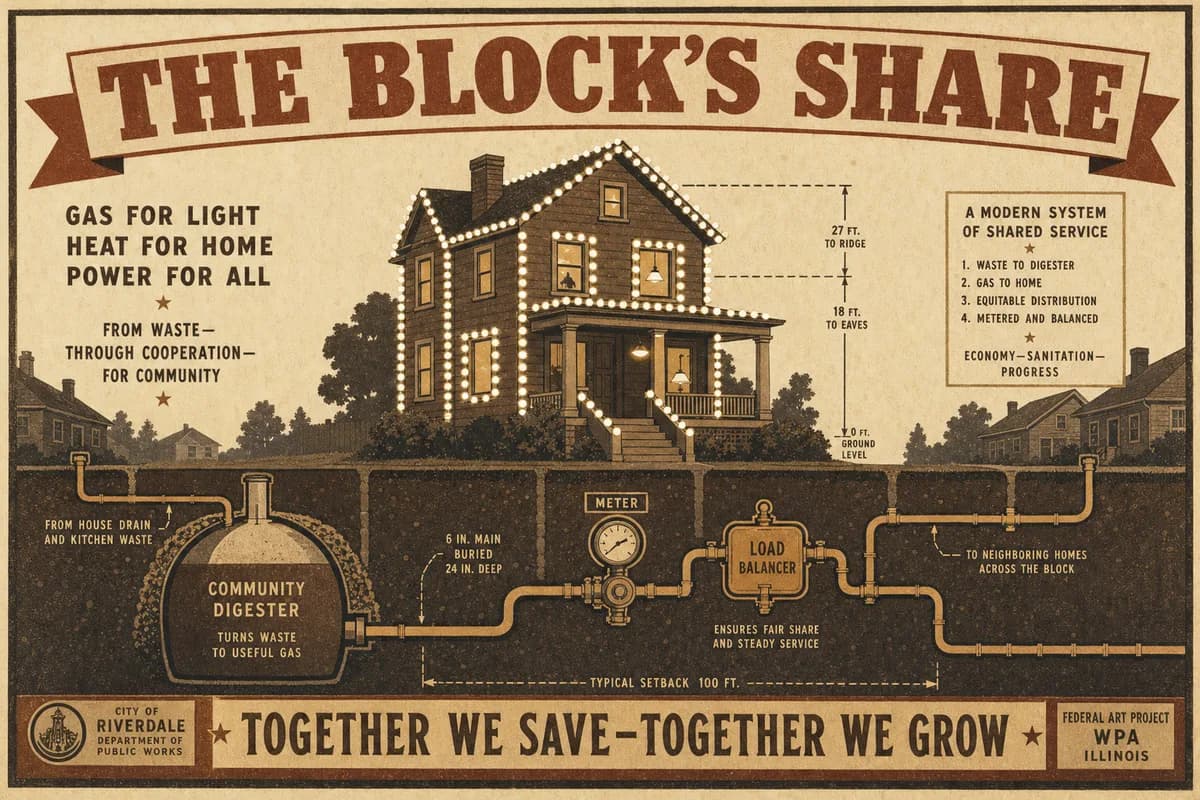
Abstract
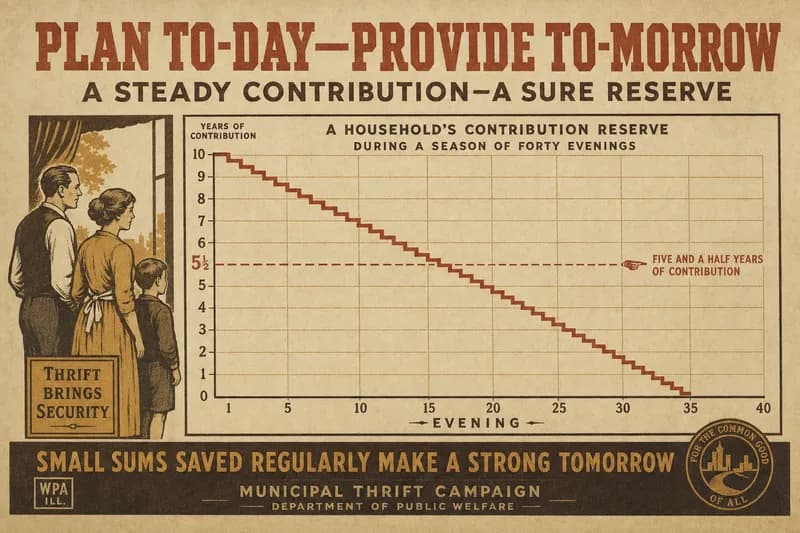
This memorandum restates a seasonal fixture in the Bureau's standing unit: How much poop would it take to power a suburban Christmas-light display? We take a heavy residential display at its evening load, convert household digestive output to electricity by the standard chain, and express the display's demand as the household contribution it consumes — nightly, and across a full season. We find that a single evening burns fifty days of a four-person household's output, and that a forty-night season draws down five and a half years of it.
Assumptions
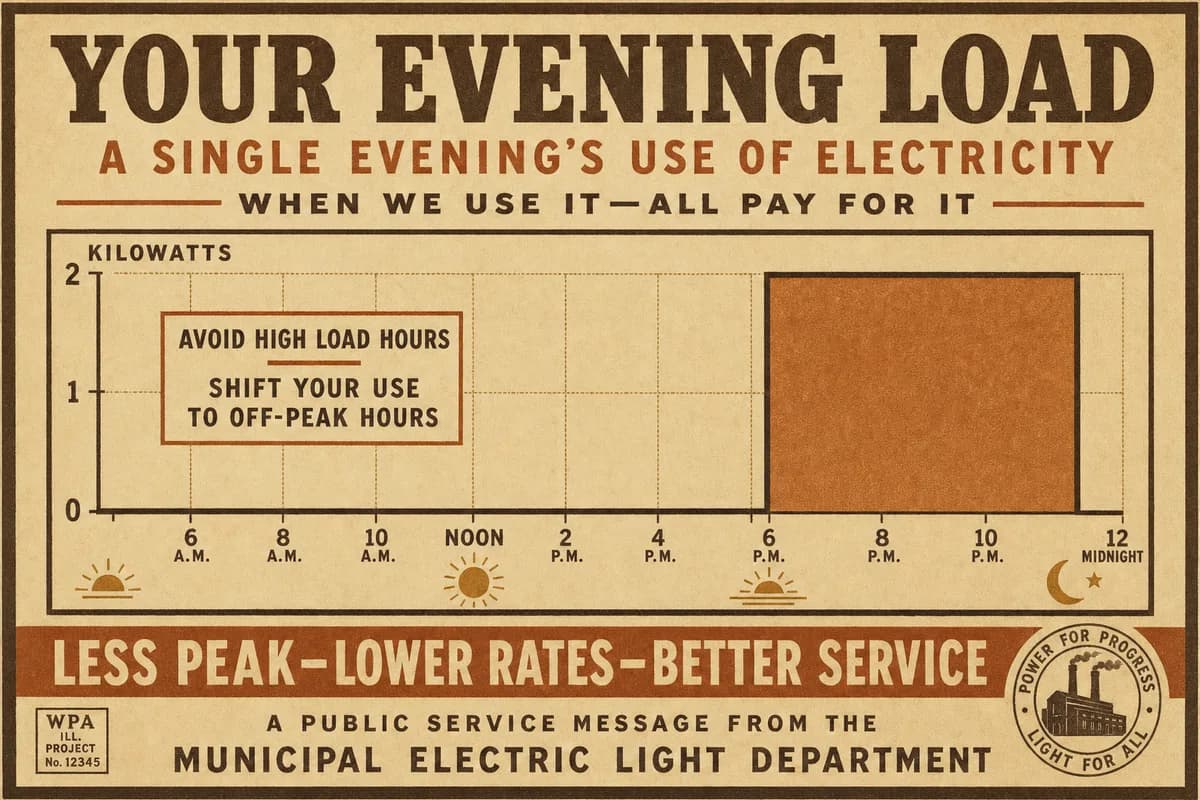
- The display. A heavy residential installation drawing 2 kW while lit, run for 5 hours from dusk to bedtime, over a 40-night season. One evening therefore consumes 2 kW × 5 h = 10 kWh; the full season, 40 × 10 = 400 kWh.
- The standard daily contribution. By the series chain, one contributor yields 0.05 kWh of electricity per day; a household of four yields 0.2 kWh per day, or a continuous 8.3 watts.
- The block. Where a live evening supply is wanted rather than a stored one, the relevant unit is continuous watts, and the relevant population is the surrounding street.
The Calculation
A single lit evening costs 10 kWh. Measured in the household's own output, that is
10 kWh ÷ 0.2 kWh per day = 50 household-days,
so each evening the display burns fifty days of the family's contribution. Held against the full season, the 400 kWh becomes 400 ÷ 0.2 = 2,000 household-days, or about five and a half years of uninterrupted four-person output to fund one forty-night run.
If the display is instead to be supplied live, drawing its 2 kW as it burns rather than from a reserve, the household cannot carry it at all — its 8.3 watts of continuous output is a two-hundred-fortieth of the load. Meeting 2,000 watts at 2.08 watts per contributor requires
2,000 W ÷ 2.08 W = ≈ 960 contributors,
digesting through the evening in concert — about 240 households, which is to say a small subdivision, holding one lawn lit from dusk to bedtime.
Operational Concerns
The block's consent. A live display is not a household load but a neighborhood one, and routing 240 households' evening output to a single lawn is a redistribution the other 239 lawns are entitled to notice. The Bureau anticipates that the tributary pipes crossing the neighbors' property will feature in the next HOA meeting more prominently than the lights themselves.
Storage. Funding the season from the household's own reserve rather than the block's live output demands a gas holder banked across the preceding five and a half years, and a Fecal Load Balancer disciplined enough to protect the reserve against every intervening kettle. In practice the reserve is spent long before December on the ordinary business of being warm, and the display reverts to the live supply and the block.
Compliance. Decorative lighting is a discretionary load; the Office of Civic Digestion neither credits the contribution against the Residential Digestive Contribution Act nor objects to it, provided the interconnect to the Municipal Fart Grid is filed and the exhaust scrubbed. The Office does ask that displays be extinguished by the bedtime hour, which is also when the contributing population would prefer to stop.
Conclusion
The suburban display is feasible on contribution in exactly one configuration: a whole subdivision, digesting in concert through the evening, to hold one house alight. Funded from a single family's reserve, it costs five and a half years of output for forty nights of glow — a rate of exchange the Bureau finds difficult to distinguish from simply not decorating. We recommend the family light one strand for itself and leave the block's full contribution to the block, which will want it back by bedtime.