How to Store Three Days of Emergency Methane
Banking a three-day biogas reserve against a grid outage, with the honest math on how much room three days of household methane actually takes.
Overview
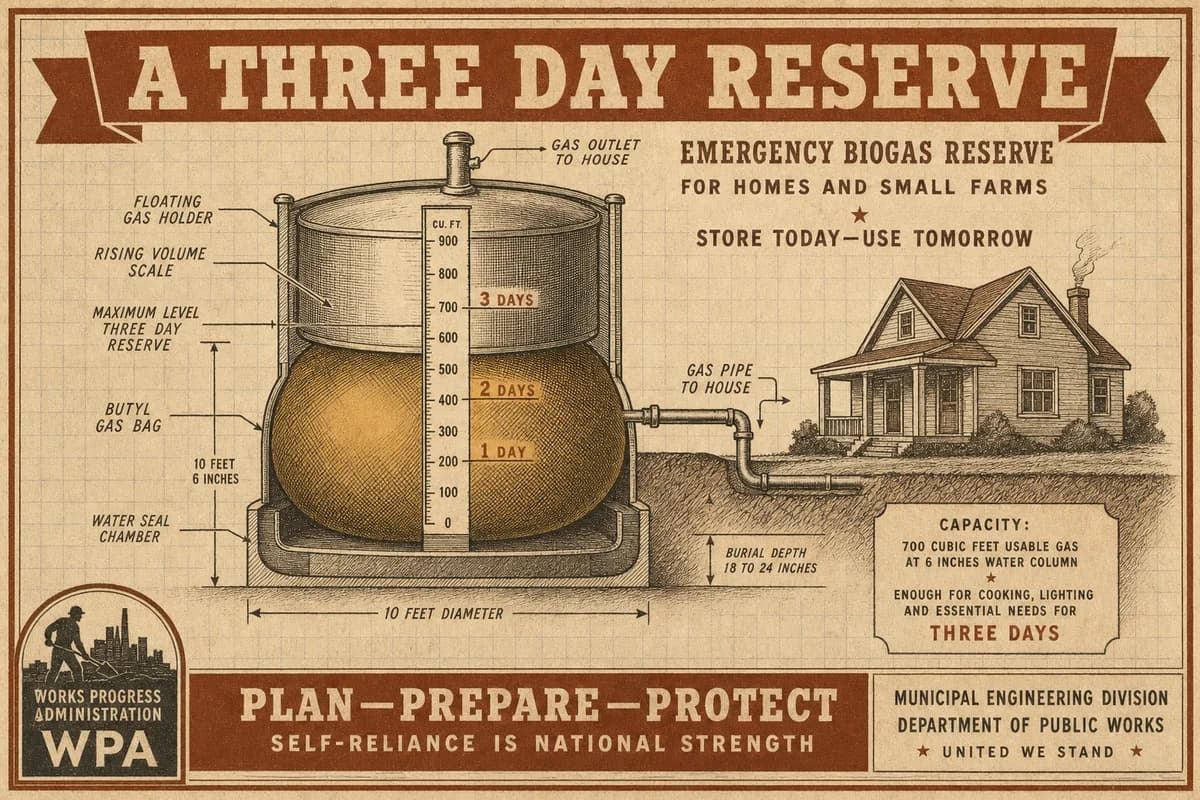
A working Dungester 5000 makes gas every day whether or not you need it that day, and the emergency-minded homesteader can turn that steady trickle into a standing reserve. This guide covers banking roughly three days of household biogas against a Municipal Fart Grid outage or a called Demand Defecation event — enough to keep the Farm-to-Fart Range lit and the essential circuits fed while the grid is down. The good news is that the gas costs you nothing to make. The honest news is that three days of it is surprisingly large, and where you put it matters more than how much you have.
What you'll need
- A running household digester already producing gas — you cannot bank a reserve you are not making.
- A floating gas holder for your standing reserve: an inverted drum, or better, a purpose-built holder that rises visibly as it fills so your charge is never a guess.
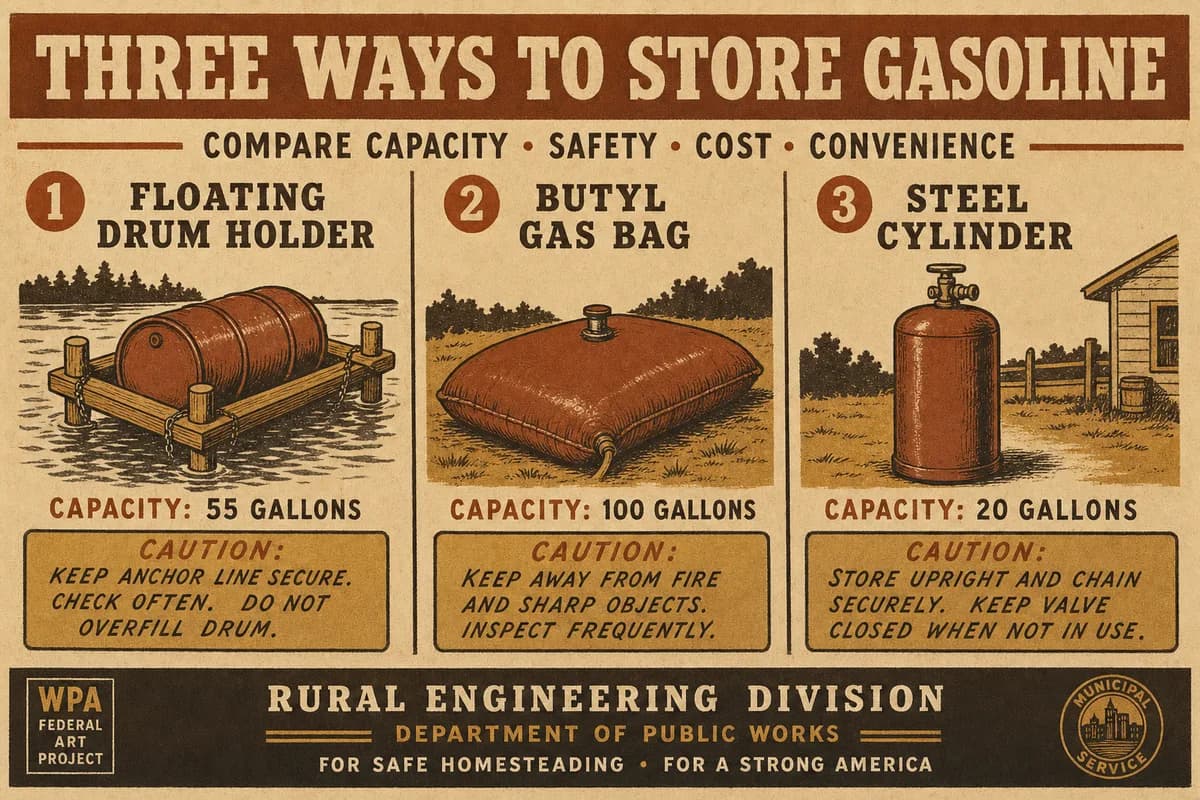
- A butyl gas bag for the overflow — a low-pressure bladder sized to hold the balance of a three-day charge.
- A Fart Scrubber 3000 on the line before the store, so what you bank is clean gas and not a slow accumulation of hydrogen sulfide and moisture.
- A condensate trap at the low point, and a shut-off valve at both the store and the burner.
- A Fecal Load Balancer, so that when you spend the reserve it spends on the essentials first and the deferrable loads not at all.
- A soap bottle for leak-testing. Never a flame.
Steps
- Clean the gas before you store it. Storage concentrates whatever you bank. Run every litre through the scrubber and a condensate trap first; a reserve of wet, sour gas corrodes its own vessel from the inside.
- Bank the surplus, not the supply. Fill the reserve from the days you are not using much — draw the holder up during mild weeks when the digester outpaces the kitchen.
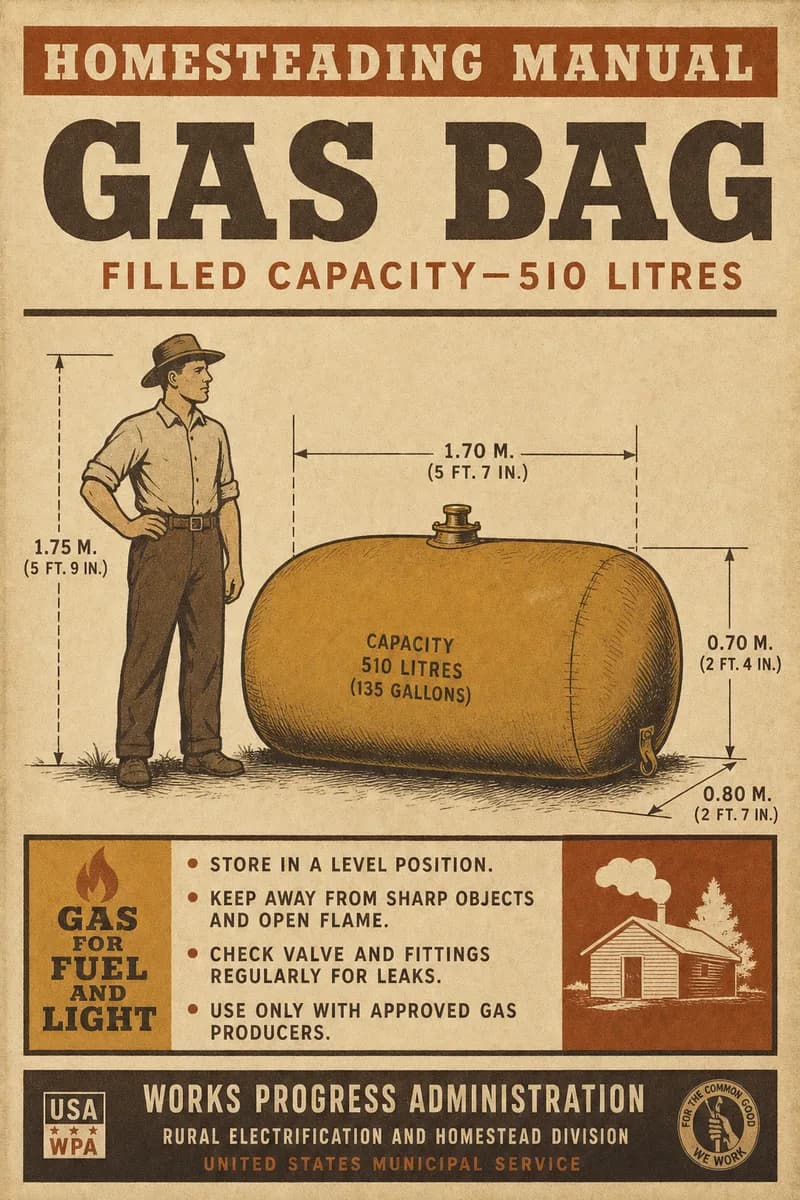
- Size the store to three days of production, honestly. A household drum makes about 170 litres a day, so a three-day reserve is roughly 510 litres of gas at low pressure. Size the holder and bag together to that number and no smaller.
- Site it outdoors and downwind. The store goes outside, away from the house, and clear of every ignition source — no pilot lights, no shop tools, no smoking within the ring.
- Do not compress it at home. The temptation is to squeeze three days into a small cylinder. Resist it. Compressing raw biogas needs equipment rated for a flammable, corrosive gas, and a home compressor is how a reserve becomes an incident.
- Rotate the reserve. Draw it down and refill it on a schedule so the gas in the store is never months old and the vessel is never left sitting under a static charge.
Sizing
The arithmetic is unforgiving in exactly one direction: methane at the low pressures a household system runs takes up a great deal of room. The figures below are for a household drum making about 170 litres a day, biogas at roughly six kilowatt-hours of energy per cubic metre.
| Reserve | Gas volume | Usable cooking energy | What it holds |
|---|---|---|---|
| One day | ~170 L (0.17 m³) | ~1.0 kWh | A single day's cooking |
| Two days | ~340 L (0.34 m³) | ~2.0 kWh | Cooking, with margin |
| Three days | ~510 L (0.51 m³) | ~3.0 kWh | Three days of a lit burner |
| The same three days, at 10× pressure | ~51 L | ~3.0 kWh | The same energy, ten times the risk |
Read the bottom two rows together. The energy in a three-day reserve is modest — about three kilowatt-hours, three days of one careful burner. The volume at safe household pressure is half a cubic metre, which is a bag the size of a small mattress. You do not make that bag smaller by wishing; you make it smaller only by compressing it, and compression is the line a beginner should not cross.
Maintenance & safety
- Store outdoors, always. A biogas reserve indoors is not a reserve; it is a hazard with a schedule. Keep it outside, downwind, fenced, and vented.
- Respect the gas. Biogas and air are explosive across a wide range. Check the store and every fitting with soapy water on a routine, and never with a flame.
- Mind the sulfide. Even scrubbed gas can carry a trace of hydrogen sulfide, which smells of rotten eggs at low concentrations and of nothing at all at dangerous ones. Do your work in open air and trust the scrubber, not your nose.
- A full holder in a hard freeze holds less than it reads. Cold gas contracts; budget your reserve to the coldest night, not the mild afternoon you filled it on.

Expected output
Three days of methane is not heavy and it is not expensive; it is only large, and the beginner's mistake is every time to underestimate how large. A properly banked reserve keeps the Farm-to-Fart Range lit and the essential circuits fed through a short outage, which is exactly what the emergency-minded homesteader wants of it — no more, and no less.
Size your reserve to what the outage actually demands: cooking, a little light, the router if you insist. A household that has reduced its load first will find three days of gas covers far more than a household that has not. Bank the surplus in the mild weeks, rotate it honestly, and when the grid goes quiet you will be the one neighbor whose kitchen never noticed.