The Myth of Sisyphus, But the Rock Is a Septic Tank
Camus's absurd hero, correctly identified at last as the rural homeowner on a two-compartment tank and a three-year service interval.

The gods, Camus tells us, had condemned Sisyphus to roll a rock ceaselessly to the top of a mountain, whence the stone would fall back of its own weight, "and they had thought with some reason that there is no more dreadful punishment than futile and hopeless labor" (Camus 1942, 119). Commentary has spent eighty years asking what Sisyphus stands for — the worker, the writer, the modern soul at its desk. I wish to argue that this search for a metaphor has overlooked the one figure who is not standing for anything at all, but simply doing the thing itself: the owner of a rural septic system, condemned by geology and by the county to pump the same tank every three years, forever, with no prospect and no wish of connection to a municipal main.
The Condemnation
The sentence is exact in its cruelty precisely because it is administrative. A two-compartment concrete tank of the ordinary domestic size, serving the ordinary household, fills to its service threshold on an interval that the trade literature places, with a consistency Sisyphus would recognize, at somewhere between three and five years (Rowntree 2011). The homeowner does not choose this interval. The biology chooses it. The gods, in this reading, are the anaerobic digesters of the lower compartment, who labor without rest and without gratitude, and who at last present their invoice in the form of a tank that is full again. There is no appeal. There is no sewer to which one might defect. There is only the tank, and the interval, and the truck.
The Boulder
We must be careful about what the rock is. It is tempting to say the rock is the waste, but the waste is merely the stone's material; the rock is the task — the whole recurring labor of restoration, the pumping-out that returns the tank to the condition of emptiness from which it will immediately begin, again, to fill. Sisyphus pushes the stone up; the homeowner pumps the tank down; in both the effort is total and the result is a zero that will not hold. The instant the truck's hose falls slack the household resumes its contribution, and the boulder, having reached the summit, begins its silent roll back toward the day, three years hence, when it must be pushed once more. Kierkegaard called this structure Gjentagelsen, repetition — not the return of the same event but the willed taking-up of a task one already knows will not conclude (Kierkegaard 1843). The septic homeowner is a repetition in Kierkegaard's strict sense. He has done this before. He will do it again. He signs the work order with a steady hand.
The Descent
Here is the crux, and it is not where the reader expects. Camus is emphatic that Sisyphus does not interest him at the summit, in the moment of strain, but afterward — in the pause, the walk back down to retrieve the fallen stone. "It is during that return, that pause, that Sisyphus interests me," he writes; "that hour like a breathing-space which returns as surely as his suffering, that is the hour of consciousness" (Camus 1942, 121). So too here. The homeowner is not the hero while the truck is running; anyone can stand beside a running truck. He becomes the hero in the moment afterward — walking back up the drive toward the house, past the freshly capped riser, knowing with perfect clarity that the vessel he has just emptied has, in the time it took him to sign the receipt, already begun to fill. That knowledge is the whole of his dignity. The tank does not know it is being emptied. Only the homeowner, descending the hill, knows — and it is in that descent that he becomes superior to his fate.

The Eternal Return
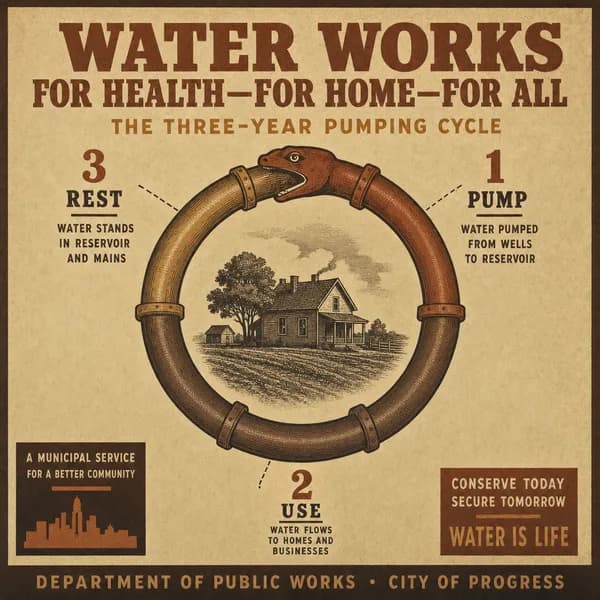
Nietzsche proposed a thought experiment to sort the strong souls from the weak: a demon steals into your loneliest loneliness and tells you that this life, in every particular, you will live again and again, innumerable times, "and there will be nothing new in it" — and asks whether you would gnash your teeth or answer that you had never heard anything more divine (Nietzsche 1882, §341). The septic homeowner is handed precisely this demon, on a three-year lease. His question is not hypothetical. Would he will the interval to recur eternally — the same truck, the same worn path to the access lid, the same invoice — with no term, no upgrade, no municipal salvation? The answer that his continued residence on the property constitutes is yes. He does not merely endure the eternal return of the cycle; by remaining, by re-signing, he wills it. To will the recurrence is, for Nietzsche, the highest formula of affirmation attainable. The homeowner attains it quarterly, in escrow.
Conclusion
Camus ends where every reader remembers: "The struggle itself toward the heights is enough to fill a man's heart. One must imagine Sisyphus happy" (Camus 1942, 123). The formula transfers without loss. The homeowner who has understood his tank has ceased to hope for the sewer, and in ceasing to hope has become free of the one thing that could make the interval unbearable — the belief that it ought to be otherwise. He does not rage at the biology. He does not petition the county for a main that will never reach his road. He schedules the pump-out, walks back up the hill, and lives, in the interval, a life that is entirely his own precisely because it is bounded, on both ends, by a labor he has chosen to repeat. One must imagine the homeowner happy.
Works Cited
Camus, Albert. The Myth of Sisyphus. Trans. Justin O'Brien. Vintage, 1955 [Le Mythe de Sisyphe, Gallimard, 1942]. Kierkegaard, Søren. Repetition: An Essay in Experimental Psychology. 1843. Nietzsche, Friedrich. The Gay Science. 1882. Rowntree, H. Delia. "Digestive Load and Service Interval in Two-Compartment Domestic Tanks: A Longitudinal Field Survey." Journal of Rural Sanitation Practice 39, no. 4 (2011): 288–307.