The Sewer-Source Heat Pump: Recovering Warmth From Your Own Shower Water
Reclaim the heat in graywater with a drain-coil exchanger and a small heat pump — honest coefficient-of-performance arithmetic and a shower schedule the whole household keeps.
Overview
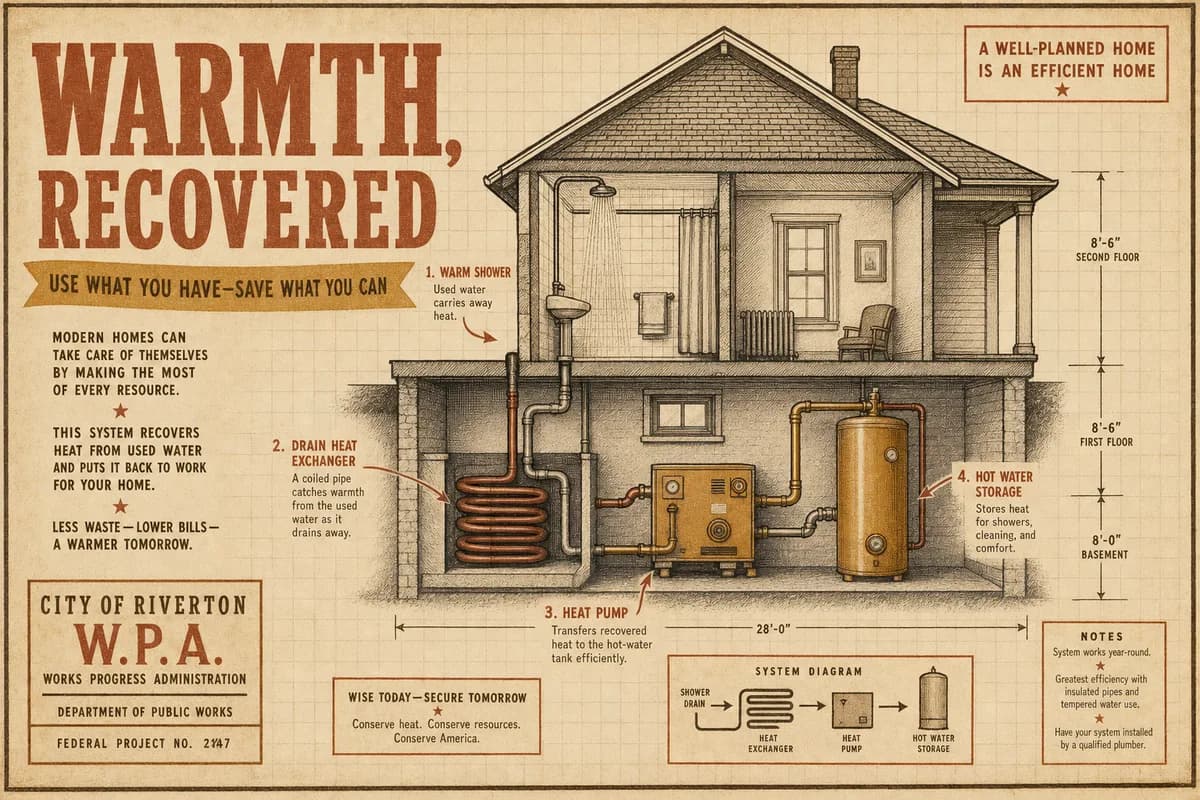
Every warm shower you take is a small, deliberate act of throwing heat away. The water arrives at the tap near 40 °C, spends a minute on you, and leaves down the drain still warm — carrying most of its heat with it into the ground. The Sewer-Source Heat Pump is how you keep some of it. A copper coil wrapped around the drain stack catches the easy part as the water falls, and a small water-source heat pump lifts the rest into your hot-water tank. This guide covers the exchanger, the pump, and the arithmetic that ties them together. The physics is honest and the gains are modest, and the whole thing works only if the household showers on a rhythm it can keep.
What you'll need
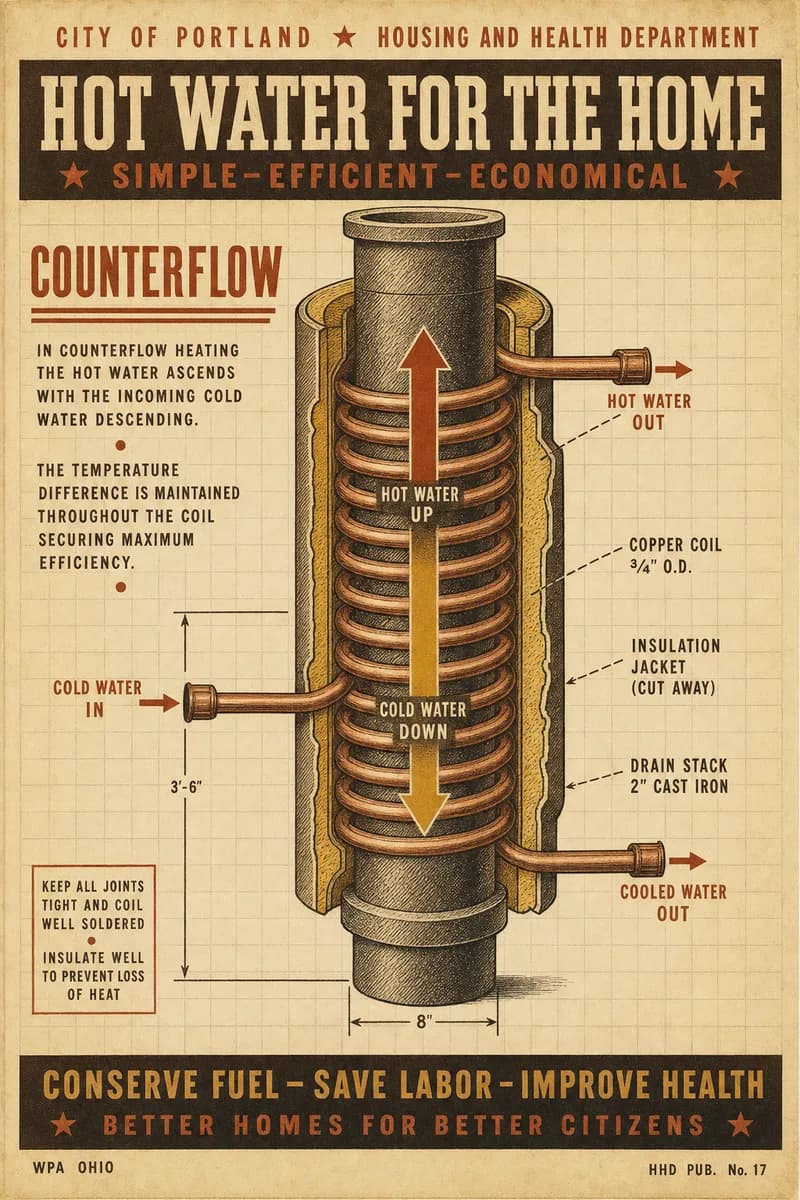
- A falling-film drain heat exchanger: a length of vertical drain stack, typically copper, wrapped tightly in a copper coil so incoming cold water counterflows against the warm drain water on the far side of the wall. The vertical orientation is what makes it work — a warm film clings to the pipe wall as it falls and gives up its heat the whole way down.
- An insulation jacket for the exchanger, so the heat it recovers goes into the coil and not into the basement.
- A small water-source heat pump rated for low-grade heat, plumbed to lift the preheated water the rest of the way to tank temperature.
- A graywater sump or buffer tank for the heat pump to draw its source heat from between draws.
- A hot-water tank — the Sewer-Source Heat Pump returns its warmth here, so it wants to sit close to the tank and the incoming main.
- Two thermometers or a simple gauge pair, so you can read the exchanger's inlet and outlet and know honestly what it is doing.
Steps
- Find a vertical drain run. The exchanger needs a straight vertical section of drain below the shower — a basement or crawlspace stack is ideal. Horizontal runs do not work; the film has to fall.
- Wrap and insulate. Fit the coil against the drain stack with good metal-to-metal contact, then jacket the whole assembly. Any air gap is heat you paid for and then abandoned.
- Plumb the counterflow. Route the incoming cold main up through the coil so it rises against the falling drain water. Counterflow, not parallel — matched directions leave most of the heat on the table.
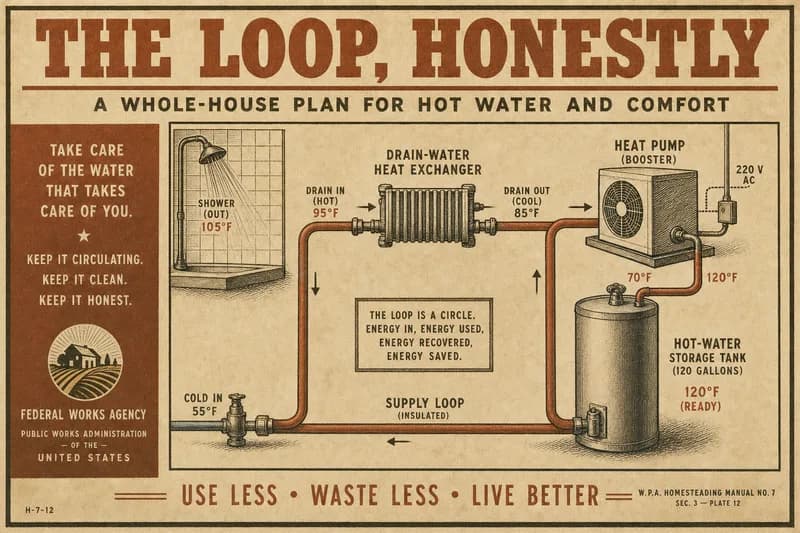
- Set the heat pump on the sump. Plumb the small heat pump to draw from the graywater sump and deliver into the tank. The exchanger does the free, easy recovery; the heat pump does the paid, thorough recovery.
- Commission and read it. Run a shower, watch the incoming water rise from mains cold to something noticeably warmer at the coil outlet, and confirm the heat pump lifts the sump water into the tank. Write the temperatures down; you will want the baseline.
Sizing
The honest lever here is the coefficient of performance. A water-source heat pump on a mild graywater source runs a COP of about 3.5 — for every kilowatt-hour of electricity it draws, it moves roughly three and a half kilowatt-hours of heat into your tank. That number is real, but it is not a free lunch: the pump can only move heat the showers actually deposited in the sump, so your recovery is capped by the schedule, not the compressor.
The passive exchanger is the modest half. A vertical falling-film unit is rated near 40 percent in the laboratory, but a real retrofit — unequal flows, short showers, a coil that fouls — settles closer to 15 to 20 percent effective. Size your expectations to the installed number, not the brochure.
Maintenance & safety
- Post the shower schedule inside the bathroom door. The exchanger only works while the water is running, and the sump only holds what the last shower left it. A household that showers in a considerate rhythm recovers heat; a household that queues four showers back to back simply drains the tank. The schedule is not a suggestion.
- Keep the coil clean. Graywater films the exchanger over time, and a fouled coil recovers less each month without ever announcing it. Flush it on a season.
- Screen the sump. Hair and lint find the sump and then find the heat pump. A cleanable screen at the inlet is cheaper than a seized pump.
Expected output
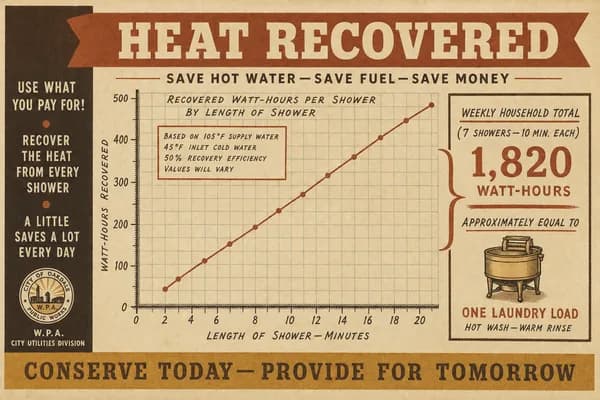
A disciplined two-person household — short showers, kept to the schedule — recovers on the order of a few tenths of a kilowatt-hour per shower, and about three and a third kilowatt-hours across a week. Held against the household's other loads, that is roughly the energy of a single hot laundry load, recovered from water you were pouring down the drain anyway.
| Shower length | Water used | Recovered |
|---|---|---|
| 5 min | ~45 L | ~220 Wh |
| 8 min | ~72 L | ~350 Wh |
| 12 min | ~108 L | ~530 Wh |
That is a truthful, unspectacular number, and the Sewer-Source Heat Pump does not dress it up. It will not heat your water for you. What it returns is smaller than that and stranger: the warmth your showers already paid for, caught on its way to the ground and sent back up the pipe — one laundry load a week, for as long as the household keeps the rhythm.