The Semiotics of the "Employees Must Wash Hands" Sign
A close reading of the workplace's most-read and least-studied text: its addressee, its unenforceable imperative, and its studied silence about everyone who is not an employee.
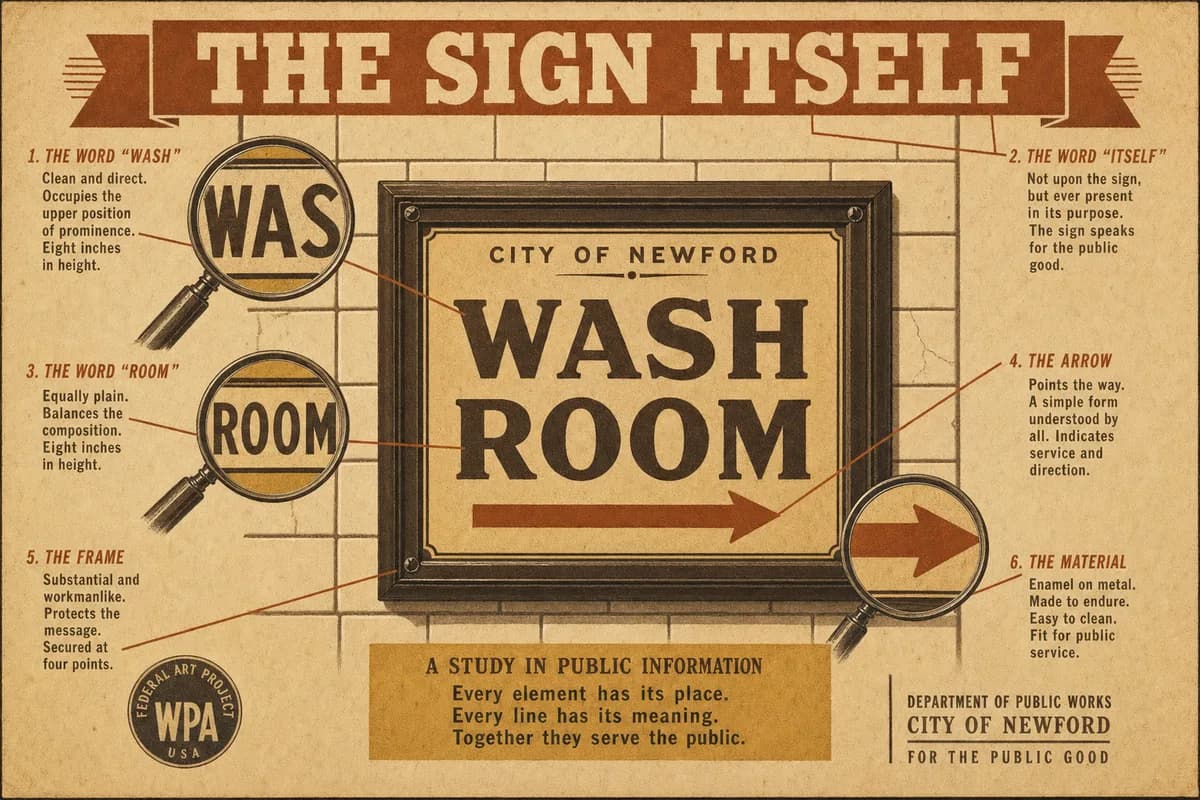
There is no text in the modern built environment more widely read than the notice, affixed above a great many of the nation's washroom basins, that reads: EMPLOYEES MUST WASH HANDS. It is read by everyone and studied by no one, and it is the burden of this essay that the neglect is undeserved. The sign is a small masterpiece of the imperative mood, and its silences are as carefully composed as its speech. What follows is a close reading of the sort we would extend without hesitation to a sonnet, applied to four words that have never once asked for it.
The Text as Object
We must begin, as any editor begins, by establishing the text. The received reading is stable — four words, no punctuation, uniform capitals — but its very stability is worth an editor's suspicion, for it disguises how much labor the words are performing. Barthes taught us that the apparently natural sign is precisely the one most in need of unpacking, that "what goes without saying" is the disguise mythology wears (Barthes 1957). The washroom sign goes entirely without saying. It presents itself as a mere transcription of hygienic necessity, a window onto a fact. It is nothing of the kind. It is a constructed utterance, with an author who has withdrawn, an addressee who is assumed, and a demand that no grammar in the world can enforce.

Signifier and Signified
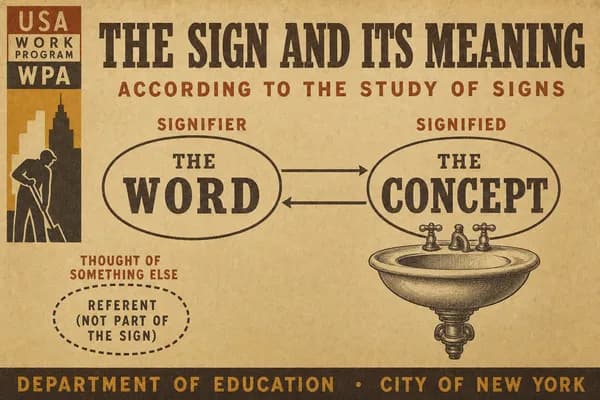
Consider the word MUST. In Saussure's account the linguistic sign binds a signifier — the acoustic or graphic image — to a signified, the concept, in a union the two parties cannot dissolve (Saussure 1916). The signifier MUST would seem to point cleanly to the signified obligation. But the reader who arrives at the basin discovers that the binding is looser than Saussure's diagram admits. The word carries the full grammatical weight of compulsion while possessing none of the institutional weight that would make compulsion real. It is a signifier that has been severed from its ordinary signified and set to float — an obligation with no obligor behind it, a must that no one is standing by to enforce. The sign says MUST and means, at most, it would be preferable if. Between those two the entire drama of the notice unfolds.
The Unenforceable Imperative
Austin distinguished the locution — the words said — from the illocution, the act performed in saying them, and warned that an illocutionary act can misfire when its felicity conditions go unmet (Austin 1962). The washroom imperative is a permanent, structural misfire, and endures precisely because it is one. A command presupposes an authority empowered to command and a capacity to observe compliance; the sign possesses neither. No manager stands sentinel at the basin; no mechanism records the passage from tap to towel. The imperative is issued by no one, to a self-selected audience, on pain of nothing. It is the purest command in the language, because it has been distilled entirely free of the power that ordinarily contaminates commands. Foucault would recognize the structure at once: the sign is a fragment of discipline that has outlived its disciplinarian, a surveillance whose watchtower is empty and whose subjects watch themselves (Foucault 1975). Its authority is wholly internalized, which is to say wholly optional, which is to say — for those who obey — absolute.
The Studied Silence
The sign's most eloquent feature is the party it declines to name. MUST WASH HANDS is addressed, with grammatical precision, to EMPLOYEES — and by the iron logic of the specified addressee, to no one else. The customer, the patron, the passing member of the public who uses the same basin under the same conditions, is not commanded, and therefore, in the sign's own economy of obligation, is not bound. Derrida insisted that every text is haunted by what it excludes, that the margin is never merely outside but is the condition of the center's meaning (Derrida 1967). Here the excluded margin is the entire non-employed public, present at the basin, addressed by nothing, released by the sign's silence into a hygienic state of nature. The scholarship on what Vandersteen has termed "the epigraphy of the unenforceable" reads this omission as the sign's true subject: the notice is not, at bottom, about employees washing their hands. It is about the vast unnamed remainder who need not (Vandersteen 2019). The four words in capitals are a fence around a small enclosure of the obligated, and the fence's whole purpose is to define, by exclusion, the far larger field of the free.
Conclusion
The sign endures, unrevised and unenforced, above millions of basins, because it has achieved something most texts never approach: a perfect equilibrium between the force of what it says and the impossibility of its meaning it. It commands without commanding. It binds a chosen few and liberates the rest by the mere fact of not addressing them. To read it closely is to watch the imperative mood perform, in four words, the entire tragedy of authority in an age that has kept the grammar of command and mislaid the power. One washes one's hands, or one does not. The sign, having spoken, observes nothing, and is content.
Works Cited
Austin, J. L. How to Do Things with Words. Oxford University Press, 1962. Barthes, Roland. Mythologies. Éditions du Seuil, 1957. Derrida, Jacques. Of Grammatology. Trans. Gayatri Chakravorty Spivak. Johns Hopkins University Press, 1976 [De la grammatologie, Minuit, 1967]. Foucault, Michel. Discipline and Punish: The Birth of the Prison. Gallimard, 1975. Saussure, Ferdinand de. Course in General Linguistics. Payot, 1916. Vandersteen, Aurelia. "The Epigraphy of the Unenforceable: Imperative Signage and Its Absent Addressee." Semiotica 231 (2019): 115–140.