Seasonal Variation in Goat-Based Energy
The seasonal swing in a goat's biogas output: why one animal makes far more energy in the green season than the white, and how to plan for it.
Overview
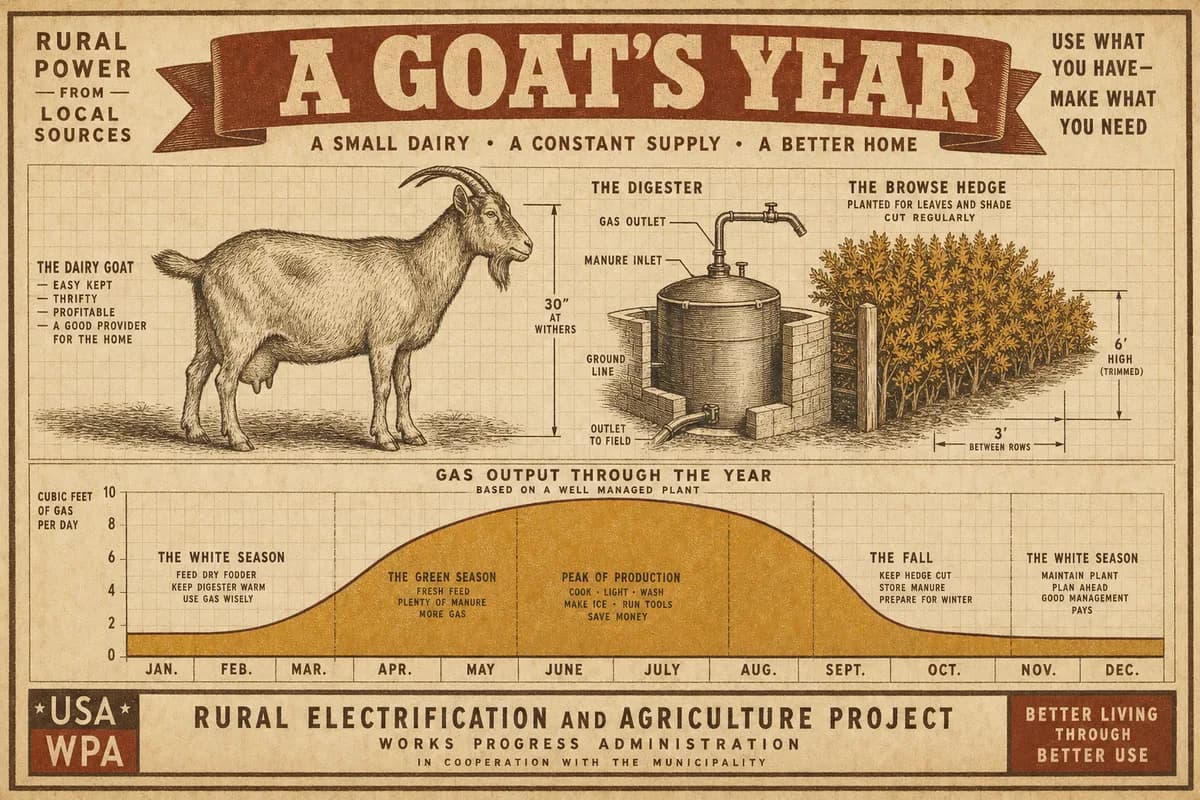
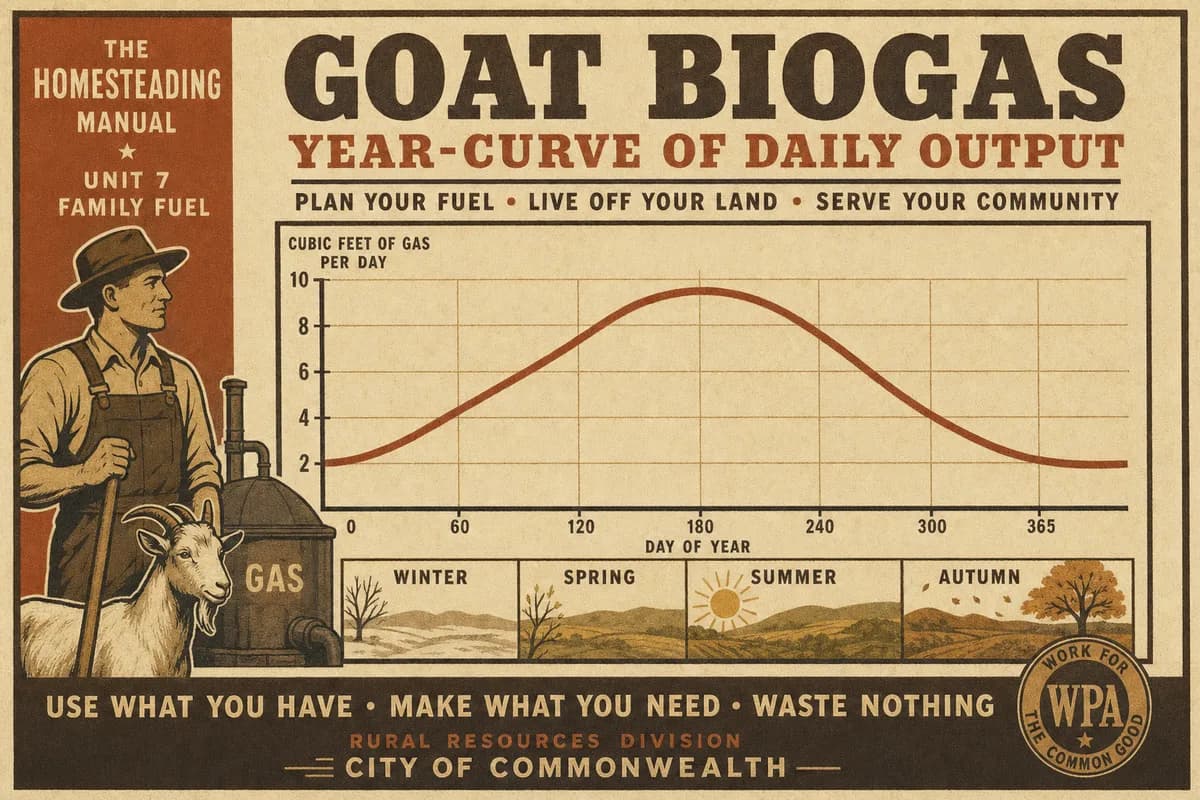
A goat is the most seasonal generator on the homestead. In the green months it browses richly, milks heavily, and feeds a digester well; in the white months it eats hay, dries off, and gives the drum a fraction of what it did in June. This guide traces that swing — where it comes from and how large it is — and lays out how to plan a household energy budget around an animal whose output rises and falls with the year. The gas is real in every season. It is simply never the same amount twice, and the honest homesteader plans for the trough, not the peak.
What you'll need
- A dairy or brush goat in good health, and an honest record of what it actually produces month to month — the seasonal curve is yours to measure, not to assume.
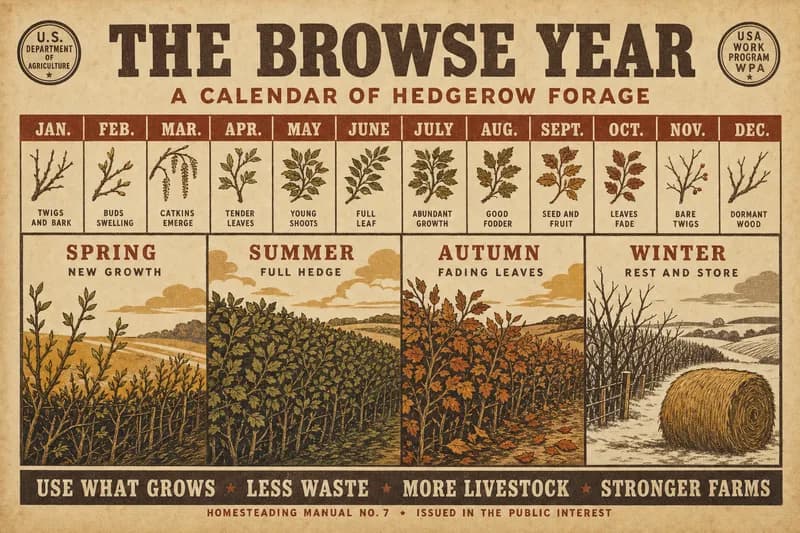
- Browse to carry the green season: a hedge, a brush lot, a rotation the goat can work through as the year turns.
- Stored winter feed — good hay — and the understanding that hay-fed manure yields less gas than browse-fed manure.
- A floating gas holder large enough to carry some of the summer surplus forward into the lean months.
- The insulation and stolen waste heat the digester needs to hold 35 °C in winter, because the season that starves the goat also chills the drum.
Steps
- Measure your own goat's year. Read the holder and the feed log month by month for a full year. Every homestead's curve differs with breed, browse, and climate; plan on the one you record, not the one in a table.
- Budget to the trough. Size the loads you count on the goat to carry to its worst month, not its best. A winter budget built on a June yield fails every January.
- Bank the summer surplus. In the green season the goat makes more gas than the kitchen burns. Carry that forward in the holder, or in the work it lets you defer, so some of summer reaches winter.
- Match feeding to the season. Browse in the green months, good hay in the white, and a lighter, warmer ration when the drum runs cold. A cold goat and a cold digester both want less at once.
- Let the herd, not the flame, do the scaling. If the winter trough is too deep for your needs, the answer is another animal or a stored reserve — never a bigger burner under a drum the goat cannot keep fed.
Sizing
Honest seasonal figures for one dairy goat and a well-established mesophilic drum, biogas at roughly six kilowatt-hours per cubic metre, net electrical after a twenty-percent generator conversion. The swing is driven by three things at once: richer browse in the green season, heavier milking, and a drum that holds temperature more easily in warm weather.
| Season | Feed | Fresh input/day | Biogas/day | Net electrical/day |
|---|---|---|---|---|
| Spring (fresh browse, in milk) | Rich | ~2.0 kg | ~100 L | ~0.12 kWh |
| Summer (full browse, peak milk) | Richest | ~2.2 kg | ~110 L | ~0.13 kWh |
| Autumn (browse fading, breeding) | Falling | ~1.5 kg | ~75 L | ~0.09 kWh |
| Winter (hay only, dried off) | Lean | ~1.0 kg | ~50 L | ~0.06 kWh |
Read the top and bottom rows together: a goat's deep-winter output is roughly half its summer peak, and that is before you count the extra gas the drum itself burns to stay warm. The lesson is the same one the whole department keeps arriving at — you do not fight the season by demanding more of the animal. You plan the budget around the month it gives least, and treat every litre above that as the surplus it is.
Maintenance & safety
- Do not overfeed a winter drum to chase a summer number. A cold digester fed a summer ration sours, and a soured drum is a spring project. Feed the season you are in.
- The season that starves the goat chills the drum. Insulate and steal waste heat before the first frost; the winter trough is deepest exactly when the digester can least afford to be cold.
- Respect the gas year-round. Output falls in winter but the hazard does not. Never store biogas indoors, keep the Fart Scrubber 3000 charged, and never chase a suspected leak with a lit match.
- Trust the record over the memory. Last July's holder is not this January's. Keep the log, and let it, not your recollection of a good month, set the winter budget.
Expected output
A goat is not a steady appliance; it is a seasonal one, and the homesteader who budgets its June for its January is disappointed twice — once in the cold, and once at the arithmetic. Kept and read honestly, a single goat will pour gas into the holder all green season and slow to a trickle in the white one, and both are the animal working exactly as it should.
Plan for the swing and it becomes a strength: bank the summer surplus, budget the winter loads to the trough, and let the goat be generous when it can and modest when it must. The homesteads that run calmly on goat energy are never the ones that expected a flat line. They are the ones that learned the shape of their animal's year and built the household to fit it.