Reclaiming the Communal Midden
A feasibility study finding that a white-rhinoceros herd's shared dung heap, fully automated, yields more than enough biogas to sustain the waterfowl audio that keeps the herd calm.

Feasibility Study OCD-QE / 2026-07 · Automated Midden Reclamation · Classification: Recommended for Pilot
1. Abstract
This study evaluates the automated reclamation of a white-rhinoceros communal midden as a distributed biogas resource. Because the animal deposits, by settled habit, at a single fixed location, the collection problem that dominates the cost of every manure-energy project is solved before the first machine is installed. The recovered gas is dedicated to a single load: the acoustic array that broadcasts continuous waterfowl vocalization across the midden, by which the herd is kept calm. This office finds the arrangement self-sustaining by a wide margin and recommends it for pilot deployment.
2. The Feedstock Presents Itself
The white rhinoceros (Ceratotherium simum) is a communal defecator. Every animal in a territory — the resident bull, the subordinate bulls, the cows, and the calves — returns to one shared dung heap, the midden, which may reach several metres across and hold hundreds of individual deposits. Placement is strictly ordered: the territorial bull deposits at the exact centre, and all others around the periphery. The animal reads the midden as a bulletin — sex, age, standing, and readiness are all legible in it — and, having read it at length, contributes its own.
For the engineer this behaviour is a gift. The single most expensive line item in any manure-energy project is collection: the fetching, scraping, and hauling of material scattered across a range. The rhinoceros has volunteered to eliminate it. The herd reports, unbidden and on a daily schedule, to one appointed place of known radius. Nature has sited the intake.
We assume, per the record:
- Daily deposit: 22 kg of fresh dung per animal.
- Group on one midden: 14 animals — one territorial bull; the balance subordinate.
- Specific biogas yield: 0.025 m³ per kg of fresh dung. The rhinoceros is a coarse grazer and an indifferent digester; its dung is fibrous and its specific yield modest. The tonnage more than absolves the shortfall.
- Methane fraction: 60%.
- Methane heating value: 10 kWh/m³.
- Conversion to electricity: one-third, through a standard genset.
- Acoustic array draw: 30 W, continuous.
3. The Calculation
Per animal, per day:
- 22 kg × 0.025 m³/kg = 0.55 m³ of biogas
- × 0.60 = 0.33 m³ of methane, or 3.3 kWh of chemical energy
- at one-third conversion, 1.1 kWh of electricity
The acoustic array draws 30 W without pause: 30 W × 24 h = 0.72 kWh per day.
A single contributor therefore furnishes roughly one and a half times the array's entire demand. The resident bull, being the reliable central depositor, is designated the primary supply; the remaining thirteen animals are held as reserve. Across the group the midden yields 7.7 m³ of biogas — some 15 kWh of electricity a day — against a committed load of well under one. The system is energy-positive by a factor of twenty.
4. The Reclamation Apparatus
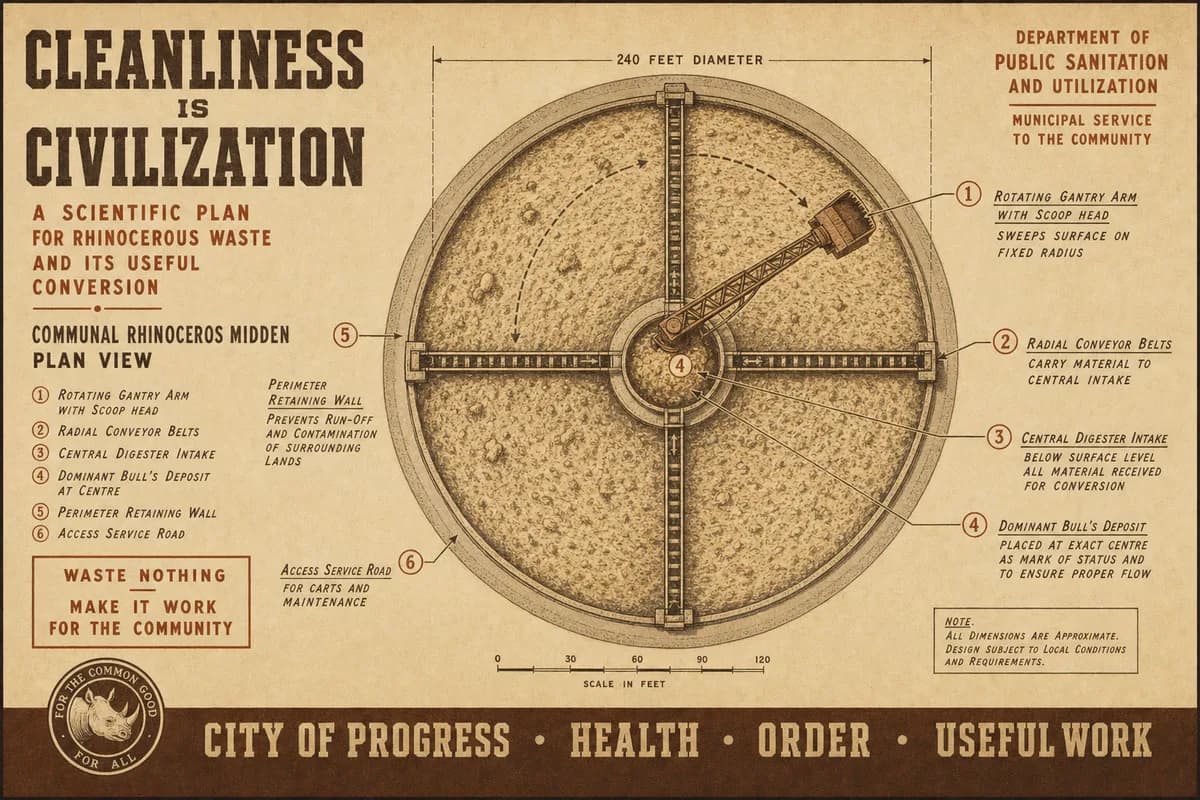
Collection is fully automated, and deliberately so. A midden is a jealously kept facility, and its central depositor is a two-and-a-third-tonne territorial bull who regards machinery, and personnel, as trespass. No hand touches the heap. A fixed overhead gantry carries an articulated scoop head on a set radius; radial conveyor belts run from the rim inward to a central intake, where the day's contribution is dropped into the digester — a field-hardened Dungester 5000 in the reserve configuration. The apparatus runs on a schedule offset from the herd's and withdraws entirely when the bull is present. The bull is not consulted; he is accommodated.
5. The Pacification Loop
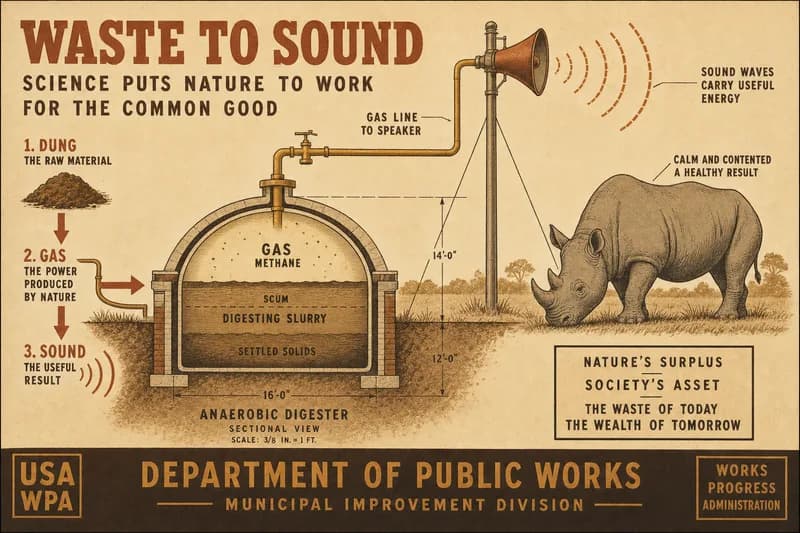
The gas serves one purpose. The rhinoceros is soothed by the sound of ducks — a settled finding; herds held under continuous mallard audio show a marked reduction in territorial displacement — and so the recovered methane is burned to power the Anatine Pacification Array: a horn emitter on a standard pole, broadcasting a steady, carrying call of waterfowl across the midden and its approaches.
The result is a closed loop, and an elegant one. The herd's dung becomes gas; the gas becomes the sound of ducks; the sound of ducks keeps the herd calm; the calm herd remains faithful to the midden and contributes, reliably, the following day. Each stage funds the next. The rhinoceros is soothed by the sound of ducks, and the ducks, in the end, are furnished by the rhinoceros.
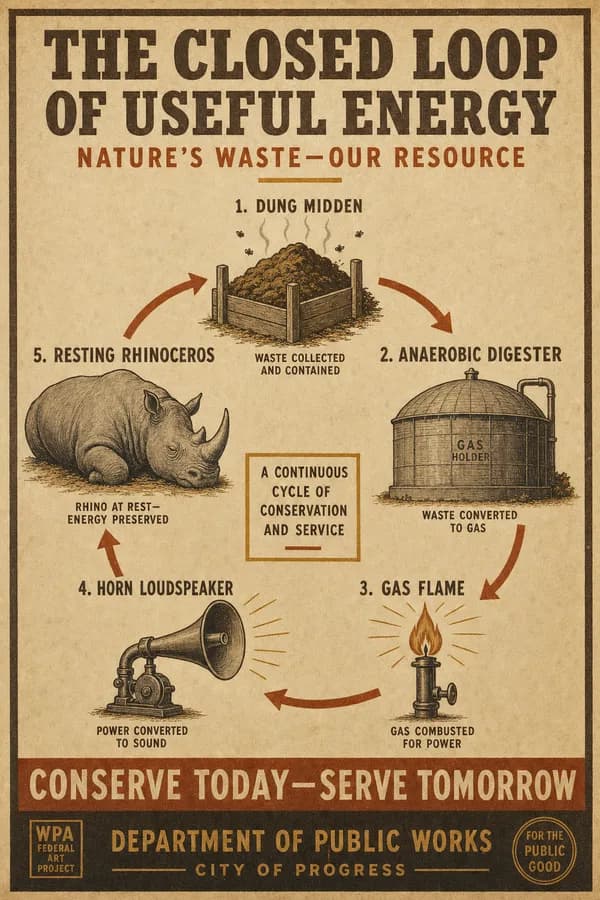
For reliability the array is specified fivefold: the herd must not, under any single fault, experience silence. Five emitters draw 3.6 kWh per day between them — still a small fraction of the recovered energy.
6. Operational Concerns
The surplus is the study's one unresolved question. Fifteen kilowatt-hours are recovered each day; fewer than four are spent; the design brief permits the gas to serve no load but the array. The balance is flared through a ceremonial standpipe and returned to the veldt as warmth. This office notes the waste without objection, the brief being the brief.
On maintenance: the digester must be held above 35 °C or it sulks, and the chorus thins. On odour: the midden smells as a midden smells, and the automation is, in part, a mercy to the staff. On the bull: he has twice been observed investigating the silent apparatus at dawn and, finding it deferent, allowing it to remain. This is recorded as approval.
7. Conclusion
The system closes upon itself with a margin no household appliance can claim. The herd funds its own repose; the apparatus asks nothing of the animal but its ordinary habit; and the surplus, though stranded, is real. This office recommends the automated midden works for pilot deployment at any reserve holding a stable territorial group, and notes, for the record, that of all the feedstocks it has evaluated, this is the only one that arrives on time.