Powering One Bitcoin Miner: A Contribution Audit
One Bitcoin miner draws three and a quarter kilowatts without pause; this audit sizes the contributing population needed to keep a single machine hashing.
From the series: How Much Poop Would It Take?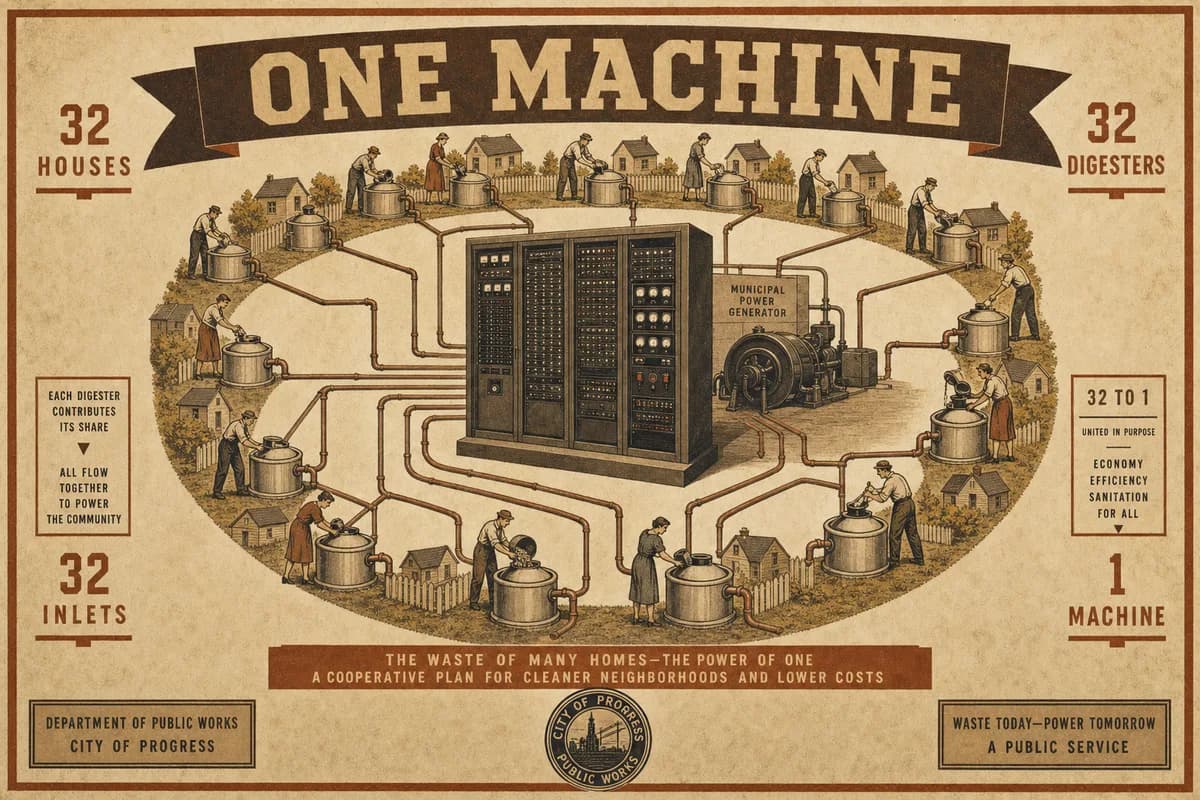
Abstract
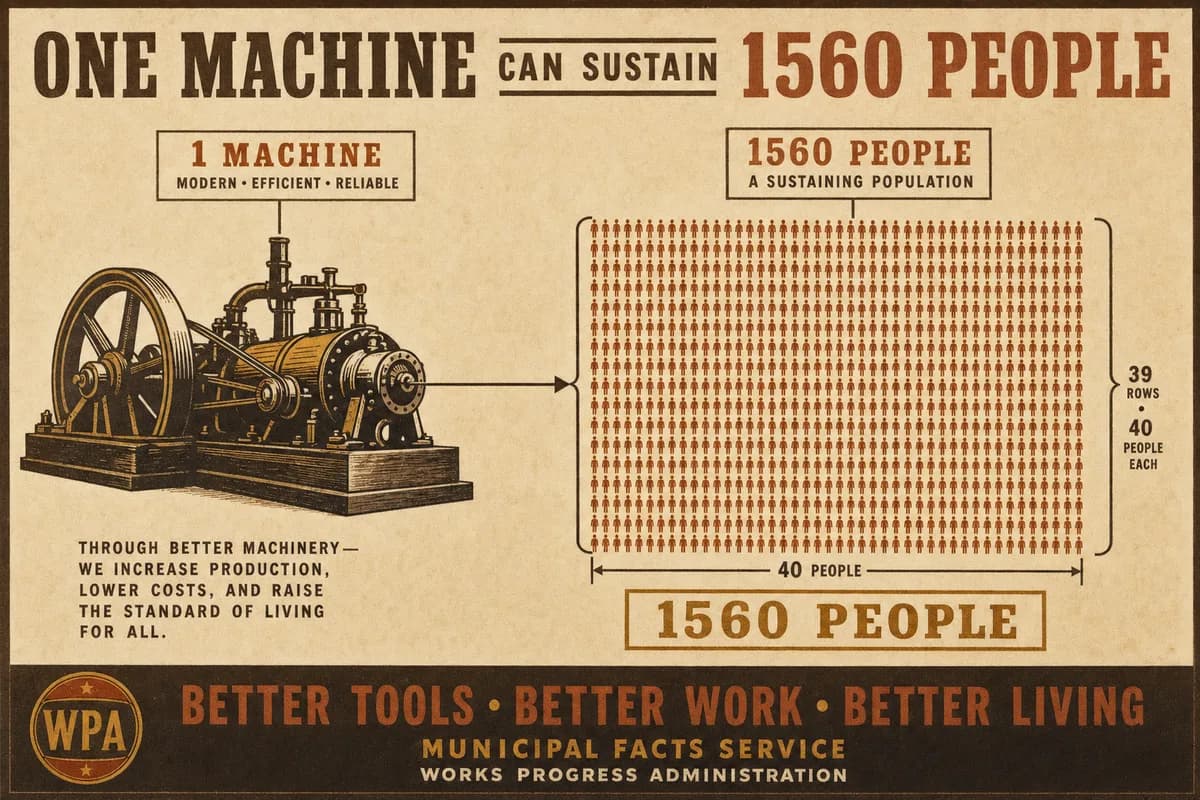
This audit answers a narrow procurement question: How much poop would it take to power one Bitcoin miner? We take a single modern application-specific machine at its rated draw, convert household digestive output to electricity by the standard chain, and determine the contributing population that must produce, daily and without interruption, to keep exactly one machine running around the clock. We find the figure to be 1,560 contributors in perpetuity, and we note that a lapse of any one of them is measured in seconds of lost hashing.
Assumptions
- The machine. One application-specific miner drawing 3.25 kW continuously, running the full 24 hours, for a daily appetite of 78 kWh and an annual appetite of about 28,500 kWh (28.5 MWh). The machine does not idle, sleep, or observe holidays.
- The standard daily contribution. As carried through this series: 0.5 kg wet per contributor per day, of which roughly 0.1 kg is volatile solids; at 0.3 m³ of biogas per kg, 6 kWh per m³ thermal, and 30% generator efficiency, one contributor yields 0.05 kWh of electricity per day, or about 18.25 kWh per year.
- The obligation. Continuous. The machine's demand is flat; the contribution is a once-daily batch. Reconciling a flat draw against a batched supply is the whole of the problem.
The Calculation
Sustaining the machine for one day requires
78 kWh ÷ 0.05 kWh = 1,560 contributor-days,
which, because the machine runs every day, must be supplied every day. The population is therefore fixed at 1,560 contributors, held in place indefinitely. The annual figures confirm it independently: 28,500 kWh of demand divided by 18.25 kWh of yearly output per contributor returns 1,560, the same population viewed across a year rather than a day.
The individual's share is best appreciated from the other direction. A contributor's daily 0.05 kWh, applied to a machine drawing 3.25 kW, sustains it for
0.05 kWh ÷ 3.25 kW = 0.0154 hours = 55 seconds.
A single contributor, giving everything, keeps the machine hashing for fifty-five seconds a day. The remaining twenty-three hours, fifty-nine minutes, and five seconds fall to the other 1,559.

Operational Concerns
Firmness. A mining operator values firm power above cheap power, and a contributing population is the least firm supply known to the Bureau. Output falls on weekends, rises during Fiber Week, and collapses entirely on the morning after a poorly attended Soup Night. The machine, indifferent to the civic calendar, simply throttles or halts, and a halted machine earns nothing while its share of the difficulty adjustment is redistributed to competitors on firmer supply.
Storage. Bridging the gap between a batched contribution and a continuous draw demands a gas holder sized for at least a day of reserve, plus a Fecal Load Balancer configured to shed household loads before it sheds the machine — an inversion of the usual dispatch order that most households will find disagreeable, as it prioritizes the miner over the kettle.
Standing. The Office of Civic Digestion classes a mining load as non-essential and will not count contributions routed to it against a household's obligation under the Residential Digestive Contribution Act. A household of four powering a share of one machine is therefore contributing twice: once to the machine, and once, again, to the grid it was trying to avoid.
Conclusion
One machine, run honestly, is the standing daily labor of a small town. Fifteen hundred and sixty adults, contributing without a missed day, keep a single rack alive; the same population, briefly distracted, lets it fall dark. The audit returns no configuration in which household contribution powers a miner at a profit, or indeed at a net anything, once the gas holder, the load balancer, and the redirected obligation are entered on the ledger. The Bureau's recommendation is that the 1,560 contributors power fifteen hundred and sixty water heaters instead, an application in which every one of them would be warm and none of them would be hashing.