How Much Poop Would You Need to Burn to Play Minecraft?
A feasibility study of the residential brown-energy load imposed by one block-based civilization, from single-player survival to a modded server.
Abstract
This paper estimates the residential fuel requirement for playing Minecraft on power derived exclusively from combusted household solids. We model the full chain — display load, small-scale steam conversion, feedstock drying, and demand growth from single-player to multiplayer — and report the result in the field's natural unit, the person-day of output. We find that single-player survival is achievable at the scale of a committed household, that daily play requires the coordinated output of a subdivision, and that a modded multiplayer server passes out of the residential regime entirely and into livestock.
Assumptions
- Display load. A mid-range gaming tower under a modded load draws 450 W; add a 50 W monitor for a system draw of 500 W at the wall. We hold this flat; the honest reader may add a fan.
- Session. One canonical session is four hours, giving 500 W × 4 h = 2.0 kWh, or 7.2 MJ of electricity per session.
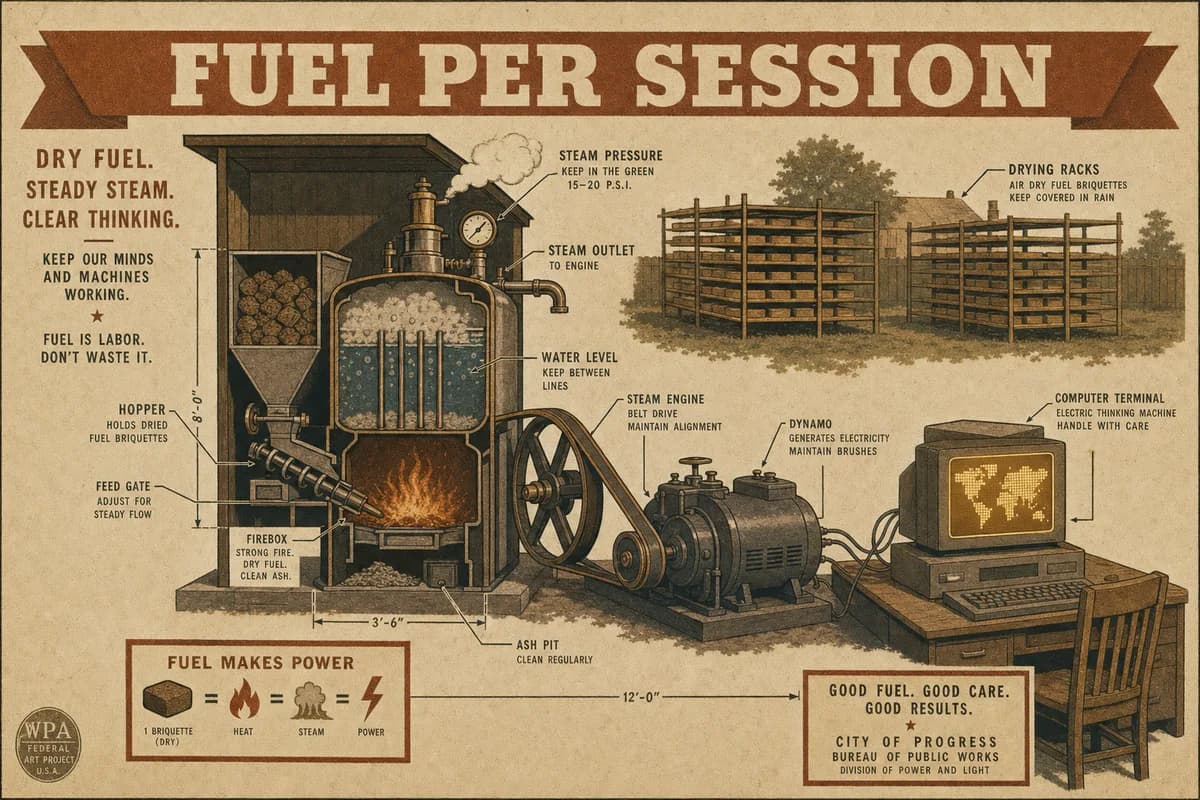
- Conversion. Boiler-to-busbar efficiency of a backyard steam plant — a fired drum, a reciprocating engine, and a salvaged automotive alternator — is taken as 2%, a figure we regard as heroic and do not defend.
- Fuel. Dried human solids have a higher heating value of 17 MJ/kg, comparable to seasoned wood. We assume complete combustion, which the drying yard exists to make possible.
- Supply. One contributor produces roughly 128 g of fresh material daily at 75% moisture, which reduces on the drying yard to 32 g of dry fuel per person per day.
The Calculation
Begin at the wall and work backward to the source. A four-hour session consumes 7.2 MJ of electricity. At 2% conversion, the boiler must liberate 7.2 MJ ÷ 0.02 = 360 MJ of heat. At 17 MJ/kg, that heat requires 360 ÷ 17 = 21.2 kg of dry fuel per session.
Converted to the field unit, 21.2 kg ÷ 0.032 kg per person-day = 662 person-days of output for a single four-hour session. The result is best absorbed as a table.
| Play pattern | Dry fuel demanded | In contributors |
|---|---|---|
| One session (once) | 21.2 kg | 662 person-days |
| Household of four | 21.2 kg | ~166 days of collection |
| One session weekly | 3.03 kg/day | ~95 contributors |
| One session daily | 21.2 kg/day | ~662 contributors |
The household line is the finding most readers came for. Four people, contributing without exception and diverting nothing to the garden, accumulate one session's fuel in 21.2 ÷ 0.128 = 166 days — roughly two funded sessions per calendar year. To sustain daily single-player play, a neighborhood must field 662 daily contributors: a large subdivision, mobilized in full.
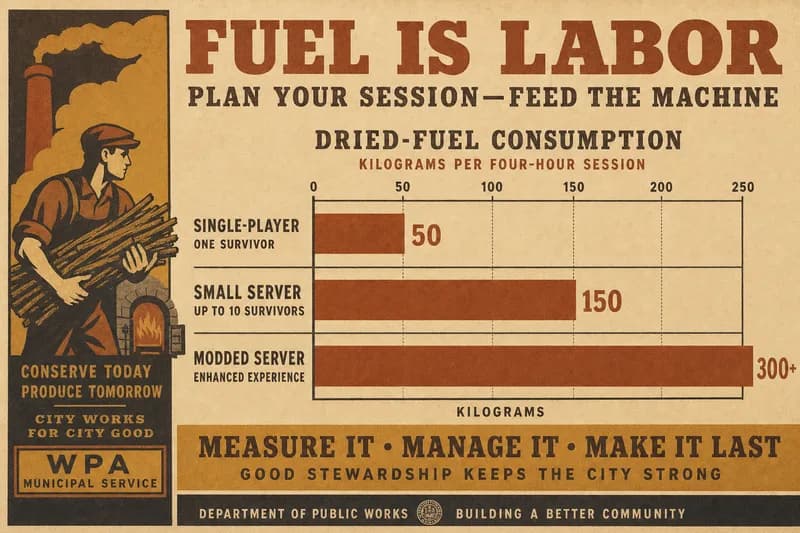
The three service classes are plotted for comparison.
Operational Concerns
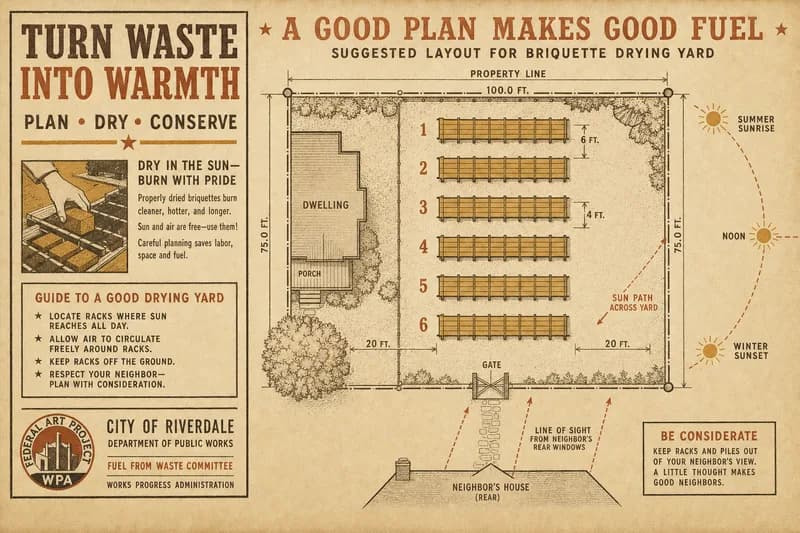
The drying yard. Fuel arrives at 75% moisture and must reach the boiler dry. Each session's 21.2 kg of fuel begins as roughly 85 kg of fresh material, of which some 64 kg is water that must leave before combustion. For daily play, budget a south-facing drying apron on the order of a two-car driveway and accept that a single afternoon shower returns the yard to zero. Sequence the racks; a covered drying shed converts a weather dependency into a throughput constraint, which is the better of the two problems.
Multiplayer demand. A modded server is not a session; it is a continuous load. A capable host draws 300 W around the clock — 300 W × 24 h = 7.2 kWh, or 25.9 MJ of electricity daily. Through the same 2% plant that is 25.9 ÷ 0.02 = 1,296 MJ of heat, 76.2 kg of dry fuel, and 2,382 person-days of output every day, in perpetuity. Login events compound this: when twenty players load the same chunk for a scheduled build, the transient draw spikes well above the flat host figure, and a fired boiler cannot follow a spike. Size to the peak and bank fuel against it, exactly as a utility banks spinning reserve.
Compliance. A residential drying yard and fired boiler fall under the Residential Digestive Contribution Act and are visible to your neighbors. File the accessory-appliance permit before the first burn; route flue gas through a Fart Scrubber 3000 to keep the combustion products within the setback; and confirm with the Office of Civic Digestion that diverting household output to a private boiler does not short your metered obligation to the Municipal Fart Grid. Households drawing from grid feedstock during a declared Demand Defecation window should expect their session to be curtailed first.
A plan of the recommended drying-yard arrangement follows.
Conclusion
Single-player survival mode is achievable and always was, provided the player accepts that a four-hour session is a semiannual event for a household of four, a weekly one for a city block, and a daily one only for a fully committed subdivision. The modded multiplayer server is a different animal, and the arithmetic names it plainly: 2,382 person-days a day is beyond the reach of any household and is met, in practice, by roughly seventeen dairy cows run continuously, by the coordinated civic output of a small town, or by a single well-attended chili cookoff, whose transient-output economics we treat in a separate study. We recommend beginning in survival mode. The server can wait for the herd.
We close with the contribution interval, rendered day by day.