Overwintering the Dungester 5000: Keeping Your Digester Warm Through Winter
A seasonal owner's guide to holding your Dungester 5000 at 35 °C through a real winter, and honest expectations for what a cold-climate drum will and will not produce.
Overview
Winter is the season the Dungester 5000 fights you. The culture inside is a colony of methanogens that only feed above about 35 °C; let the drum cool and they slow, stall, and stop turning your waste into gas — and a stopped digester is just a sealed barrel of everything you put into it, waiting for spring. This guide is the owner's seasonal manual: how to hold the vessel at temperature through a real freeze, where to steal the heat to do it, and what one household drum will honestly still produce when the weather has turned against it.
The goal of overwintering is not a good January yield. The goal is a living culture in March. Keep that distinction and the season goes well.
What you'll need
- A 36-inch dial thermometer or a sealed probe reading the slurry core, checked daily — the core temperature is the only number that matters this season.
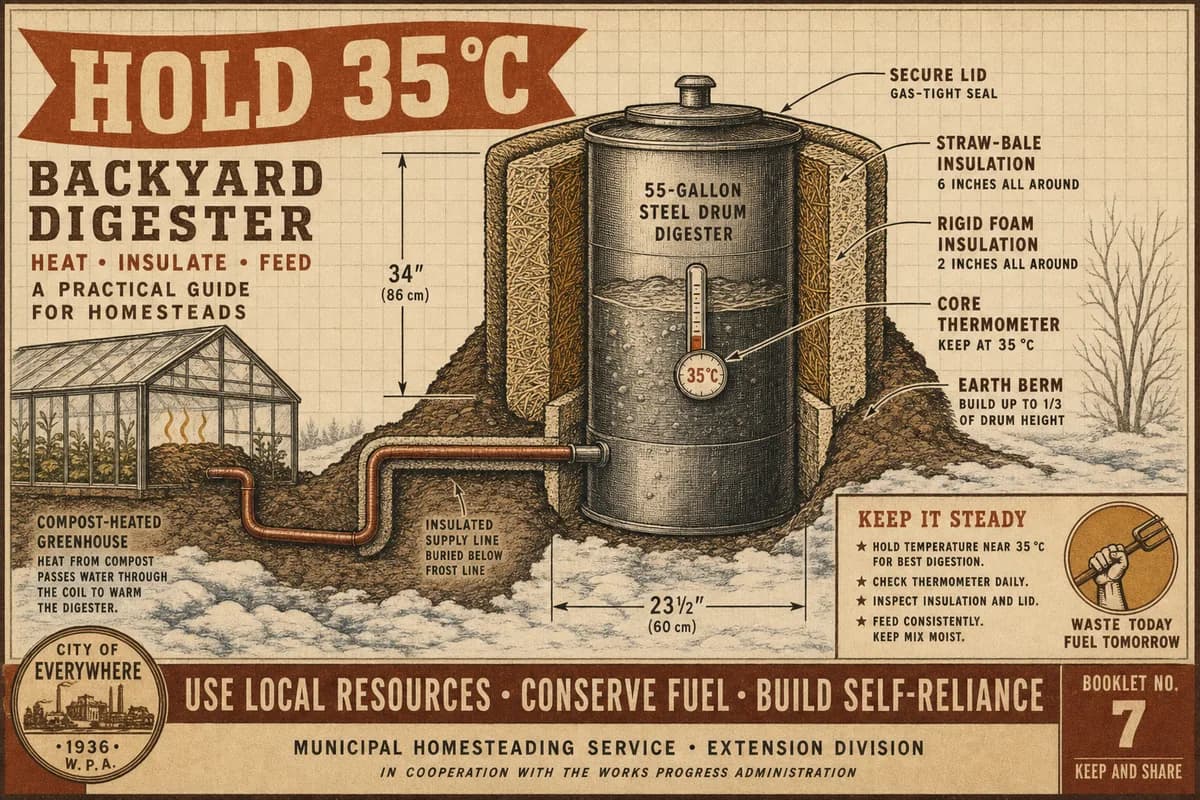
- Insulation to at least R-20 on the vessel walls, and more over the exposed top: rigid foam board, straw bales stacked around the drum, or earth banked against the lower third.
- A waste-heat source, in rough order of honesty: adjacency to a Turd Furnace; a coil off the Brownwall Powerwall; the recovered warmth of the Sewer-Source Heat Pump; or, last and least efficient, a low-wattage immersion heater on a thermostat.
- A weatherproof jacket or a small unheated enclosure to keep wind and snow off the vessel.
- A lighter, warmer winter feed: a bucket to temper the daily ration to blood heat before it goes in.
Steps
- Insulate before the first frost, not after it. Wrap the walls to R-20, cap the top thickest of all, and berm earth against the base. Insulation is free heat you already have; every degree it holds is gas you do not have to burn to replace.
- Cut your surface losses. A single compact, well-lagged drum loses far less per litre than the same volume spread thin. If you run more than one Dungester 5000, cluster them and jacket them together so they warm each other's walls instead of the sky.
- Steal waste heat; do not manufacture it. Park the vessel against the Turd Furnace and share its warmth; run a Brownwall Powerwall coil through the jacket; tie in the Sewer-Source Heat Pump. Burning your own scarce winter biogas to heat the digester that makes it is a loop that barely closes, and in a hard freeze does not close at all.
- Feed lighter and warmer. A cold culture cannot process a full ration. Cut the daily charge, temper it to blood heat before it goes in, and never dump cold feed into a cool drum — overfeeding a cold digester sours it, and a soured drum is a spring project.
- Read the core every day. Above 35 °C the culture feeds; between 20 and 35 °C it merely survives; below 20 °C nothing you do that week will bring it back quickly. Trend the number, and act on the trend before the vessel reaches the floor.
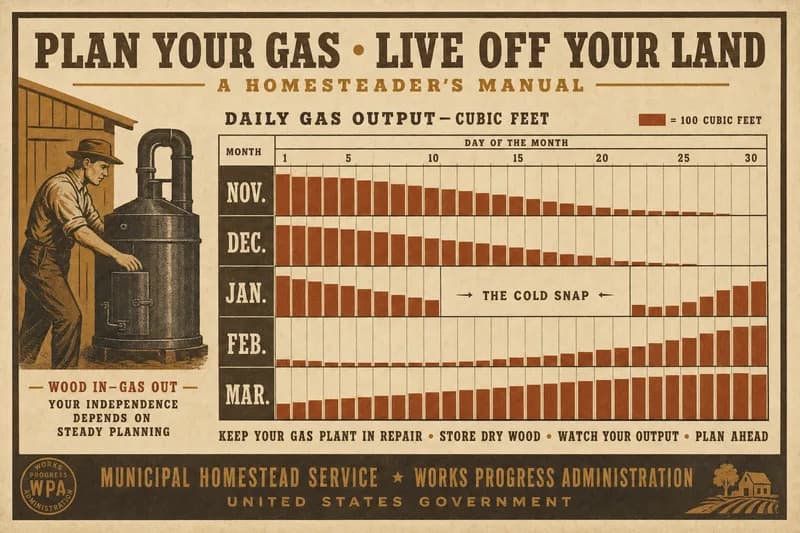
- Accept the season when it arrives. When the heat needed to hold 35 °C approaches the day's yield, stop chasing production. Hold the culture alive, burn the little gas you make on the Farm-to-Fart Range, let the Fecal Load Balancer protect the essential circuits, and treat the deep-winter weeks as maintenance rather than output.

Sizing
The figures below are the honest heat-loss arithmetic for a single 55-gallon drum (about 2 m² of surface) held at 35 °C, set against the roughly one kilowatt-hour of usable energy a faithfully fed household drum yields in a day. The lesson is in the last column.
| Winter condition | Insulation | Heat to hold 35 °C | Share of a household drum's daily yield |
|---|---|---|---|
| 5 °C, mild | R-10 | ~0.8 kWh/day (~35 W) | ~80% |
| 5 °C, mild | R-20 | ~0.4 kWh/day (~17 W) | ~40% |
| −10 °C, hard freeze | R-10 | ~1.2 kWh/day (~50 W) | over 100% |
| −10 °C, hard freeze | R-20 | ~0.6 kWh/day (~25 W) | ~60% |
Read the bottom-left row plainly: a bare-to-modestly-lagged drum in a hard freeze spends more heat staying alive than it earns, which is the whole argument for insulation and for stolen waste heat. You do not win winter by making the drum work harder. You win it by asking it to hold less.
Maintenance & safety
- A digester does not die loudly. It cools, it slows, it stops feeding, and it waits — a sealed drum of everything you put into it, patient until spring. Keep it at 35 °C, or keep it company; a daily reading is the difference between a dormant culture and a dead one.
- Do not force-heat a soured drum. If the culture has stalled and gone sour, heat alone will not restart it on your schedule. Hold it, feed it lightly, and let it recover into the lengthening days.
- Respect the gas in a closed season. A jacketed, enclosed winter setup traps more than heat. Never store biogas indoors, keep the Fart Scrubber 3000 charged, and never bring a heater's ignition or a lit match near the vessel while chasing a suspected leak.
The owner who checks the core at two in the morning during the first hard freeze is not being excessive. They are doing the one job the season actually asks of them.
Materials Referenced in This Guide

poster No. 7
Poster No. 7 — Keep Calm and Digest On
Authorized archival reproduction of the Office of Civic Digestion's brownout-era morale notice. The most reproduced item in the Bureau of Renewable Discourse archive, and, until now, the least once-seen. Heavy print grain preserved for authenticity.
Expected output
Winter is the maintenance season, and the honest owner budgets it as one. A well-insulated, waste-heat-fed drum can hold its culture and still net a small surplus through a mild cold snap; a bare drum in a hard climate will spend its entire yield simply staying alive, and that is a fair trade if the alternative is a dead colony. Size your winter expectations to the coldest week, never the seasonal average.
What overwintering buys you is not any single frozen-January kilowatt-hour. It is continuity: come the thaw, a culture you kept above 35 °C resumes feeding without a restart, weeks ahead of a drum that went cold and had to be re-established from scratch. Keep the culture alive through the dark months and it will pay you back across every warm one that follows.