Who Gets Priority in a One-Bathroom Household?
Priority to the single household bathroom at the morning peak, tested against four theories of justice, yields a lexical rule this essay defends outright.
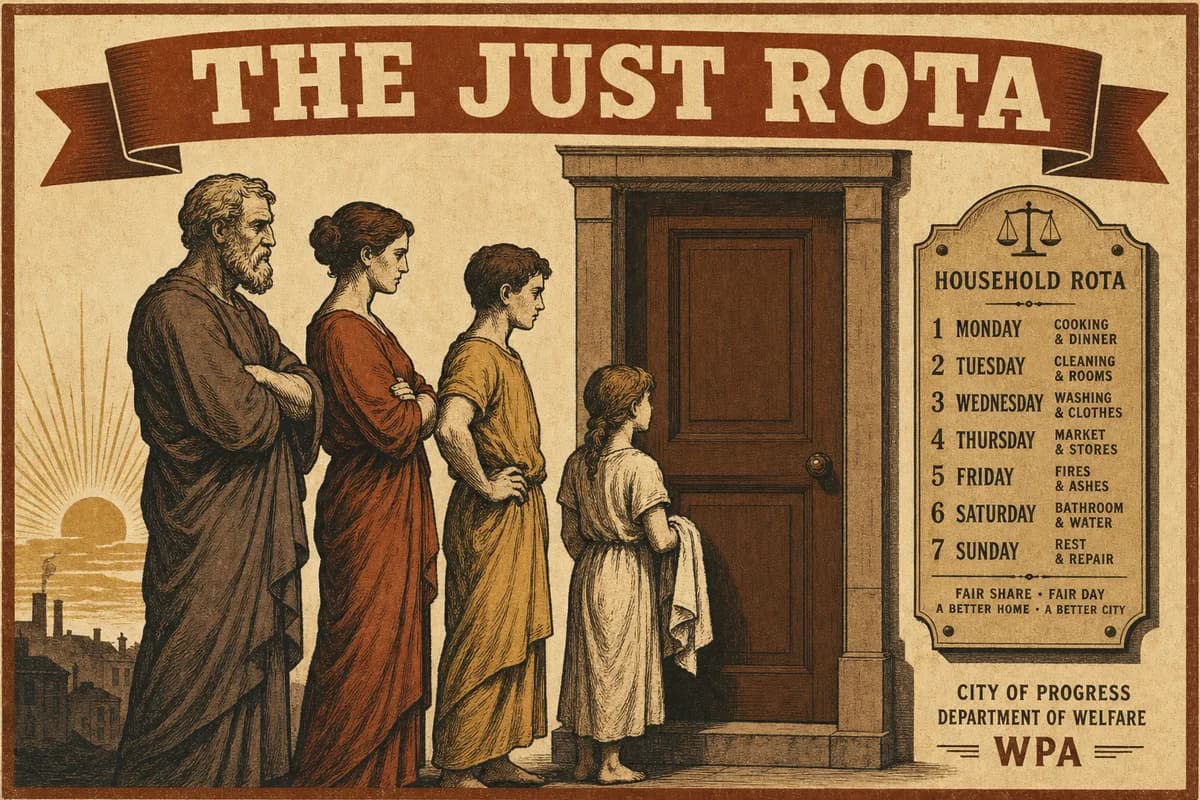
A household of four, one bathroom, seven o'clock in the morning. The good is scarce, indivisible, and demanded simultaneously by more claimants than it can serve; the stakes for each range from convenience to genuine distress. This is not a domestic annoyance dressed up as philosophy. It is a distribution problem of the purest form, isomorphic to the ones over which the theory of justice has fought its largest battles, and it can be adjudicated by the same instruments. I survey four, and then, as the occasion demands, rule.
First Possession
The intuitive answer is the libertarian one: the bathroom belongs, each morning, to whoever reaches it first. On Nozick's entitlement theory a holding is just if justly acquired, and first appropriation from an unowned state is the paradigm of just acquisition (Nozick 1974, ch. 7). The early riser has, by rising, mixed the relevant effort and earned his tenure; the latecomer has a grievance against his own alarm clock and no one else. The rule has the great merit of requiring no deliberation and no authority to enforce. It has the corresponding defect that it is indifferent to need: it will hand a leisurely twenty minutes to the first-arriving member with nowhere to be and turn away, behind him, a member in acute distress or under a hard external deadline. First possession is a rule of order, not of justice, and the two come apart precisely at the cases that matter.
Greatest Need
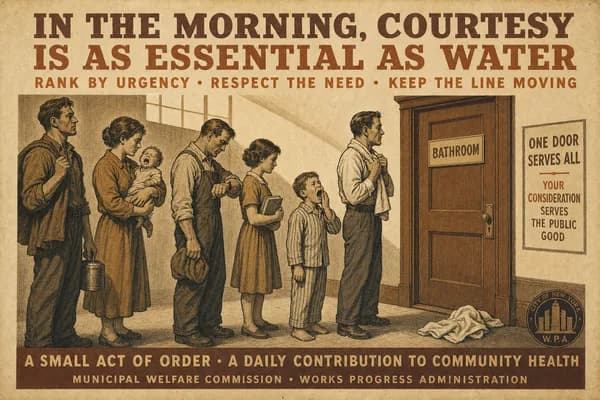
The medical tradition supplies the opposing principle: triage, the allocation of a scarce resource by urgency rather than arrival, so that the most acute case is served first regardless of who queued when. On this rule the member with the pressing biological emergency, or the one whose bus departs in nine minutes and whose absence costs a job, takes precedence over the comfortable early riser. Triage tracks what first possession ignores — that the value of the bathroom-minute is wildly unequal across claimants, catastrophic for one and trivial for another — and a utilitarian aggregation endorses it, for serving the desperate first plainly maximizes the household's total welfare (Bentham 1789). Its weakness is symmetrical to possession's strength: it requires judgments of urgency that the urgent are motivated to exaggerate, and it offers no guidance at all when two claims are equally acute.
The Veil of Ignorance
Rawls supplies the procedure for choosing between these rules without rigging the choice. Imagine the household legislating its morning constitution behind a veil of ignorance, each member ignorant of which member he will turn out to be, of his age, his authority, his schedule, and above all the state of his bowels on any given morning (Rawls 1971, §24). What queue-discipline would rational parties choose from behind that veil? Not first possession, which a heavy sleeper or a person prone to emergencies would be mad to gamble on. Not brute seniority, which one might wake up junior to. They would choose, Rawls's difference principle predicts, the rule most favorable to the worst-off position — the member in acute need — since any of them might occupy it (Rawls 1971, §13). Behind the veil, not knowing which member you will wake as or in what condition, you would not gamble on seniority; you would insure against catastrophe. The maximin logic delivers triage, but now as a principle of fairness rather than mere aggregate welfare: priority to the most desperate is what free and equal members would unanimously adopt before knowing who they were.
The Tyranny of the Parent
Walzer adds the constraint that saves the rule from abuse. In Spheres of Justice he argues that different goods belong to different distributive spheres, each with its own proper criterion, and that injustice — "tyranny" — is the invasion of one sphere by the dominant good of another: when money buys what money should not buy, or when political power commands what it has no title over (Walzer 1983). Bathroom-time is its own sphere, and its proper criterion is need. It is therefore a tyranny, in Walzer's exact sense, when the good is seized instead by the household's dominant good — parental authority — the parent who commandeers the door by rank rather than urgency, converting a sphere that should answer to need into a colony of household power. The just household walls the bathroom off from authority as a liberal state walls the franchise off from wealth. Seniority may break a tie. It may not found a claim.
The Verdict
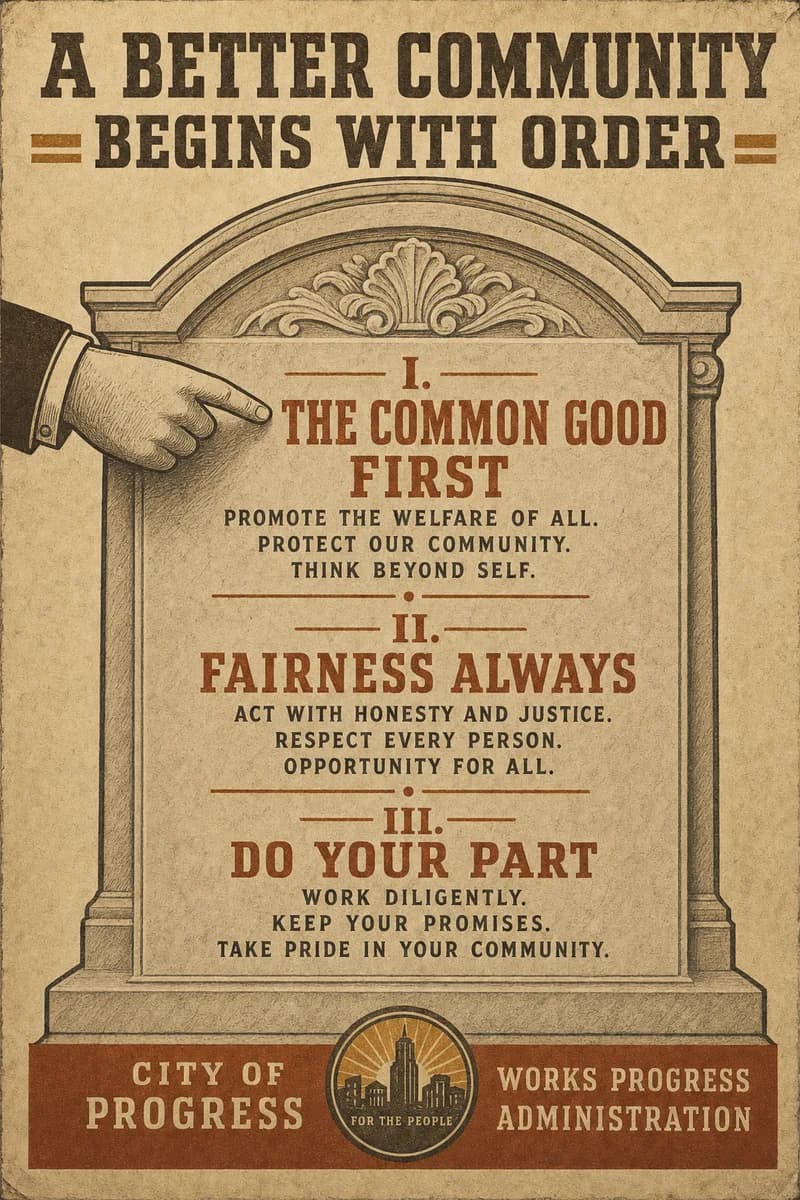
The theories, consulted in turn, assemble into a single ordered rule, and I state it without the hedging the subject usually attracts. First, acute need takes absolute priority — the biological emergency and the hard external deadline, adjudicated by triage, insulated by Walzer from capture by mere authority. Second, where needs are comparable, the difference principle counsels a rotation that protects whoever is worst-off across the week, not merely this morning, so that no member is permanently last. Third, and only as a tiebreaker among the genuinely equal, first possession governs: absent urgency or standing disadvantage, the early riser keeps his honest tenure. The rule is lexical — each tier is exhausted before the next is consulted — and it is, I submit, simply correct. The household that adopts it will find its mornings not only more just but, because just, quieter. The one that distributes by volume of complaint or seniority of voice has chosen, with open eyes, to run a small tyranny at the hour it can least afford one.
Works Cited
Rawls, John. A Theory of Justice. Harvard University Press, 1971. Nozick, Robert. Anarchy, State, and Utopia. Basic Books, 1974. Walzer, Michael. Spheres of Justice: A Defense of Pluralism and Equality. Basic Books, 1983. Bentham, Jeremy. An Introduction to the Principles of Morals and Legislation. 1789. Quilligan, T. Marisol. "Lexical Priority at the Household Peak: Triage, Rotation, and the Single Fixture." Journal of Applied Distributive Justice 9, no. 1 (2020): 40–71.