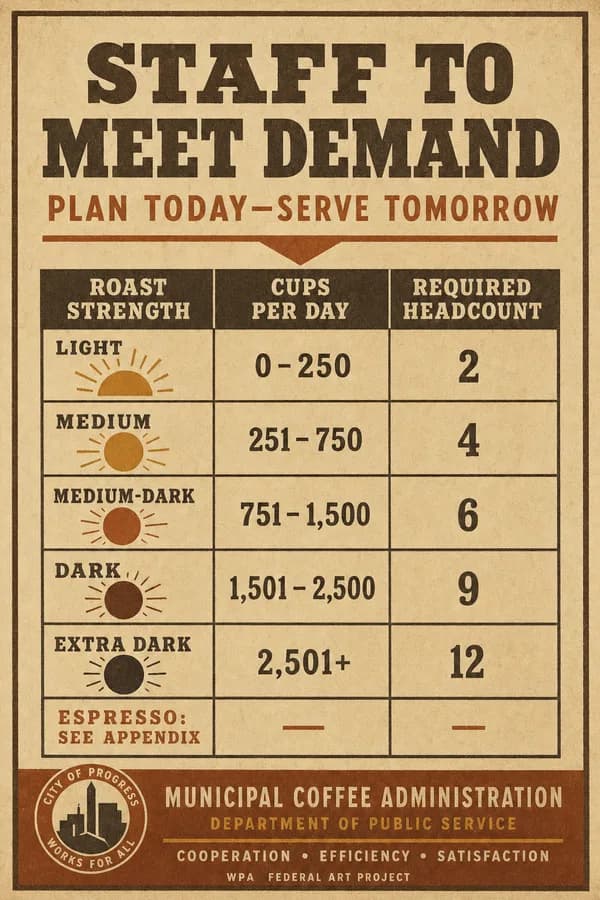
How Many Office Workers Does It Take to Run a Keurig?
A workplace contribution model setting one break-room pod machine against the metered output of a mid-size office floor, with staffing recommendations.
Abstract
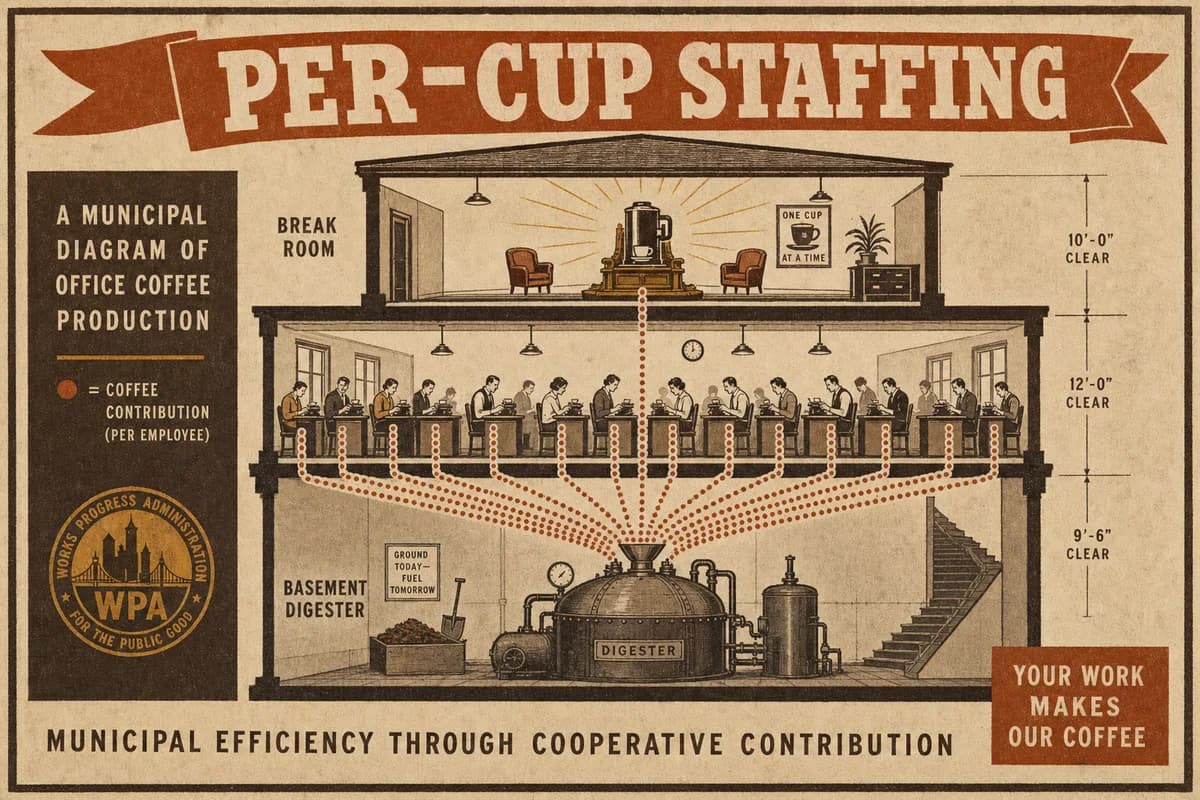
This paper estimates the staffing required to operate one break-room single-serve coffee machine on power derived from an office building's own metered contribution. We model per-cup demand against per-contributor daily yield through the building's combined heat-and-power plant, and report the result in the unit that matters to Human Resources: contributors per cup. We find that a single daily cup obligates the full metered output of roughly one and a quarter colleagues, and that a standard 150-person floor drinking to habit funds about a third of its own machine.
Assumptions
- The machine. A break-room pod brewer heats roughly 300 mL of water per cup from tap to brewing temperature and holds a hot tank between cups. Per cup, including tank losses, we take the electrical demand as 0.108 MJ — 0.03 kWh — a figure consistent with a 1,500-watt heater and an honest standby draw.
- The floor. A mid-size office of 150 employees, each metered to the building's plumbing during working hours.
- Per-contributor yield. A compliant contributor delivers 0.352 MJ of biogas thermal per day (see our household load studies); the building's continuously-run CHP plant converts at 25%, better than any backyard generator, giving 0.088 MJ of electricity per contributor per day.
- Habit. We model an average consumption of 2.5 cups per employee per day, spiked at the nine o'clock arrival and again after lunch. HR may substitute its own figure; the arithmetic scales linearly and the conclusion does not improve.
The Calculation
The core ratio is per-cup demand divided by per-contributor supply:
0.108 MJ per cup ÷ 0.088 MJ per contributor-day = 1.23 contributors per daily cup.
That is the finding in miniature. To fund one colleague's single daily cup, the metered output of one and a quarter colleagues must be committed to nothing else. Scaled to the floor:
| Quantity | Figure |
|---|---|
| Cups per day (150 staff × 2.5) | 375 cups |
| Demand (375 × 0.108 MJ) | 40.5 MJ / 11.25 kWh |
| Floor supply (150 × 0.088 MJ) | 13.2 MJ / 3.67 kWh |
| Fraction of habit self-funded | ~33% |
| Contributors required to fund in full | ~460 |
A 150-person floor therefore produces about a third of what its own coffee habit demands. Closing the gap requires the metered output of roughly 460 contributors — about three times the current headcount — or a corresponding reduction in the habit, which HR is not expected to enjoy proposing and the floor is not expected to enjoy hearing.
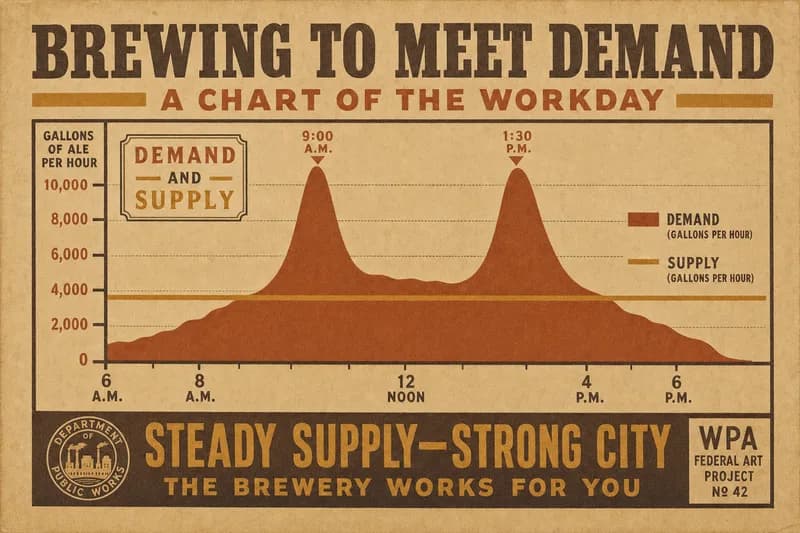
The demand curve above explains why additional hiring does not solve the problem cleanly. Supply is flat: contribution arrives steadily across the working day. Demand is not: it spikes at arrival and after lunch, and the machine cannot draw against contribution that has not yet been made. The nine o'clock spike is structural, it is the largest single load event on the floor, and it is funded, if at all, from gas banked the day before.
Operational Concerns
Capture. The per-contributor figure assumes the building meters a contributor's full working share. It does not always. A contributor whose schedule is misaligned with the building's hours delivers that share to a residential grid instead, and the floor's self-funded fraction falls below the third computed above. The remedy is longer hours, which we mention only to disclaim.
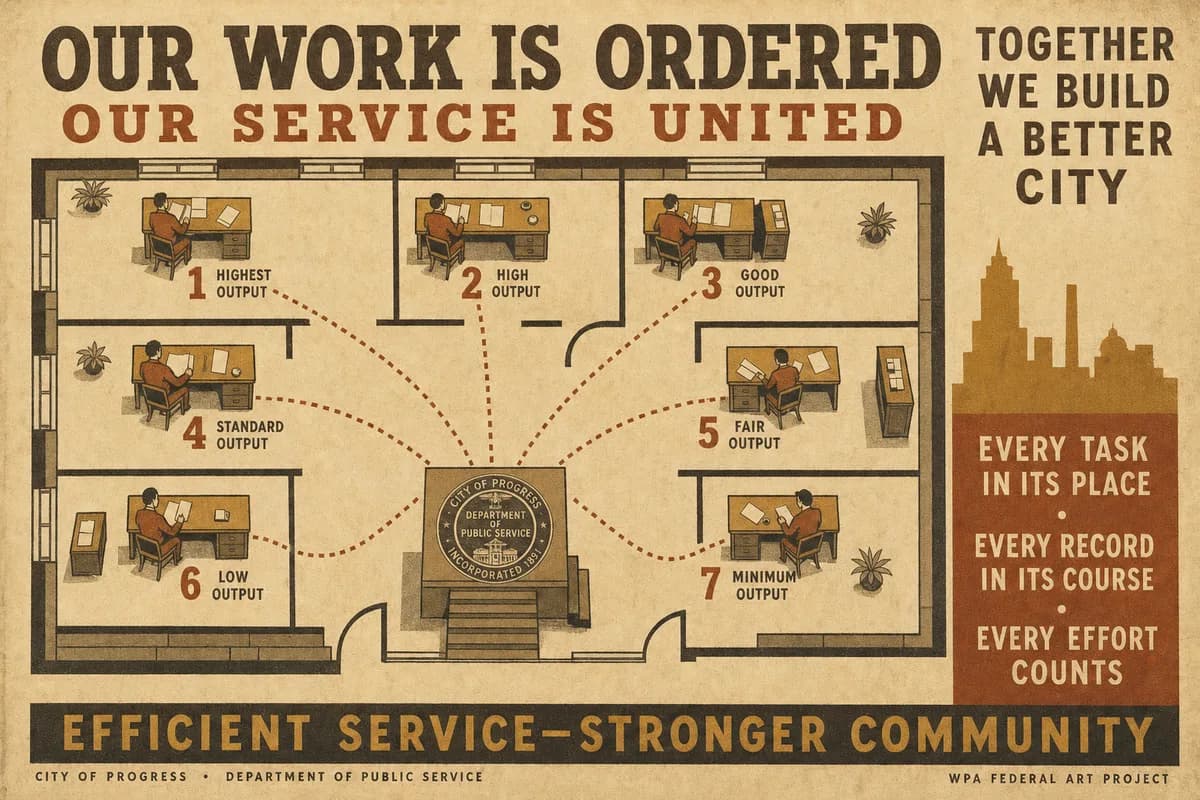
Zoning. Where contribution must be maximized, the standard floor plate is zoned into output tiers, with the higher-yielding desks positioned nearest the riser to reduce collection losses. Tier assignments are reviewed quarterly. We advise that they not be posted, that they not be tied to compensation, and that the phrase "output tier" not appear in any document an employee may lawfully request.
Compliance. The building's plant falls under the Residential Digestive Contribution Act in its commercial schedule and reports to the Municipal Fart Grid. A floor that runs its machine from banked gas during a declared Demand Defecation window will find the break room curtailed before the elevators. Route the CHP exhaust through a building-scale Fart Scrubber 3000 and confirm the break-room circuit sits low on the Fecal Load Balancer's priority list, beneath the servers and above nothing.
Conclusion
One break-room machine, run honestly on the floor's own output, obligates the full metered contribution of about one and a quarter colleagues per daily cup, and a standard 150-person floor drinking to habit funds roughly a third of its own supply. The remainder is drawn from the grid, from gas banked the day before, or from a reduction in either the habit or the headcount, and of those levers only one is ever pulled. We recommend, without expectation, that the machine be placed on the load balancer beneath every circuit that does actual work, and that espresso — whose staffing we found could not be reconciled with a floor of any size — be removed from the menu.