Can a Medieval Castle Run on Chamber Pots?
A retrofeasibility study converting a 400-occupant castle to chamber-pot district energy, benchmarked against the modern suburb it predates.
Abstract
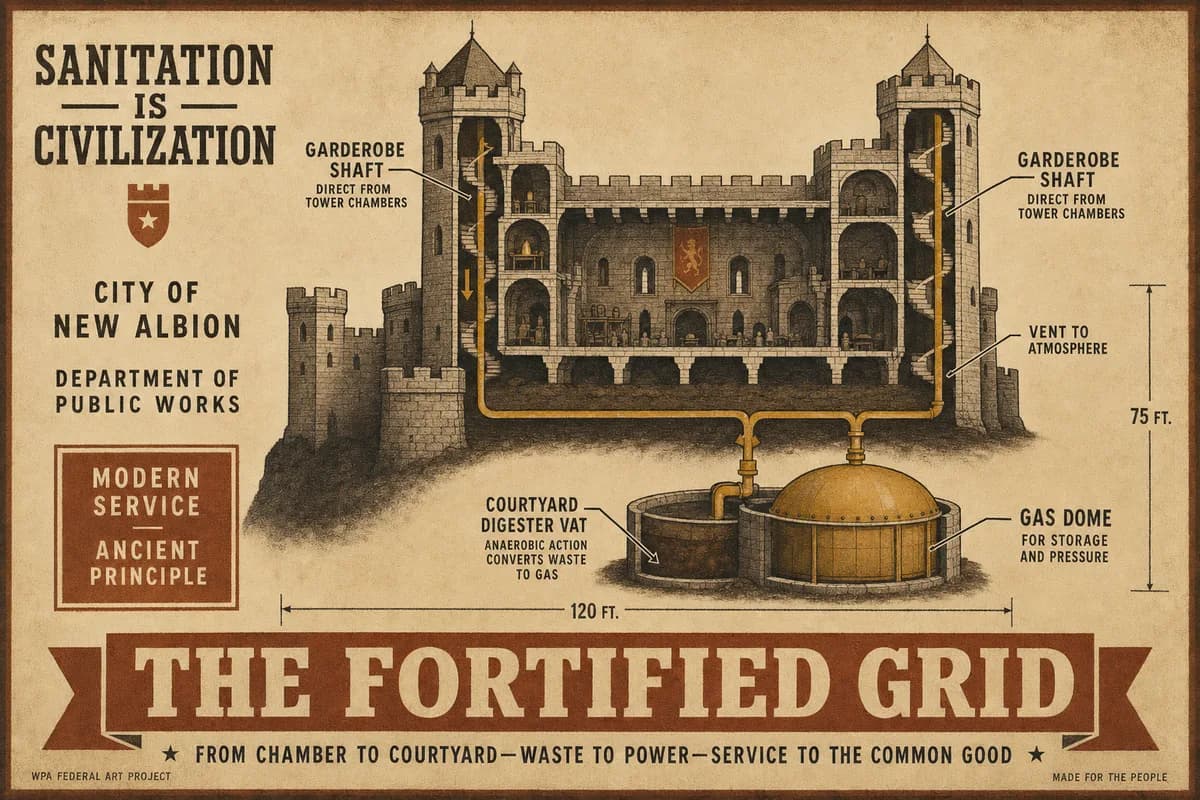
This paper assesses the conversion of a 400-occupant medieval castle to chamber-pot district energy, and benchmarks the fortress against the modern suburb of equal population it would someday become. We model daily collection, courtyard digestion, and useful output, and reach a divided finding: the castle is centuries ahead of the suburb on the logistics of gathering, and about the same distance behind it on everything that happens after the material reaches the vat. The garderobe shaft is the most advanced piece of infrastructure in the study, and it was built for another purpose entirely.
Assumptions
- The garrison. 400 occupants — household, garrison, servants, and the perennial guests a fortress cannot refuse. Each contributes at the standard rate of 0.352 MJ of biogas thermal per day once digested.
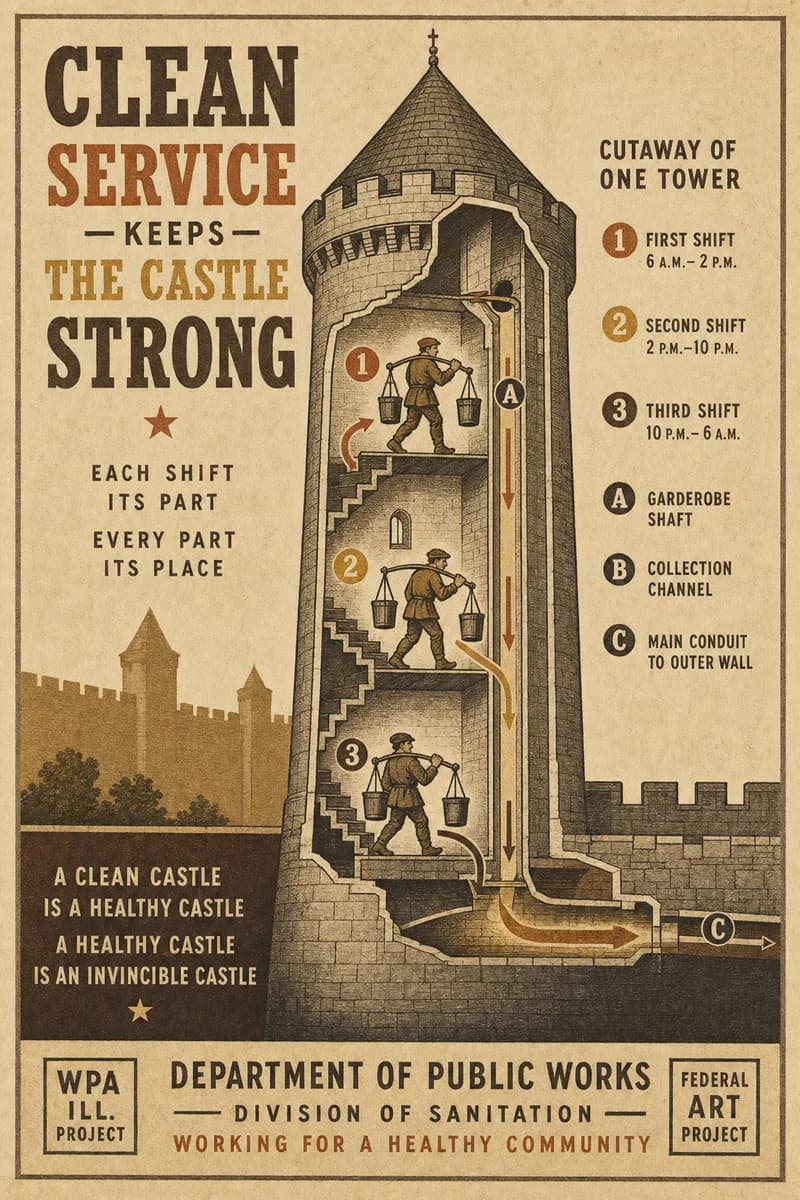
- Collection. Every tower is served by a garderobe shaft discharging by gravity to a common channel — vertical collection, requiring no transport energy and no cartage, only the porters who clear the channels on a three-shift rotation.
- The works. A covered courtyard vat receiving four outfalls, with a gas dome and a flare stack raised on the battlements. We assume the mason can seal stone against methane, which is the study's single most heroic assumption and is defended nowhere.
- The benchmark. A modern suburb of 400 residents — roughly 140 homes on horizontal streets, collected by pumped sewer or by truck.
The Calculation
Total daily output is 400 × 0.352 MJ = 140.8 MJ, or 39.1 kWh of biogas thermal per day. The number is best understood against the load it is asked to serve. A great-hall hearth and the kitchens that feed 400 people burn on the order of 200 kg of firewood daily — near 3,000 MJ at 15 MJ per kilogram. The works therefore supply
140.8 MJ ÷ 3,000 MJ = 4.7% of the kitchen's daily fire,
or, put in terms the seneschal will accept, enough to light the gatehouse and warm nothing. This is the finding downstream of the shaft, and it does not improve in winter, when the courtyard vat sits far below the 35 °C its bacteria require and the 140.8 MJ is halved by cold before it is halved again by the leaks in the dome.
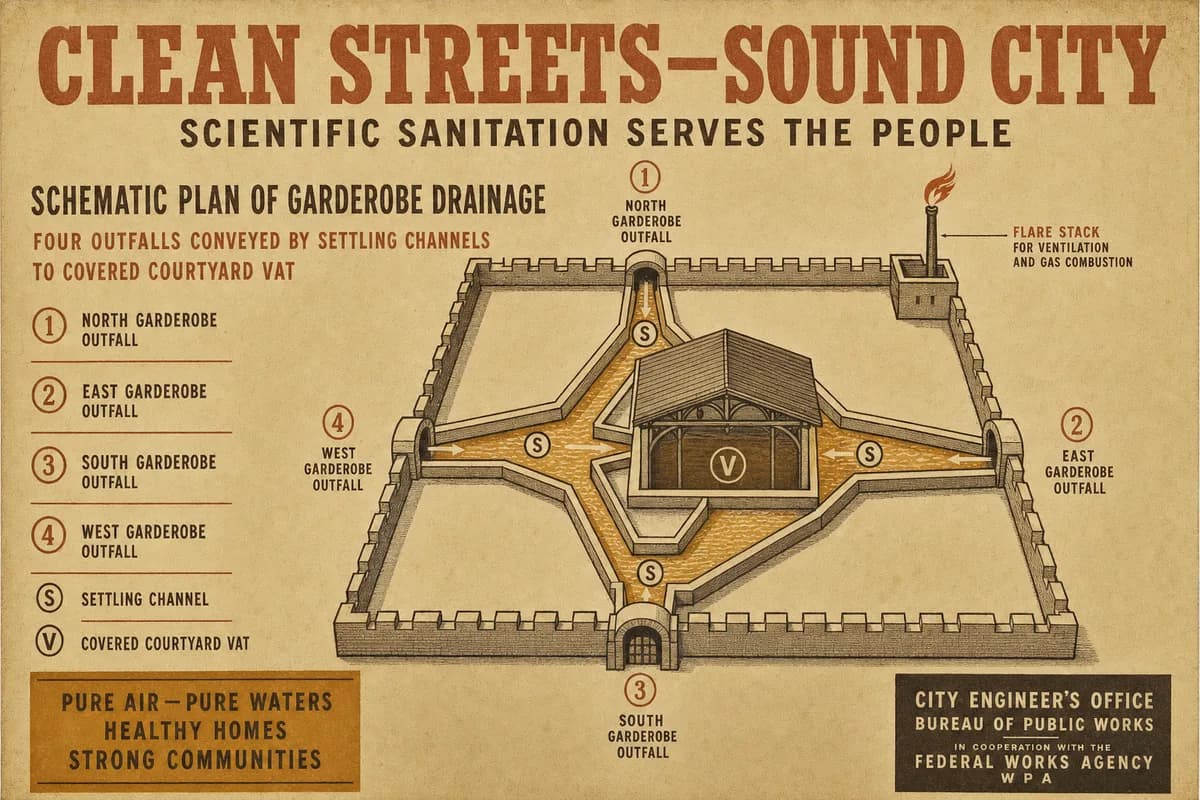
The collection finding runs the other way. The suburb of equal population spends real energy gathering — pumps lifting against grade, or trucks running horizontal routes to 140 separate addresses. The castle spends none. Four shafts drop the entire garrison's contribution to one courtyard by gravity, and the only running cost is the porters. Per capita, on the single metric of getting the material to the works, the fortress beats the suburb it predates by centuries, and it does so without having been designed to.
Operational Concerns
The porters. Three shifts clear the channels around the clock. The night shift, working the towers by candle, was in the period compensated in candles, which we record as the earliest documented instance of a shift differential paid in the medium of the work itself.
Sealing. Stone is not a pressure vessel. The gas dome loses to every joint the mason did not close, and methane finds the joints faster than mortar does. The flare stack on the battlements is therefore not merely disposal; it is the pressure relief that keeps the works from finding its own relief through the floor of the hall above. That the flare doubles as a signal to allies is a convenience of siting, not of design, and we advise against relying on it for either purpose during weather.
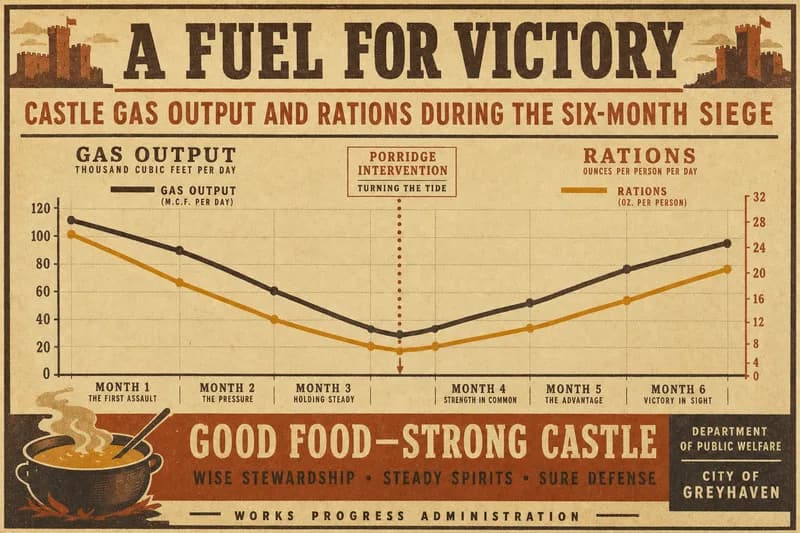
The siege. Output tracks intake, and a siege is a sustained reduction of intake. Across a six-month investment, rations fall and the works fall with them in lockstep, until at a third ration the vat delivers barely a third of its peak. The intervention recorded in the period was porridge: a fiber ration issued deliberately to restore the bulk of contribution even as caloric rations held low. The curve shows its effect plainly — a brief recovery that bought roughly three weeks before the porridge itself was gone. We note it as sound engineering under constraint. The garrison, we are told, did not experience it that way.
Conclusion
A medieval castle can run on chamber pots, in the narrow sense that the material is gathered superbly and converted poorly. The garderobe shaft gives the fortress a gravity-fed district collection network that the modern suburb, for all its pumps, has never matched per capita — and then the courtyard vat gives back under five percent of the kitchen's daily fire, less in winter, less again under siege. The lesson generalizes past the drawbridge: collection was never the hard part of district energy, and the castle proves it by solving collection eight centuries early and the rest of the problem not at all. We recommend the shaft be studied and the vat be forgotten, which is, as it happens, precisely what history did.