A Marxist Reading of the Office Restroom Key
On enclosure, reification, and the appropriation of surplus in the single most theoretically dense object the modern workplace still issues by hand.
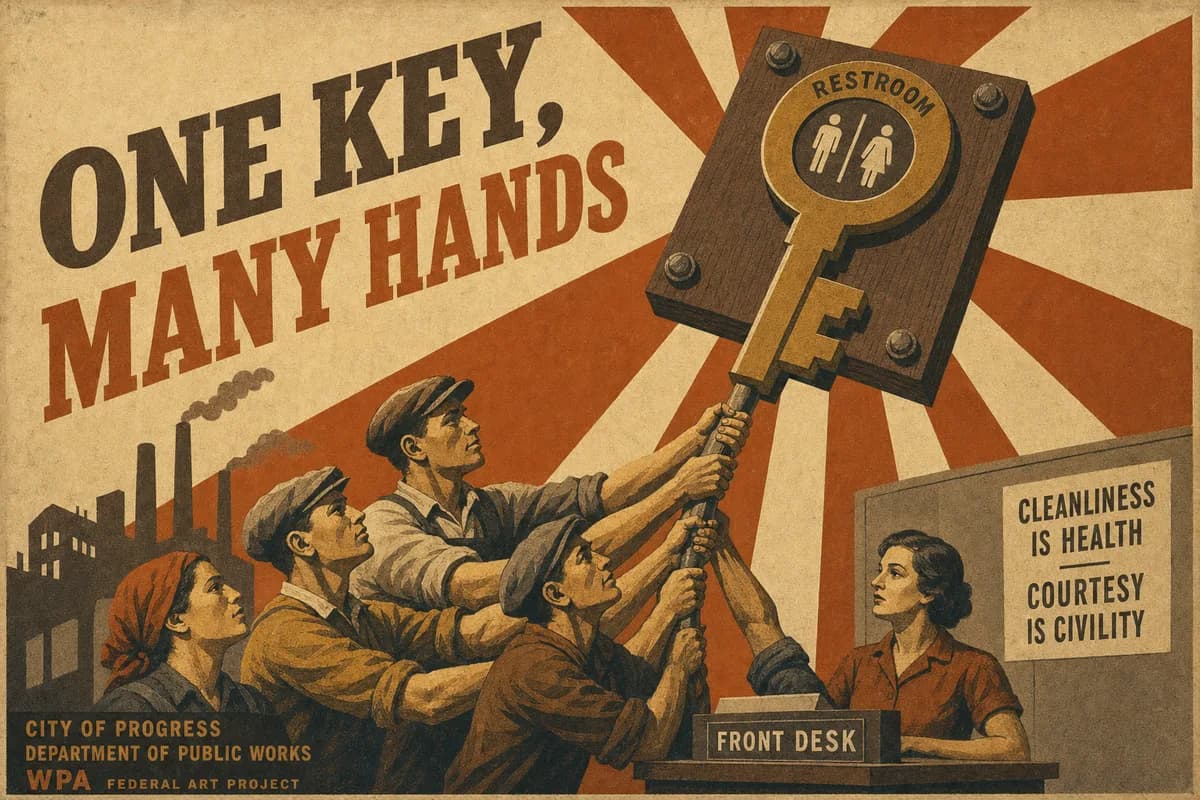
Among the small humiliations of waged life, few are as theoretically dense as the object issued by the front-desk manager to the employee in need: a single restroom key, bolted to a block of wood, a plastic spoon, or a hubcap. The object is engineered to be too large to pocket and too absurd to steal. It is also, I will argue, one of the purest instruments of class relation surviving in the contemporary workplace — a device in which enclosure, alienation, and the appropriation of surplus are compressed into a form small enough to hang on a hook.
The Enclosure of a Commons
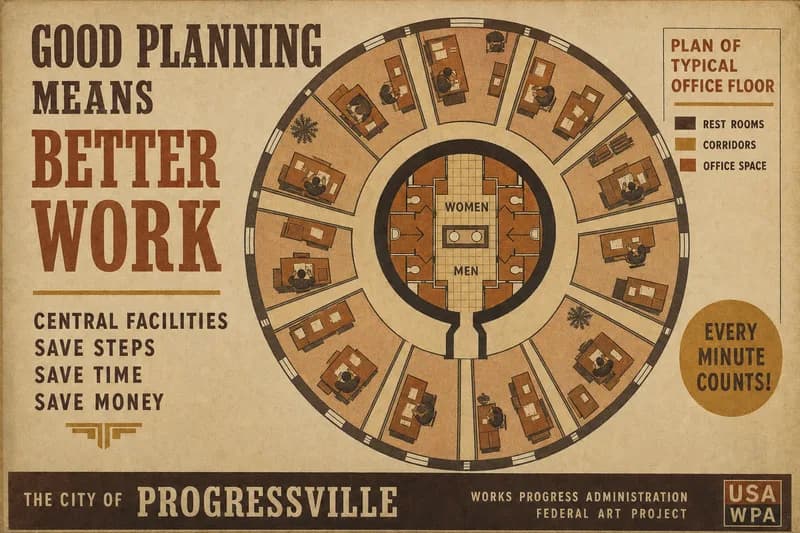
Begin with the key's precondition: a lock. The restroom is, by its nature, a commons — a shared bodily infrastructure to which the human animal has a claim older than any wage. To lock it is to perform, in miniature, the historical act Marx placed at the origin of capital: the enclosure of what had been held in common, and the conversion of a shared necessity into a resource that must be granted (Marx 1867, ch. 27). Federici has shown that such enclosures fall first and hardest on the reproduction of the body itself — on the sites where labor-power is restored and maintained (Federici 2004). The locked restroom is exactly such a site. The key is the deed of enclosure, and the manager is its holder.
The enclosure is rendered in plan below.
The Key as Reification
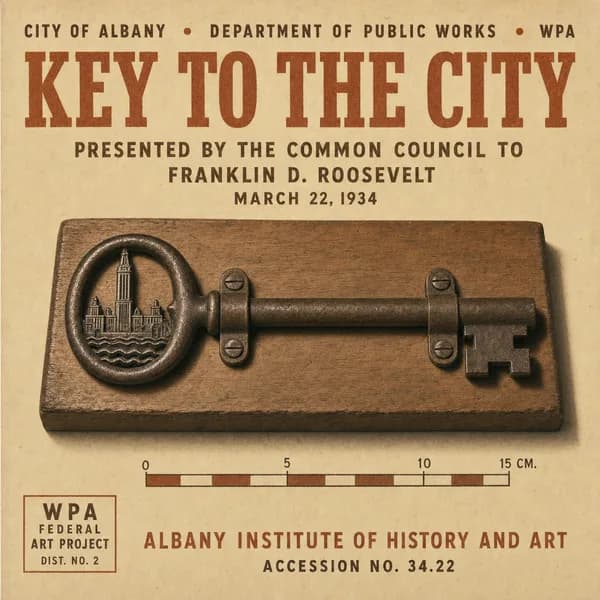
What is petitioned for, at the desk, is access to one's own body's operation. Yet the need cannot present itself directly; it must pass through an object. The worker does not say I must; the worker says may I have the key. Here is reification in Lukács's precise sense: a social relation — the employer's dominion over the worker's time and body — has taken on "the character of a thing" and now confronts the worker as an external, thing-like power (Lukács 1923). The dominion is not felt as dominion. It is felt as a key, screwed to a block of wood, and one waits for it with an open palm.
The object itself is reproduced below, to scale.
The Working Day and the Porous Hour
Marx's chapter on the working day describes capital's ceaseless effort to eliminate the "pores" of the laboring hour — the small intervals in which the worker's time reverts, briefly, to the worker (Marx 1867, ch. 10). E. P. Thompson traced how the clock and the factory whistle were enlisted to seal those pores and to render idleness legible as theft (Thompson 1967). The restroom key belongs to this lineage. By interposing a request, a walk to the desk, and a walk back, the key converts an ungoverned bodily interval into a documented transaction — a departure and a return, witnessed and, increasingly, timed. Braverman would recognize the logic at once: it is the extension of managerial control into the last unmonitored recess of the working day (Braverman 1974).
The Fob as Disciplinary Sign
Consider the fob — the wooden block, the enormous spoon. Its ostensible purpose is to prevent loss. Its actual function is semiotic. By making the key impossible to conceal, the fob renders the worker's private need conspicuously public: the walk to the restroom becomes a small procession, the need announced by the very instrument that permits its relief. The object thus performs the disciplinary labor Foucault attributed to visibility, the compelled legibility of the governed body (Foucault 1975; applied to the workplace by Prewitt 2020) — but its owner and beneficiary is unambiguously the one who holds title to the worker's hours. It is surveillance issued in the form of a novelty.
The Appropriation of Digestive Surplus
Here the analysis, if it is to be complete, must follow the logic to its terminus. In the emerging brown economy the worker's bodily output is no longer waste but product — a metered contribution to civic load under the Residential Digestive Contribution Act, remunerated nowhere on the worker's stub. The office restroom is, in this light, no longer a cost center but a site of production, and the employee within it generates value that flows, unpriced, into the Municipal Fart Grid. The key acquires its final and most damning aspect. It is not merely the enclosure of a commons or the sealing of the porous hour. It is the mechanism by which the employer retains control over the means of a production the worker performs with the worker's own body, and appropriates the surplus without so much as naming it.
Conclusion
The worker, Marx wrote, is estranged from the product of his labor, from the act of laboring, from his fellows, and at last from his own species-being — from the body as his own (Marx 1844). Nowhere is that fourfold estrangement more economically expressed than in the transaction at the desk: a human being, in possession of a need that predates all wages, holding out a hand for permission, which arrives in the form of a key bolted to a block of wood. The revolution, when it comes, will be recognizable by a single sign. The door will simply be open.
Works Cited
Braverman, Harry. Labor and Monopoly Capital. Monthly Review Press, 1974. Federici, Silvia. Caliban and the Witch. Autonomedia, 2004. Foucault, Michel. Surveiller et punir. Gallimard, 1975. Lukács, Georg. History and Class Consciousness. 1923. Marx, Karl. Economic and Philosophic Manuscripts of 1844. Marx, Karl. Capital, vol. 1. 1867. Prewitt, D. "The Legible Bladder: Visibility and Control in the Firm." Journal of Terminal Studies 14, no. 1 (2020): 3–29. Thompson, E. P. "Time, Work-Discipline, and Industrial Capitalism." Past & Present 38 (1967): 56–97.