Two Lovers Assigned to Different Sewer Districts
He gave to District 4 and she to District 7, and the grid boundary ran down the middle of the only street where they were both, by the registry, at home.
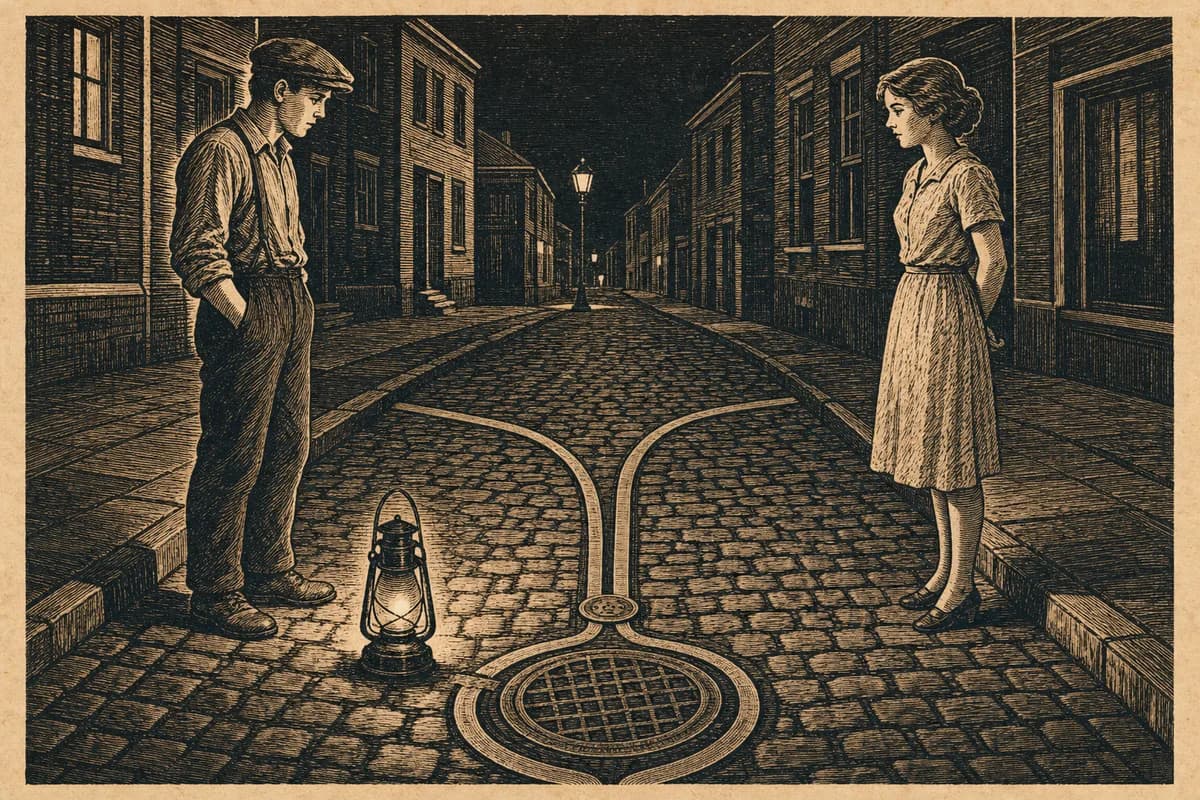
Tomás Elizondo contributed to District 4, as his father had, and as the house on Calderón Street where he was born had done since the day it was joined to the mains. Ines Vidal contributed to District 7. They met, as people in a well-ordered city meet, entirely by accident, at the one place where the two districts touched: the length of Boundary Row where the brass markers ran down the crown of the street and the paving changed pattern at the line, District 4's herringbone giving way to District 7's plain courses, so that a person could stand with one foot in each grid and be, by the registry, in two places and no place at once.
He worked the near side, delivering for a grocer whose shop faced 4. She kept the accounts of a laundry whose door opened onto 7. For a season they only nodded, the way people nod across a line that means nothing to them yet. Then there was an evening in the autumn when the lamplighter was late and the row went dark early, and they found themselves the last two on the street, and they talked across the markers for an hour in the cold, and after that they arranged, without ever saying so, to be the last two on the street as often as they could manage.

It would be easy to say the trouble was the districts, but the districts were only pipe and pumps and did not care where anyone stood. The trouble was the registry, which cared very much. A citizen was enrolled where he contributed and contributed where he was enrolled, and the two facts held each other up like the two halves of an arch; a household was the unit the whole system counted by, and a household belonged to one grid, gave to one grid, drew its light and its winter heat from the one grid it fed. There was no form for a marriage that faced two ways. The registry did not forbid them to love. It only declined to file them as one household, which in the end came to the same wall.
They tried the honest way first, as the young do. Ines applied to transfer her enrollment to District 4, so that she might come and live on Calderón Street and give to the grid that gave Tomás his light. The application was neither cruel nor quick. It went to the ward office and from the ward office to the district office and there it stopped, because District 4 was near its seasonal capacity and the standard was that no transfer in should be granted that would push a mature grid past its band, and the clerk who declined it did so with real regret and a printed form and the observation, meant kindly, that she might reapply in the spring.
So Tomás applied to transfer the other way, to leave District 4 and enroll in 7, and give up Calderón and the herringbone and the grid of his whole life to go and live with Ines on the plain courses across the line. This application did not stop at capacity. District 7 had capacity to spare, and more than spare; District 7 was the trouble district, the one whose neighborhood generator was fed the wrong things and whose output ran hot and out of band and whose quota notices came monthly. What stopped Tomás's transfer was that District 7 had been placed under an enrollment freeze precisely because it could not keep its existing households in the band, and a frozen district takes no new givers, not even ones who arrive with a clean four-year record and a strong young contribution and a very great wish to come in. The freeze was temporary. Everyone said so. It had been temporary for two years.
They were not the first this had happened to. That was the part that undid Ines when she let it, that they were not even tragic, only common — that the ward offices of every district in the city held drawers of paired applications like theirs, in from one side and out from the other, each one declined for its own good administrative reason, each pair describing two people standing on a line holding hands across it and asking only to be counted once. There was even a word for them at the registry, she learned, filed under a heading: split contributors. A category. A known quantity. It is a particular grief to discover that your love has a form number.
They did not give each other up. But they did not marry either, not in the way that files as one household, because there was no way to, and they were too practical to pretend a ceremony could move a boundary that thirty years of pipe had settled. What they did instead they arrived at slowly, over a second autumn and a third, and it was this: they took the two rooms above the laundry and the two rooms above the grocer, one on each side of the line, and they lived between them. He gave to 4 and she to 7 and they kept two enrollments and two small contributions running as the registry required, and they met in the middle, on the row, every evening the lamplighter let them, and on the nights he did not they each went up their own stairs on their own grid and slept a hundred feet apart with the boundary and its brass markers and its diverging mains running cold and full in the dark between them.
People asked them, sometimes, whether they minded. Tomás had an answer he gave the ones who asked idly, about how a person gets used to anything, which was true and told them nothing. To the ones who asked as though they meant it he said the other thing, the one he had worked out standing on the line in the cold with Ines's hand in his and the two grids running under their feet toward two different mornings: that he had come to think a marriage was not, after all, a matter of being filed as one household. It was a matter of two people deciding, every evening, against every good administrative reason, to keep meeting at the line — and of the city, for all its capacity bands and its enrollment freezes and its drawer full of split contributors, never quite managing to build a grid that could keep them from it.