The Official Livestock-to-Appliance Conversion Chart
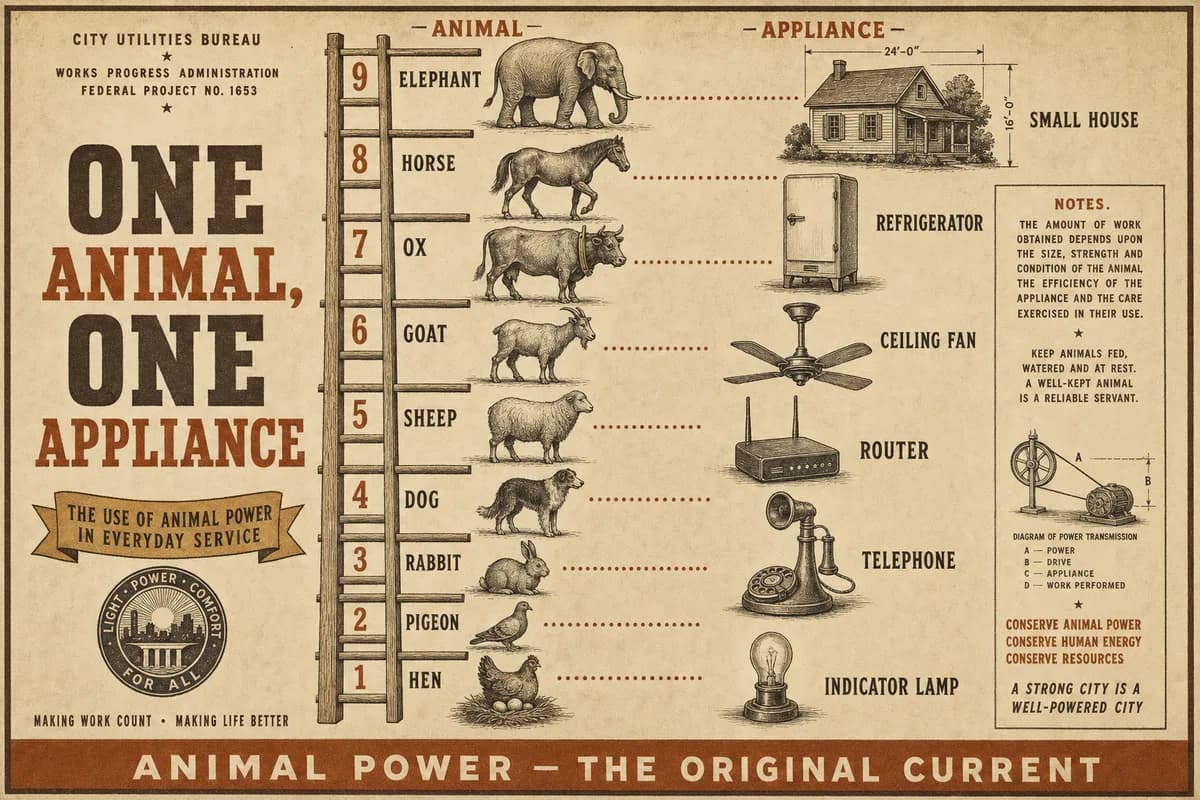
A standing conversion table pairing each common farm and household animal with the one household appliance its daily manure will honestly, and only just, power.
Abstract
This paper publishes the Bureau's standing conversion between a keeping animal and the household load its daily manure will carry, expressed in the only terms an owner acts on: which single appliance the animal runs. Each figure is the net electrical output of a well-run mesophilic digester and small generator, after the gas burned to hold the vessel warm. The chart is anchored at its upper end by the settled one-elephant result and extended downward, by the same conversion, to the laying hen.
Method
Every row is computed by one chain, applied without exception:
- Biogas yield. Fresh dung ferments to biogas at a rate set by the animal's gut. Coarse herbivores — cow, horse, goat, sheep, elephant — yield about 0.04 m³ per kg; the dog, an omnivore, about 0.05; the pig about 0.06; poultry, richest per kilogram, about 0.07. The elephant's rate is taken from the published single-elephant guide and is not re-litigated here.
- Gross energy. Biogas carries roughly 6 kWh per m³.
- Digester heating. A mesophilic vessel spends about a fifth of its own gas holding 35 °C; usable heat is therefore 80% of the gross.
- Generation. A small genset returns 20% of that heat as electricity.
The three factors collapse to a single number: net electricity ≈ 0.96 kWh per m³ of raw daily biogas. An animal's place on the chart is then fixed entirely by how much it produces and how well its gut ferments.
The Conversion Chart
| Animal | Fresh dung (kg/day) | Biogas (m³/day) | Net electrical (kWh/day) | Appliance it will run |
|---|---|---|---|---|
| Laying hen | 0.12 | 0.008 | 0.008 | An indicator lamp — about half a phone charge |
| Rabbit | 0.25 | 0.010 | 0.010 | A telephone, every other day |
| Dog (household) | 0.34 | 0.017 | 0.016 | One phone charge daily, with a little to spare |
| Sheep | 1.5 | 0.06 | 0.058 | A nightlight, through the night |
| Goat | 2.0 | 0.08 | 0.077 | A reading lamp for the evening |
| Pig | 5.0 | 0.30 | 0.29 | A wireless router, around the clock |
| Horse | 20 | 0.80 | 0.77 | A ceiling fan, day and night |
| Dairy cow | 50 | 2.0 | 1.9 | A refrigerator, and the evening's lights |
| Elephant | 100 | 4.0 | 3.8 | A lean tiny home (settled precedent) |
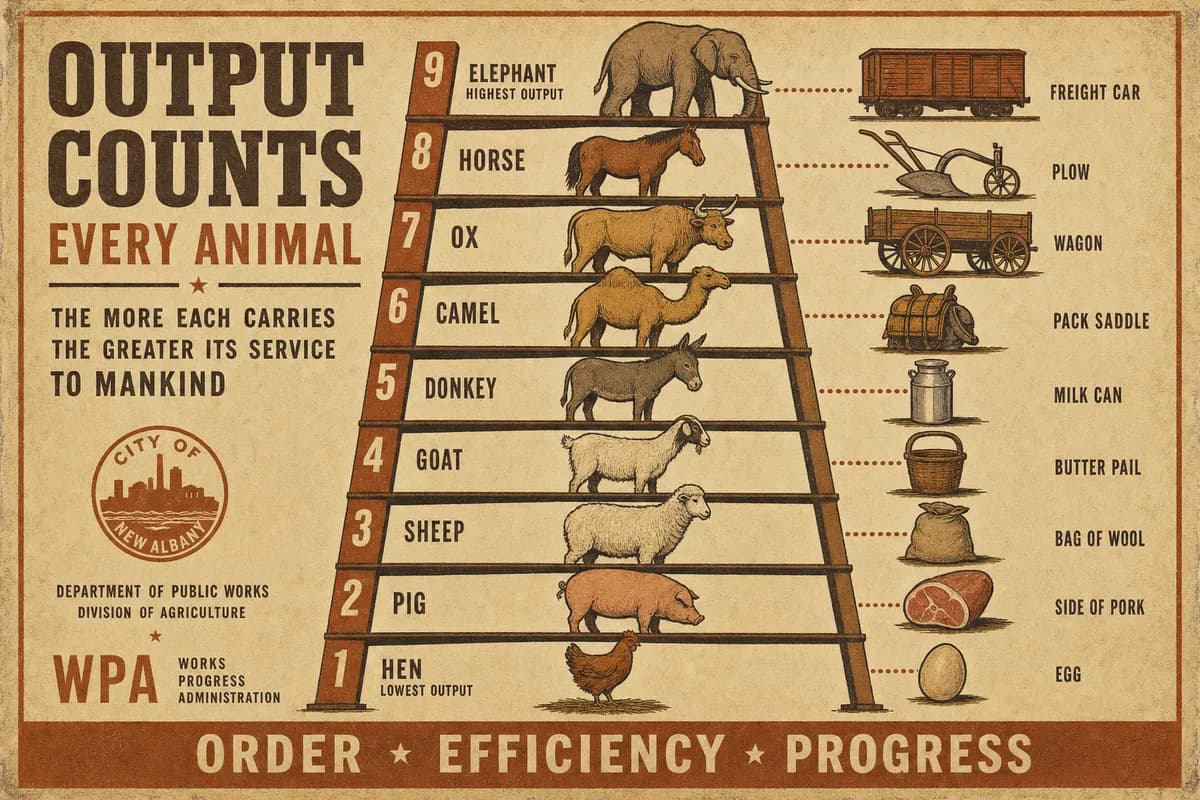
The ladder below arranges the same nine animals by the appliance each will carry.
Reading the Chart
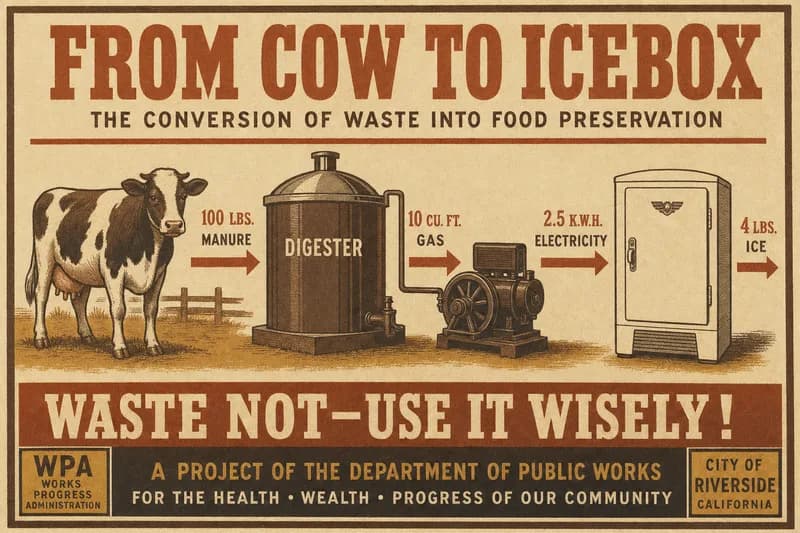
Take the dairy cow, the row most smallholders come for. Fifty kilograms of fresh dung a day, at 0.04 m³/kg, is 2.0 m³ of biogas. At 6 kWh/m³ that is 12 kWh of gross energy; the digester keeps 9.6; the generator returns 1.9. A frost-free refrigerator draws about 1.2 kWh a day, which leaves the cow's owner roughly 0.7 kWh — an evening of lights — and nothing further. One cow, one refrigerator. The chart records this as a success, because it is one.
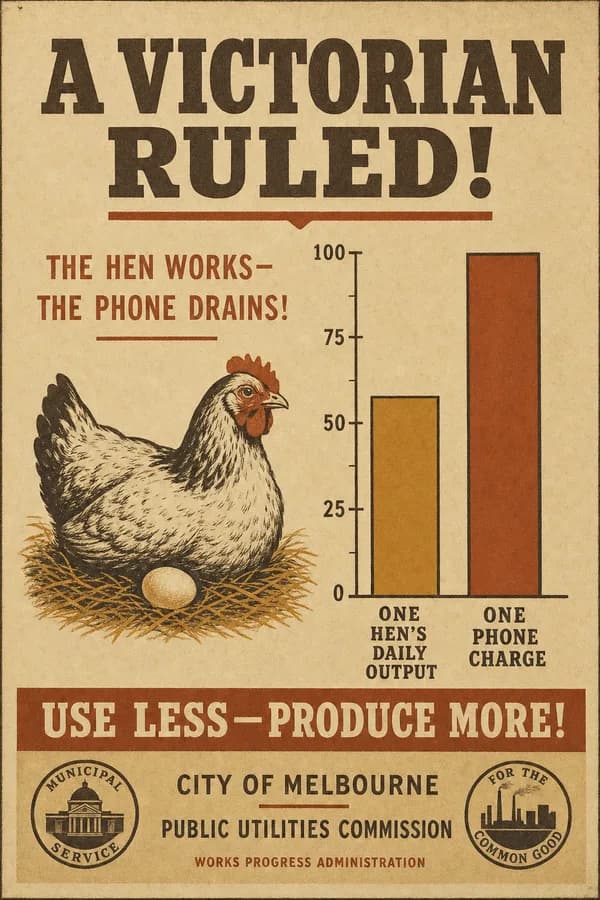
The instructive direction is downward. Each rung is not a little smaller than the one above it but smaller by the whole animal, and the animals thin out fast. Below the pig, the output stops mapping to rooms and starts mapping to objects: a router, a lamp, a nightlight, a telephone. At the bottom rung the laying hen produces, across a full and diligent day, about eight watt-hours — a little over half of what a modern telephone asks for one charge. It is listed for completeness. Completeness is the only argument for listing it.
Operational Notes
- The chart is per healthy adult animal, fed and watered as the animal requires. It sizes the output and never the input; the input is the whole cost and appears in none of these columns, which is precisely the omission the single-elephant guide was written to correct.
- Rows do not add cleanly. Two cows are two vessels, two permits, and two appetites, not a doubled flame under one tank. Aggregation across many animals is a separate and worse problem, treated in the companion study on the national dog herd.
- Cold weather moves every animal down a rung. In the months when the vessel's heating load eats most of the gas, read the chart one line higher than the animal you actually own.
- Compliance. A residential digester and genset fall under the Residential Digestive Contribution Act as accessory appliances; file before the first charge, and route the exhaust through a Fart Scrubber 3000. The animals themselves are your own affair until they cross a setback.
Conclusion
The chart's purpose is to end a specific argument before it begins. The keeping animal is not a battery with a face; it is a modest, living generator whose honest output can be named in advance and is almost always smaller than the owner hoped. A cow is a refrigerator. A horse is a ceiling fan. A pig is a wireless router. An elephant, as established, is a tiny home and a small farm to feed it. And the laying hen, at the far quiet end of the ladder, is half a telephone — which the Bureau records not to mock the hen, but because a chart that stops where the numbers get embarrassing is not a chart. It is a brochure.