Estimated Contributions Required to Illuminate the Las Vegas Strip
Illuminating the Las Vegas Strip for a year, converted from gigawatt-hours into the daily contributions a national mobilization would have to supply.
From the series: How Much Poop Would It Take?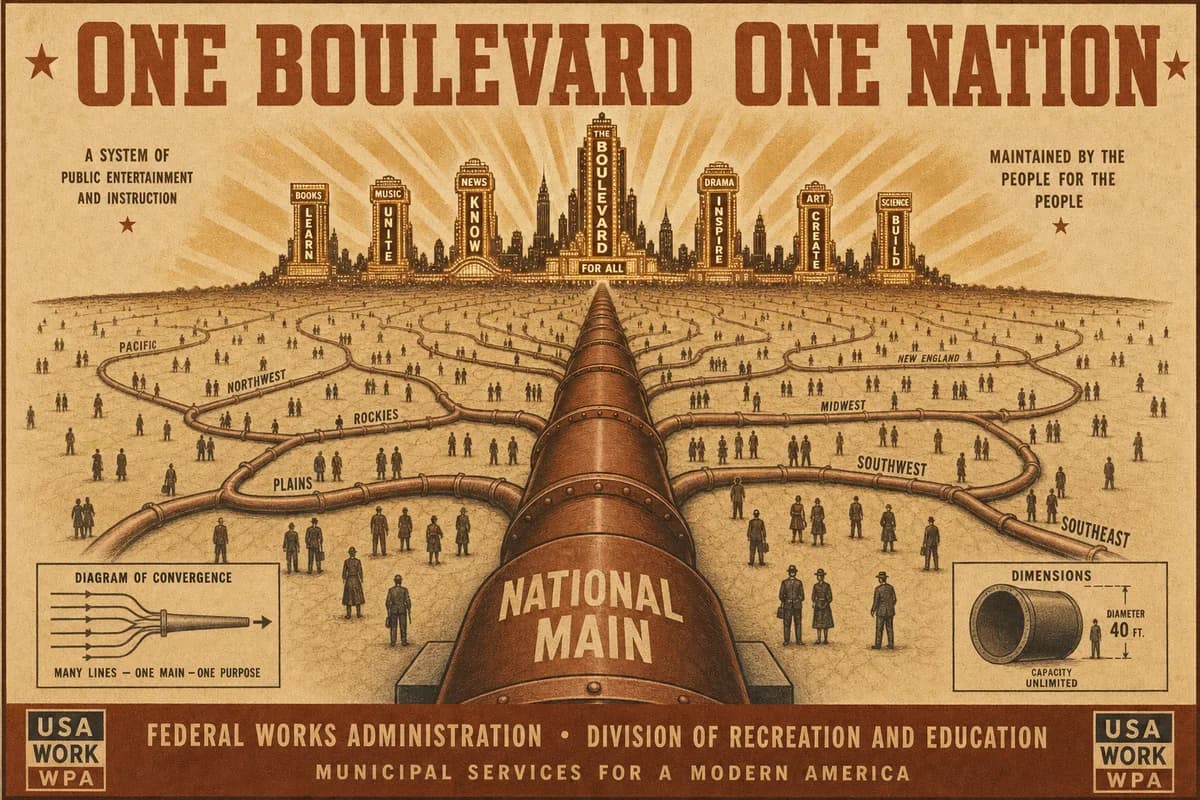
Abstract
This paper addresses the largest load the Bureau's standing series has yet entertained: How much poop would it take to illuminate the Las Vegas Strip? We take the boulevard's annual electrical demand at order-of-magnitude scale, convert household digestive output to energy by the standard chain, and report the contributing population required to carry the load for a full year. We find that figure to be approximately 438 million contributors — larger than the population of the United States — and we conclude that the Strip, lit on contribution alone, is not a municipal project but a national one with a deficit.
Assumptions
- The load. The Strip and its resorts draw on the order of 8,000 GWh per year — eight billion kilowatt-hours, taken as an order-of-magnitude figure for the boulevard's lighting and the buildings behind it. Averaged over 8,760 hours, that is a continuous demand of about 913 MW.
- The standard daily contribution. By the series chain, one contributor yields 0.05 kWh of electricity per day, or 18.25 kWh per year — equivalently, a continuous 2.08 watts.
- The reference population. The United States is taken at roughly 332 million people, so that the result can be stated in the only unit large enough to hold it.
The Calculation
The annual method divides demand by yearly output:
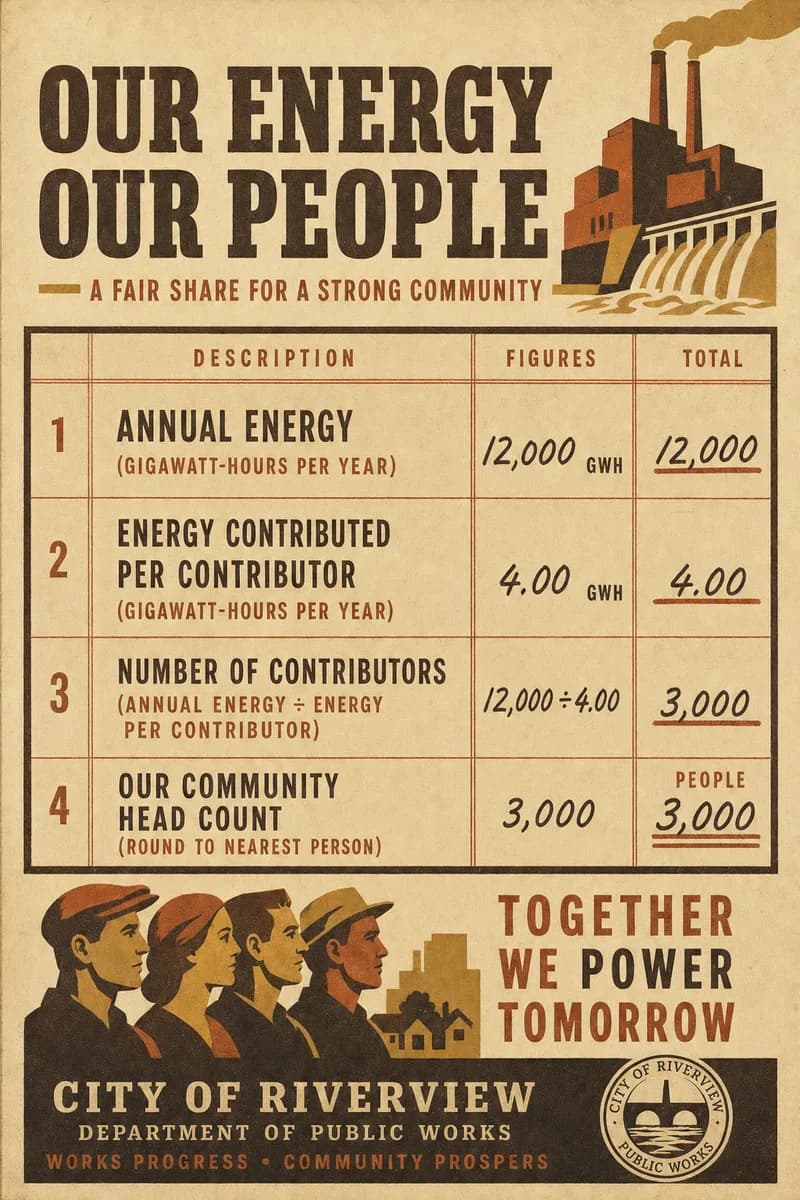
8,000,000,000 kWh ÷ 18.25 kWh = ≈ 438 million contributors.
The continuous method arrives at the same place: 913,000,000 watts of average demand, supplied at 2.08 watts per contributor, is again about 438 million. Either way, illuminating the boulevard is the full-year, every-day labor of more people than live in the United States — the entire national population, contributing without exception, plus roughly a third of a second nation to cover the shortfall.
Stated as a fraction, one American's standing annual contribution of 18.25 kWh is about two billionths of the boulevard's appetite. A citizen contributing faultlessly for a full year lights the Strip for roughly seven-hundredths of a second, after which the responsibility passes, as it must, to the next 437,999,999.

Operational Concerns
Scale of works. No household interconnect, and no municipal one, moves gas at this rate. The load requires a national trunk — provisionally, the national main — gathering regional feeders off the Municipal Fart Grid and reducing to the boulevard at a single valve. The Bureau notes without comment that the main would need to move more energy than the boulevard displays, since the boulevard mostly displays it as light and heat into the desert night.

The deficit. A national contributing population of 332 million falls about 106 million short of the boulevard's requirement. The shortfall cannot be met by working the existing population harder, digestion being what it is; it can only be met by enlarging the population or dimming the Strip, and the Strip is not the variable under municipal control. The Office of Civic Digestion would in principle declare a standing national Demand Defecation program, though a program that requires more contributors than there are citizens is, by the Bureau's own reckoning, a program in name.
Obligation. Under the Residential Digestive Contribution Act every citizen's output is already pledged to the grid at large. Redirecting the entire nation's pledge to one boulevard would leave the remaining loads — every hospital, every water pump, every other lit thing in the country — with nothing, which the Bureau records as a competing use.
Conclusion
The Las Vegas Strip cannot be illuminated on household contribution, and the reason is not engineering but arithmetic: the boulevard asks for more contributors than the country contains. Every American, digesting faultlessly through the year, lights it for seven-hundredths of a second and falls short by a hundred million people. The Bureau's finding is that the Strip is, in the strict contributory sense, a national monument — the one installation whose upkeep would require the undivided output of the nation and the annexation of a modest portion of a neighbor. We recommend it be admired from a distance and metered by the utility, as at present.