Could a Football Stadium Become Energy-Positive by Halftime?
A feasibility study of the energy-positive stadium: can a sold-out crowd's digestive contribution outrun the building's own load before the second half?

Abstract
This paper evaluates the energy-positive stadium — the proposal that a sold-out crowd's digestive contribution, captured and digested on site, could turn a stadium into a net energy exporter by halftime. We model a 65,000-seat venue against its own game-day load and find the claim fails twice over: the crowd's entire contribution, even the portion not yet produced, is smaller than the building burns in the first half; and what the crowd does contribute is delivered six to eighteen hours later, at home, to tens of thousands of separate digesters. The stadium is energy-negative at halftime and stays that way.
Assumptions
- Attendance. A sold-out venue of 65,000, each attendee consuming a game's worth of concessions.
- Marginal yield per attendee. Stadium fare — a beer, a hot dog, a tray of nachos, a bowl of stadium chili — produces, through the attendee's own household digester over the following day, about 50 L of biogas, a little above the single-bowl figure established for the municipal cookoff.
- Gas energy and conversion. Biogas at 21.5 MJ/m³, converted at 25% in a generator — the settled cookoff figures.
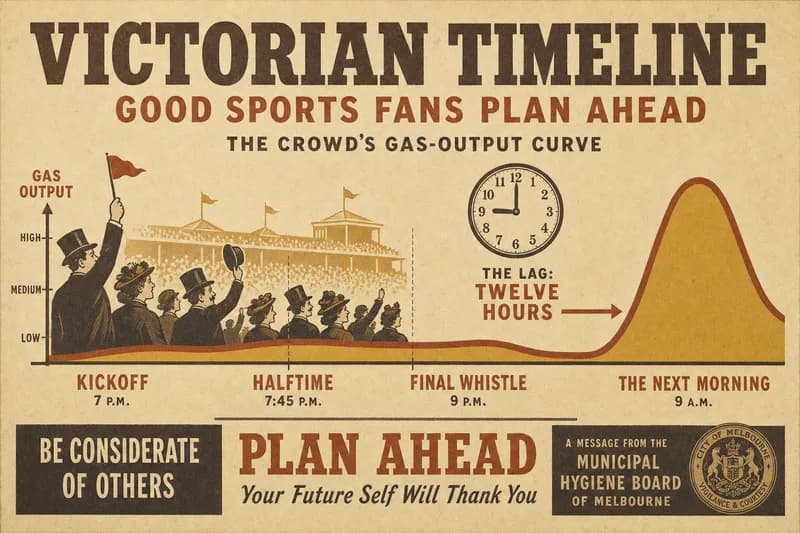
- Delivery timing. Digestive transit spreads each attendee's contribution across a 6-to-18-hour window, centered near twelve hours — again, the cookoff's established curve.
- Stadium load. Lights, HVAC, scoreboards, concessions, and broadcast draw a game-day average of about 5 MW.
The Calculation
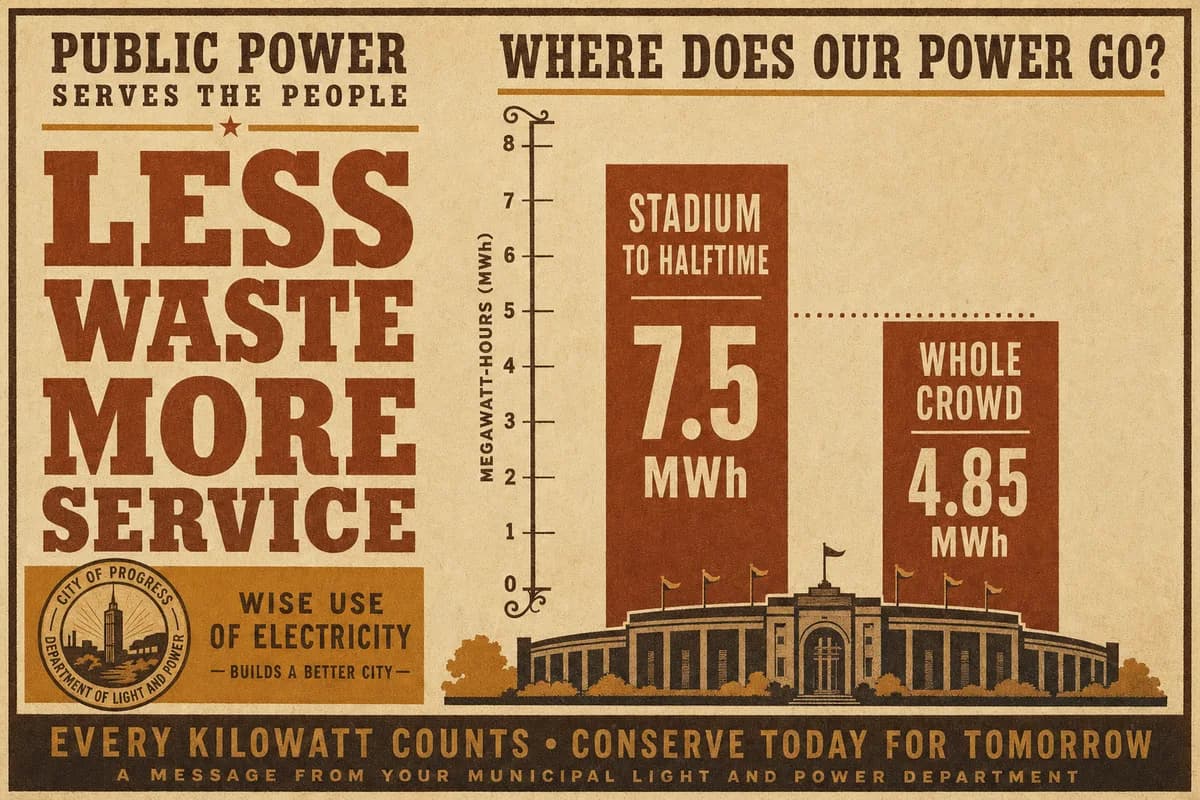
Two quantities decide the question. The first is what the building spends by halftime. At 5 MW for the ninety minutes from gates to the interval — call it 1.5 hours of full operation — the stadium consumes 5 MW × 1.5 h = 7.5 MWh before the second half kicks off.
The second is what the crowd is worth. Sixty-five thousand attendees at 50 L each is 3,250,000 L, or 3,250 m³ of biogas. At 21.5 MJ/m³ that is 69,875 MJ of heat; at 25% conversion, 4.85 MWh of electricity — the crowd's entire contribution, the whole game's worth, every attendee counted.
Set them side by side. The crowd's complete output, 4.85 MWh, is 65% of what the stadium alone burns by halftime, 7.5 MWh. Even if every attendee's full-game contribution could be produced instantly and delivered to the stadium at the interval, it would not cover the first half's electricity bill, let alone the second half's, let alone push the building into surplus. The energy-positive stadium fails on magnitude before timing is even considered.
Operational Concerns
The contribution is not there yet. The crowd's 4.85 MWh does not exist at halftime. Concessions consumed in the first half enter the digestive transit window and emerge, as gas, six to eighteen hours later — overnight, and mostly the next morning. The material actually deposited in the stadium's own restrooms during the first half was, for the most part, produced by meals eaten before the game; it too must ferment for hours before it yields anything. At the interval, the on-site digester is holding a tank that will not come to pressure until the crowd is long home.
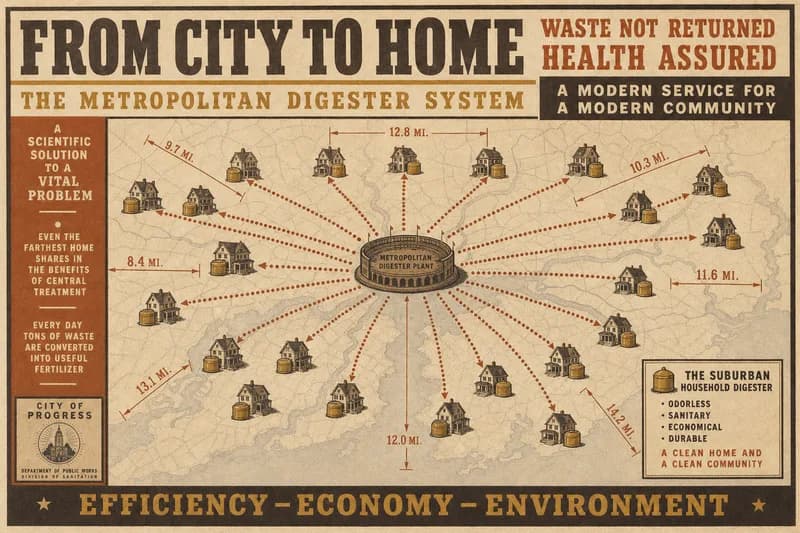
And it is delivered somewhere else. The transit delay does more than postpone the contribution; it relocates it. Ninety minutes after the final whistle, 65,000 attendees leave the stadium and drive home, carrying the game's entire fermentable load out through the turnstiles in person. The gas is produced the next morning, in 65,000 separate household digesters spread across the whole metropolitan area, credited under each household's own Residential Digestive Contribution Act obligation. The stadium hosted the meal and exported the fuel, unrefrigerated and on foot, to the suburbs.
What on-site capture actually yields. A venue determined to capture something can digest the material genuinely deposited on site during the event — a real but small fraction of the crowd's total, delayed like all the rest. It offsets a slice of the next day's operations, not this one. As a sustainability measure it is defensible. As a route to halftime surplus it is not, because nothing deposited during the game is gas during the game.
Conclusion
A football stadium cannot be energy-positive by halftime. The crowd's whole-game contribution is two-thirds of a single half's consumption, so the magnitude fails; and that contribution is not produced until hours later and not produced here, so the timing and the geography fail independently of it. The sold-out crowd is a genuine energy resource — 4.85 MWh is not nothing — but it is a resource the stadium assembles, feeds, and then watches walk out the exits to be realized the next morning in sixty-five thousand kitchens it will never meter. The building's most productive contribution to the grid happens after everyone has gone home, somewhere else, to someone else's credit. By halftime the only scoreboard the physics cares about reads 7.5 megawatt-hours to nothing.