The Fecal Load Balancer: A Dispatch Model for Homes That Produce Less Than They Use
A power-dispatch analysis of the smart panel that rations a household's biogas trickle across its circuits, and the one load it cannot make fit.
Abstract
The Fecal Load Balancer is marketed as the device that lets a household run on its own biogas. It does no such thing; it is a scheduler, and a scheduler cannot manufacture energy it was not given. This paper models the panel as a priority-dispatch problem, computes which circuits a representative Brown Home™ can and cannot serve on its digester's output, and identifies the single reassignment that turns a chronically short household into a comfortable one. The finding is that the Fecal Load Balancer's most important decision is not electrical at all.
Assumptions
- Supply. A properly fed and heated Dungester 5000, through its generator, delivers a continuous 250 W of electricity — 6.0 kWh per day.
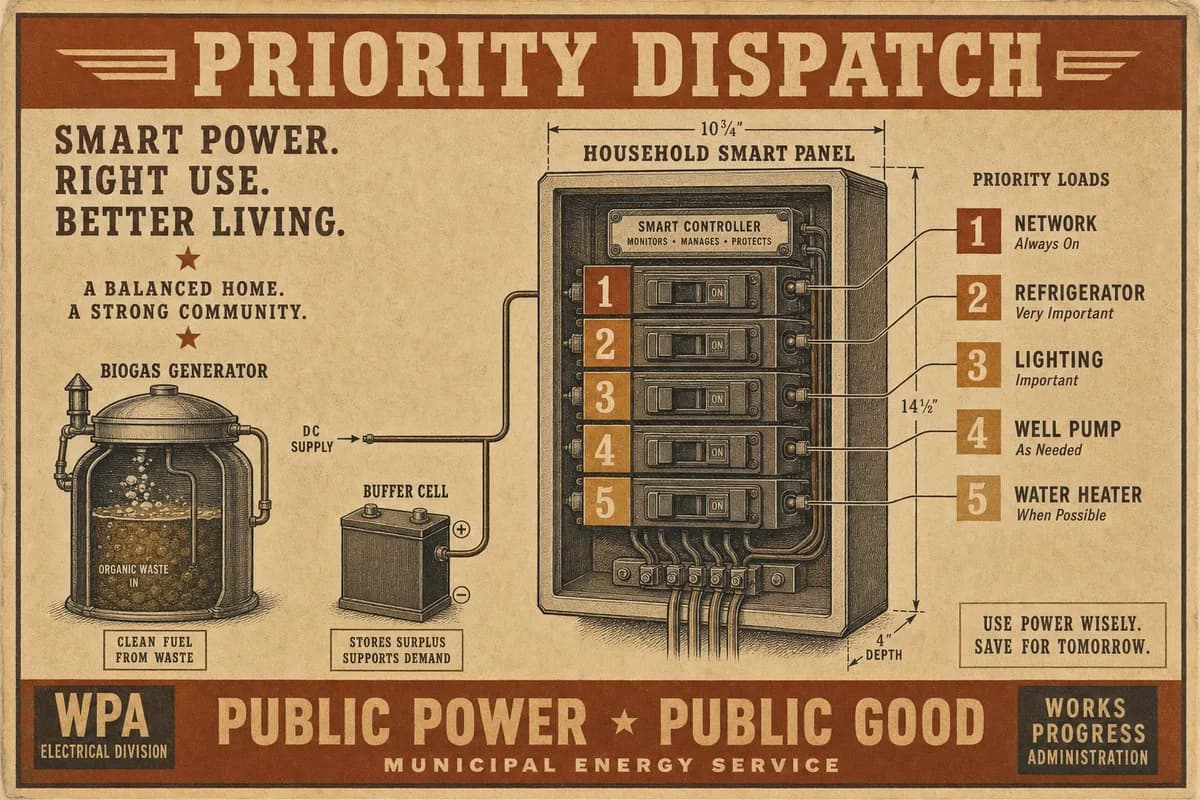
- Ranked loads. The panel serves five circuits in strict priority order, shedding from the bottom when supply runs short:
| Priority | Circuit | Draw | Daily energy |
|---|---|---|---|
| 1 | Network (router, ONT) | 12 W continuous | 0.29 kWh |
| 2 | Refrigerator | 120 W at 40% duty | 1.15 kWh |
| 3 | Lighting | 60 W for 5 h | 0.30 kWh |
| 4 | Well pump | 800 W for 30 min | 0.40 kWh |
| 5 | Electric water heater | — | 4.50 kWh |
- Buffer. A small electrical buffer absorbs surges; the Brownwall Powerwall handles thermal storage but returns heat, not amps.
Figure 1 sets that supply against a representative day's demand.

The Calculation
The daily energy budget. Summing the top four priorities:
0.29 + 1.15 + 0.30 + 0.40 = 2.14 kWh per day.
Against a supply of 6.0 kWh, the essential household — network, refrigeration, light, and water delivery — leaves a surplus of 3.86 kWh per day. On an energy basis, the Brown Home™ comfortably carries its own necessities.
Then the water heater arrives. Priority 5 alone wants 4.50 kWh per day — more than twice the other four circuits combined. The surplus can fund only:
3.86 ÷ 4.50 = 86% of it.
The Fecal Load Balancer, doing its job perfectly, energizes the water heater 86% of the time and sheds it the rest. The household gets a hot shower roughly six days in seven and a bracing one on the seventh. The deficit is 0.64 kWh per day, and no amount of scheduling cleverness closes it, because the energy simply is not there.
The power problem underneath the energy problem. The daily budget hides a worse constraint. When the well pump calls for its 800 W, the digester is supplying 250 W. The pump does not care that the day's energy balances; it needs 800 watts now. Running it for its half-hour draws 0.40 kWh while the supply contributes only 250 W × 0.5 h = 0.125 kWh, leaving:
0.40 − 0.125 = 0.275 kWh
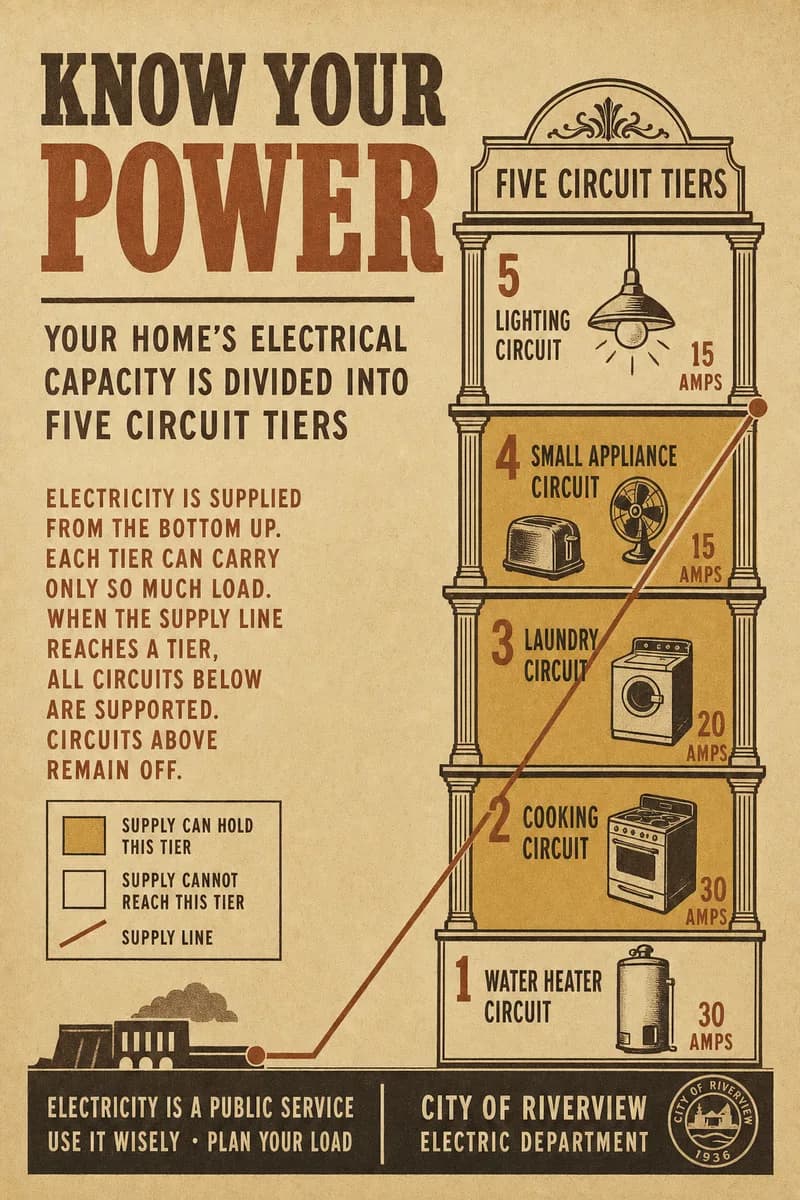
to come from the buffer in a single burst. The Fecal Load Balancer must therefore hold at least 0.3 kWh of electrical buffer and shed lighting and the water heater the instant the pump engages, or the pump stalls a 250 W source it outweighs three to one. The panel's real-time job is not allocation; it is preventing the most demanding circuit from browning out the entire house.
Figure 2 renders the stack at that instant, the fifth tier left unlit.
Operational Concerns
The Fecal Load Balancer is not a power source. It is a triage nurse with a clipboard and bad news: it decides who is treated when there is not enough to treat everyone, and it does this well, but it never once increases the supply. Every improvement in the panel's logic buys a smoother apportionment of the same 6.0 kWh — never a seventh.
The panel does, however, expose the one decision that changes the arithmetic. Four of the five circuits are electrical by necessity. One is not. Heating water is a thermal task assigned, out of habit, to an electrical appliance — and it is the assignment that breaks the budget.
Conclusion
The correct dispatch decision is to remove the water heater from the electrical bus entirely. Reassign Priority 5 to the thermal side — a Sewer-Source Heat Pump preheating against the Brownwall Powerwall — and the 4.50 kWh load leaves the panel that could never afford it. What remains is 2.14 kWh of electrical demand against 6.0 kWh of supply: a 3.86 kWh daily margin, a 0.3 kWh buffer that covers every pump surge, and a household that no longer negotiates with its own shower. The Fecal Load Balancer schedules the electricity; it is the homeowner's job to stop asking it to schedule the heat. The panel makes a short household fair. It takes moving one load off it to make the household whole.