The Fecal Flywheel: Storing Rotational Energy for Uncertain Times
A feasibility study of banking surplus digester output as rotational energy in the basement, with the bearing losses stated in full.
Abstract
This paper evaluates the storage of surplus household biogas output as rotational kinetic energy in a basement flywheel, for households wishing to bank a morning's generation against an uncertain evening. We size a representative iron wheel, compute its stored energy at operating speed, and — this being the part the literature omits — account honestly for what the bearings take back. We find that a fully charged wheel holds a little over three kettles' worth of energy, that it holds them for about five hours, and that its principal and most reliable output is warmth in the bearing housings.
Assumptions
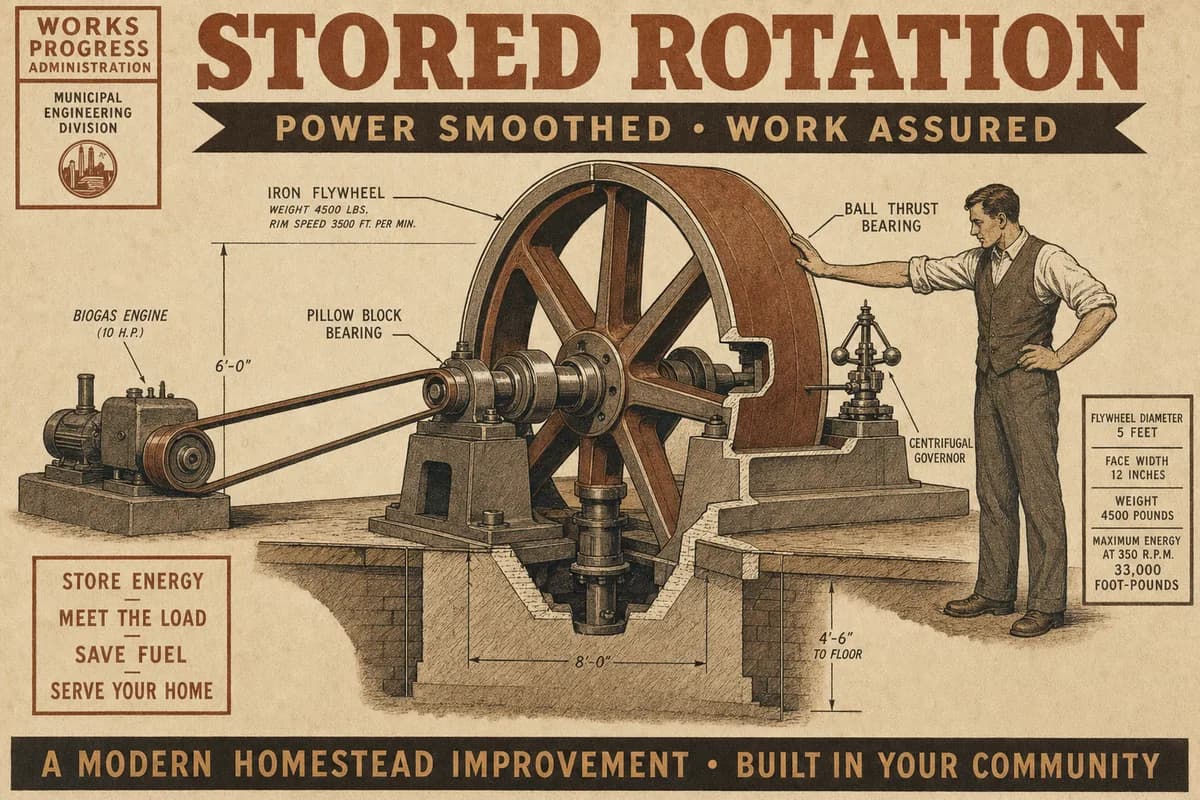
- The wheel. A solid cast-iron disk, 500 kg, 1.2 m in diameter, roughly 56 mm thick. Its moment of inertia is I = ½mr² = ½ × 500 × 0.60² = 90 kg·m².
- Operating speed. Belt-driven to 1,500 rpm, or ω = 157 rad/s. We do not spin it faster; the reasons appear under Operational Concerns and again in the insurer's letter.
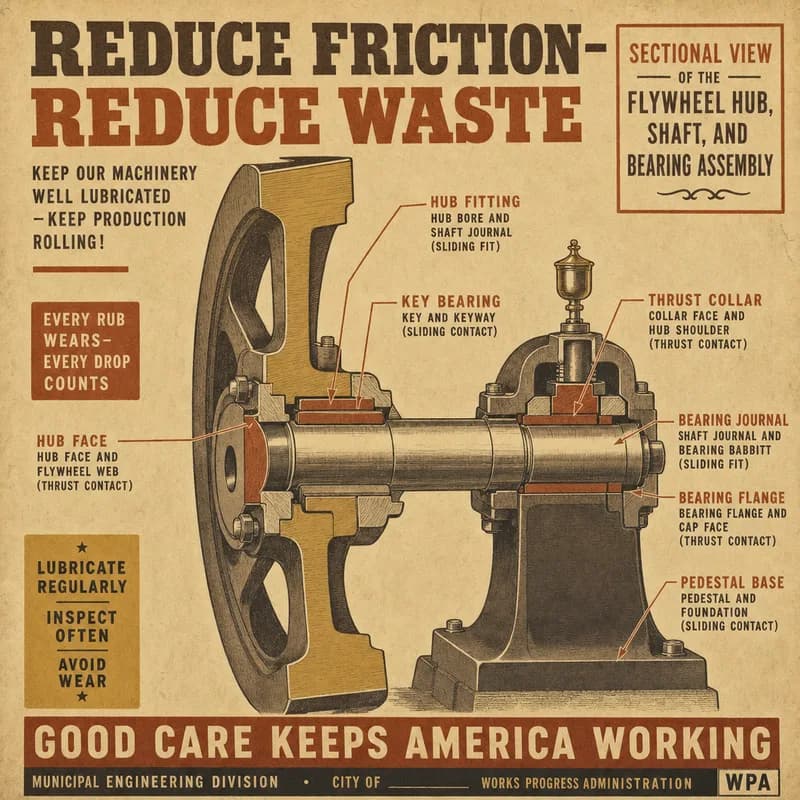
- The bearings. Plain and rolling pillow blocks, packed with grease, at basement pressure. There is no vacuum enclosure and no magnetic levitation. We are in a basement, not a laboratory, and the wheel knows it.
- Standby loss. Bearing friction and windage together dissipate approximately 40 W at full speed — a figure we regard as optimistic and offer without warranty.
- Charge source. A small biogas engine off the Dungester 5000, belt-coupled to the shaft, delivering surplus generation when the household is producing faster than it is consuming.
The Calculation
Stored energy at operating speed is E = ½Iω² = ½ × 90 × 157² = 1.11 MJ, or 0.31 kWh. To make that quantity legible, we convert it to the domestic unit of thwarted intention, the kettle: boiling one litre of water from tap to rolling requires about 0.36 MJ, so a fully charged wheel holds a little over three kettles.
It does not hold them long. At a standby loss of 40 W, the wheel sheds energy whether or not anyone draws on it. Beginning fully charged, it falls past the one-kettle line in
0.755 MJ ÷ 40 W = 18,900 s ≈ 5.2 hours,
and reaches a dead stop in under eight. A charge banked after breakfast is therefore below a single useful kettle by mid-afternoon and gone before supper, having powered nothing in the interval.
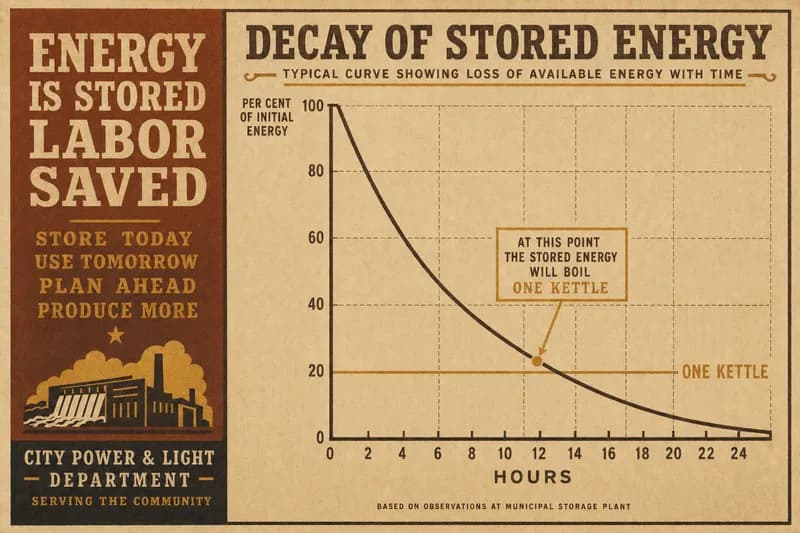
The round-trip figure follows directly. A charge banked at breakfast and drawn at breakfast returns most of what went in. A charge banked at breakfast and wanted at bedtime returns a cooling shaft. The wheel does not lose energy to the load; it loses energy to the calendar.
Operational Concerns
The pier. A 500-kilogram wheel at 1,500 rpm cannot sit on a basement slab. It requires a poured pier keyed to the footing, isolated from the floor joists, and squarely beneath no bedroom. The clearances are not aesthetic. In the event the wheel liberates itself from the shaft — the failure mode the trade calls, without affect, "liberation" — it does not remain in the basement, and the dashed arcs on the site plan describe the region in which one should not keep the water heater, the furnace, or a person.
Displacement. The pier and its clearance radius consume the corner formerly held by the laundry, which must relocate. We note this because it is the single change most households actually feel: not the physics, but the discovery that the washer now lives under the stairs.

Precession. A spinning wheel of this inertia resists having its axis moved, and transmits that resistance to whatever holds it when the house settles, a truck passes, or the ground shifts. Anchor for the couple, not merely the weight. A wheel that is adequately bolted against falling may still be inadequately bolted against turning.
Compliance. The engine and its holder fall under the Residential Digestive Contribution Act as an accessory appliance; file accordingly, and route the engine exhaust through a Fart Scrubber 3000. The flywheel itself is not a digestive appliance and the Office of Civic Digestion takes no interest in it. Your insurer will take the interest the Office declines, and will express it in a letter whose clearances we have reproduced above and whose prose we have not.
Conclusion
The fecal flywheel performs exactly as physics promises and no better. It accepts surplus rotation from the morning's gas, holds a little over three kettles at the peak, and returns whatever remains to any load applied within the hour. Applied to no load, it returns nothing, converting a morning's banked generation into five hours of warm grease and a stopped wheel by supper. It is, in the strict sense, a storage device: it stores the surplus, and it stores the regret, and by nightfall it has released only the first. For households that genuinely produce faster than they consume, we recommend consuming faster. The wheel is for those who cannot.