Can a Family of Four Power a Waffle Iron?
A load study of one 1,200-watt breakfast appliance against the honest daily output of a compliant four-person household, with a schedule.
Abstract
This paper estimates whether the residential brown-energy output of one compliant four-person household can sustain a single 1,200-watt breakfast waffle iron, and if so at what cadence. We model the full chain — daily contribution, anaerobic digestion, biogas conversion, and the wall draw of the iron itself — and report the result in the field's natural unit, the funded breakfast. We find that a family of four, contributing without exception, can serve Sunday waffles roughly once every eleven days, and that any faster schedule requires either a fifth contributor or a guest willing to be asked.
Assumptions
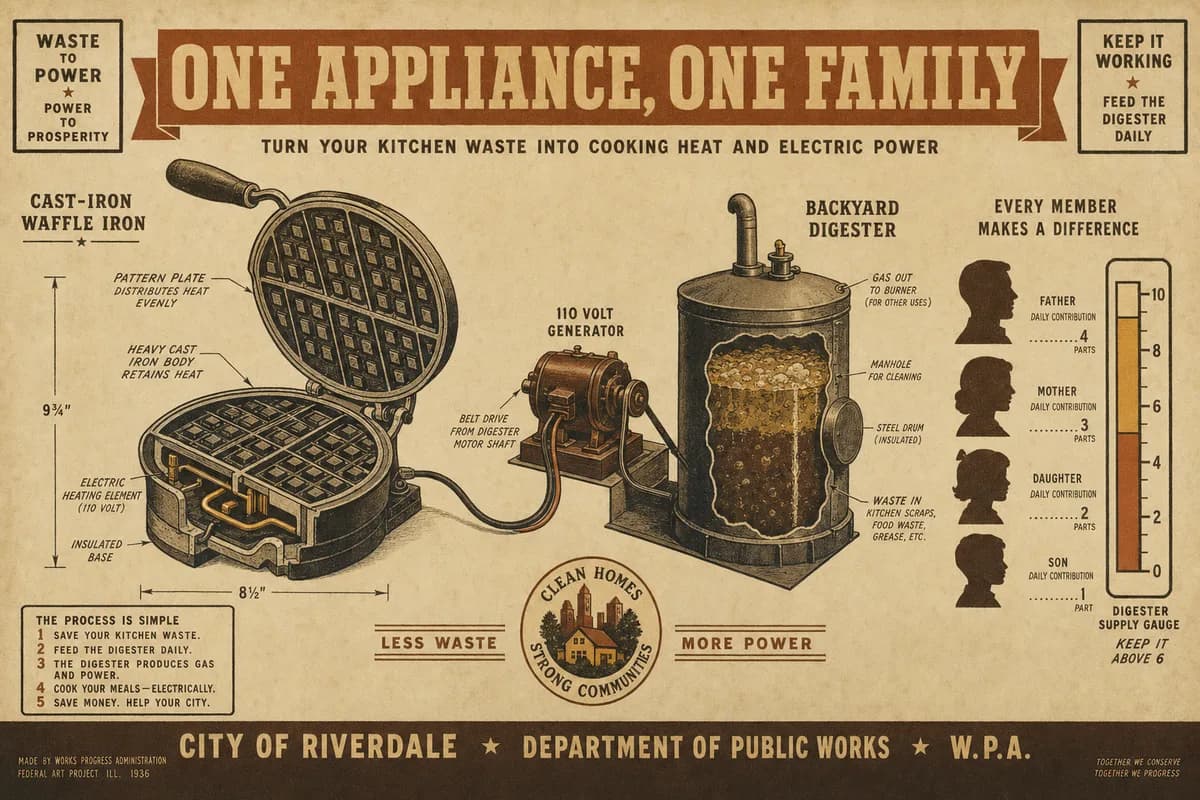
- The appliance. A domestic cast-iron-plate waffle iron draws 1,200 W. One Sunday session is taken as 25 minutes of active heating — preheat included, a single batch, no second round for latecomers. That is 1,200 W × (25 ÷ 60) h = 0.5 kWh, or 1.8 MJ of electricity at the outlet.
- The household. Four contributors, all compliant. Each produces roughly 128 g of fresh material daily at 75% moisture, which the digester receives as 32 g of dry solids per contributor per day.
- Digestion. A backyard anaerobic digester — the Dungester 5000, on its standard 35 °C cycle — returns 0.5 m³ of biogas per kilogram of dry solids, giving 0.016 m³ per contributor daily.
- Gas energy. Household biogas runs near 60% methane, or 22 MJ/m³. Each contributor's daily gas therefore carries 0.016 m³ × 22 MJ/m³ = 0.352 MJ of thermal energy.
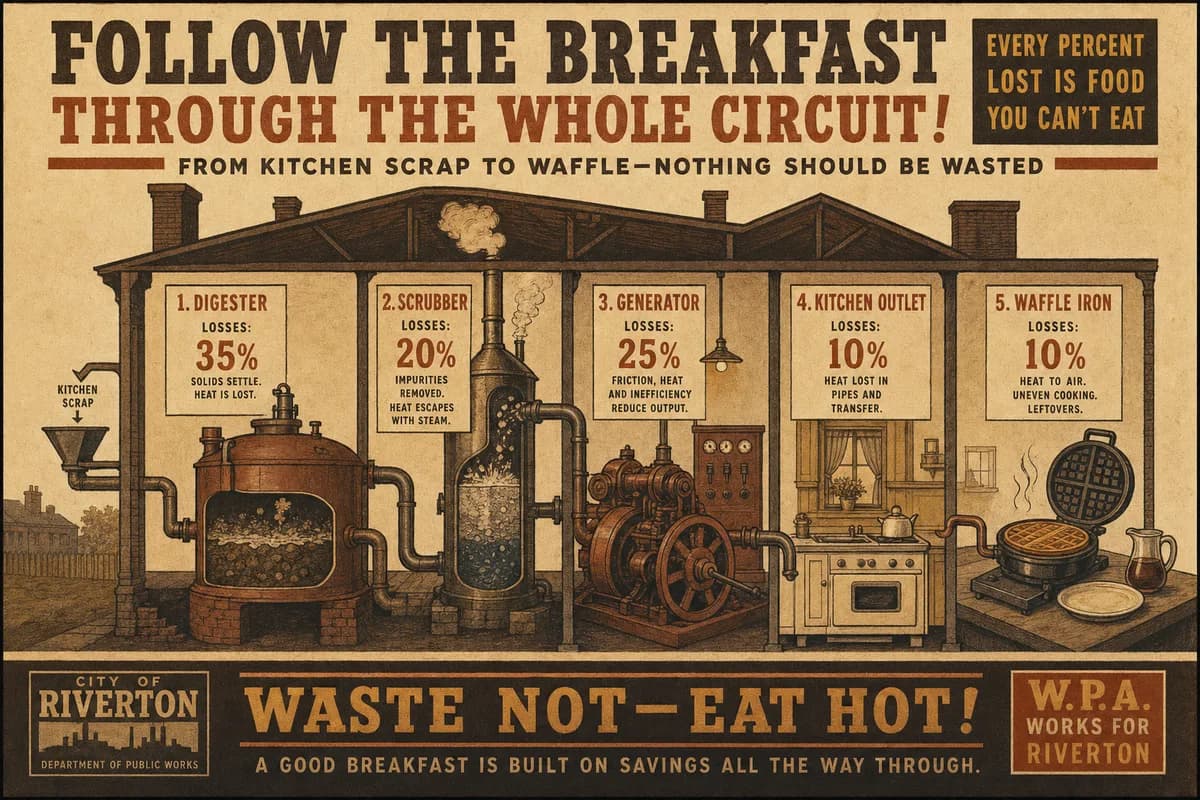
- Conversion. A small biogas engine-generator returns 12% electrical efficiency — a figure we consider generous for an engine that idles six days of every seven and is asked to perform only at breakfast.
The Calculation
We begin at the outlet and work backward to the source, posting each loss as we go.
The session demands 1.8 MJ of electricity. Through a generator that converts at 12%, the digester must deliver 1.8 ÷ 0.12 = 15 MJ of biogas to fund one breakfast. At 0.352 MJ per contributor-day, that gas represents 15 ÷ 0.352 = 42.6 contributor-days of collection.
Divided across a household of four, 42.6 ÷ 4 = 10.7 days. The result is best absorbed as a ledger.
| Quantity | Figure |
|---|---|
| Waffle session (25 min at 1,200 W) | 0.5 kWh / 1.8 MJ electrical |
| Biogas required (generator at 12%) | 15 MJ thermal |
| At 0.352 MJ per contributor-day | 42.6 contributor-days |
| Household of four, contributing in full | ~11 days per breakfast |
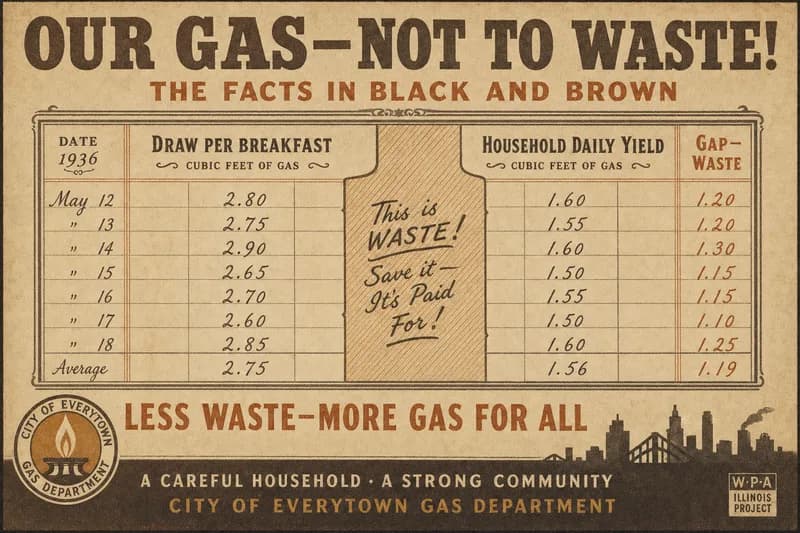
The eleven-day line is the finding most readers came for. It assumes total participation and zero diversion — no share sent to the garden beds, no output lost to travel, illness, or the workplace digester that captures a family's weekday contribution before it ever reaches the home drum. Each of those leaks lengthens the interval. A single member commuting to an office five days a week removes, in practice, most of that member's weekly yield from the household total, and the schedule slips from eleven days toward fourteen.
Operational Concerns
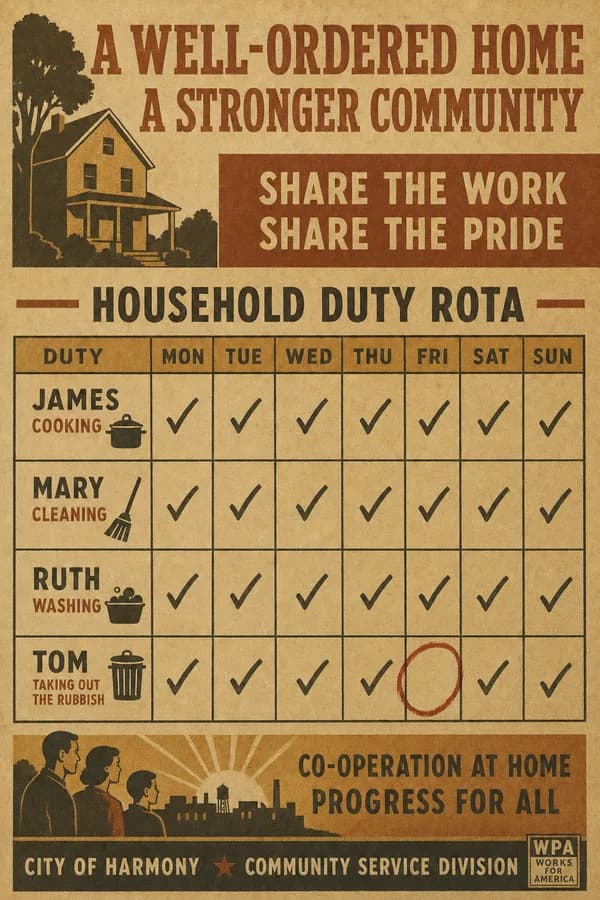
The rota. A family that wishes to hold the eleven-day cadence must treat contribution as a scheduled duty rather than an ambition. Post a rota; check the boxes; do not rely on goodwill. The recurring failure point is Thursday, when the week's fiber has been exhausted and the weekend's has not yet been issued, and the household total dips below the line needed to bank a Sunday session. Route the shortfall around it by front-loading fiber to Wednesday, or accept the occasional thirteen-day breakfast.
Gas storage. Fifteen megajoules of biogas is not produced in one sitting; it accumulates across the interval and must be held. A standard floating-dome holder on the Dungester is adequate, provided it is not also feeding the Farm-to-Fart Range on the same days you intend to run the iron. Cooking gas and generator gas draw from one dome. Meter accordingly, or the waffles and the eggs will compete.
Compliance. A residential digester and its generator fall under the Residential Digestive Contribution Act and are visible to the Office of Civic Digestion. File the accessory-appliance permit, route the generator exhaust through a Fart Scrubber 3000 to keep combustion products inside the setback, and confirm that diverting the household's Sunday output to a private breakfast does not short your metered obligation to the Municipal Fart Grid. Households that draw banked gas during a declared Demand Defecation window should expect the breakfast to be curtailed before the neighbor's.
The guest problem. A visiting fifth adult, contributing for the duration of a weekend stay, advances the next funded breakfast by roughly half a day. This is a genuine and repeatable gain. It is also the only circumstance under which we advise a household to be glad of company, and we note it without further comment.
Conclusion
Sunday waffles are achievable on household brown energy alone, provided the family accepts that "Sunday" names the appliance rather than the schedule. Contributing without exception and diverting nothing, a compliant four-person household funds one 25-minute breakfast about every eleven days — call it three Sundays a month if the Thursdays hold, two if they do not. Faster service is available at the cost of a fifth contributor, a stricter rota, or a second appliance retired to make room in the gas dome. We recommend the rota. It is cheaper than the guest and more reliable than the fiber.