A Failure Mode and Effects Analysis of the Dungester 5000
A reliability engineer computes how often the flagship digester fails, how long it stays down, and which failure the field service program exists to prevent.
Abstract
This paper applies a standard Failure Mode and Effects Analysis to the Dungester 5000 and computes three quantities the marketing literature omits: the probability that a unit completes one year without a failure, the mean time between failures, and the fraction of the year the appliance is actually available to its household. We find that the Dungester 5000, in routine residential service, achieves an availability of roughly two nines — adequate for a compost pile, marginal for anything a family plans a dinner around — and that a single failure mode, addressable entirely through scheduled service, dominates the risk profile.
Assumptions
- Series topology. The gas train is a series system: any one component failing takes the whole appliance offline. System reliability is therefore the product of the component reliabilities, not their average.
- Component reliabilities. Estimated annual reliability (probability of surviving one year without failure) for the six critical components:
| Component | Annual reliability |
|---|---|
| Digester vessel seal | 0.95 |
| Agitator motor | 0.90 |
| Heater and thermostat (holds 35 °C) | 0.88 |
| Gas holder and pressure relief | 0.97 |
| Fart Scrubber 3000 media | 0.85 |
| Gas-train fittings | 0.98 |
- Repair time. A failed unit is not merely fixed; the anaerobic culture must re-establish before gas resumes. Mean time to repair, dominated by re-culturing, is taken as 21 days.
- Exponential failures. Failures are memoryless, so component failure rates add and the system failure rate is their sum.
The Calculation
Probability of a clean year. Multiplying the six reliabilities:
0.95 × 0.90 × 0.88 × 0.97 × 0.85 × 0.98 = 0.61.
A new Dungester 5000 therefore has about a 61% chance of running a full year with no failure, which is to say a 39% chance of at least one failure — better than a coin flip, worse than an appliance anyone would describe as reliable.
Mean time between failures. Each component contributes a failure rate of −ln(R) per year. Summing them:
0.051 + 0.105 + 0.128 + 0.030 + 0.163 + 0.020 = 0.497 per year.
The reciprocal is the MTBF: 1 ÷ 0.497 = 2.0 years. The flagship appliance fails, on average, once every two years. (As a check, e^(−0.497) = 0.61, recovering the clean-year probability above.)
Availability. With an MTBF of 2.0 years (734 days) and a mean repair time of 21 days:
A = 734 ÷ (734 + 21) = 0.972.
The Dungester 5000 is available 97.2% of the time — two nines — and dark for the remaining 10 days a year. For comparison, the grid connection it is often pitched to replace runs above four nines. The appliance you cook on achieves the reliability of a hobbyist web server, and for the same reason: nobody changed the filter.
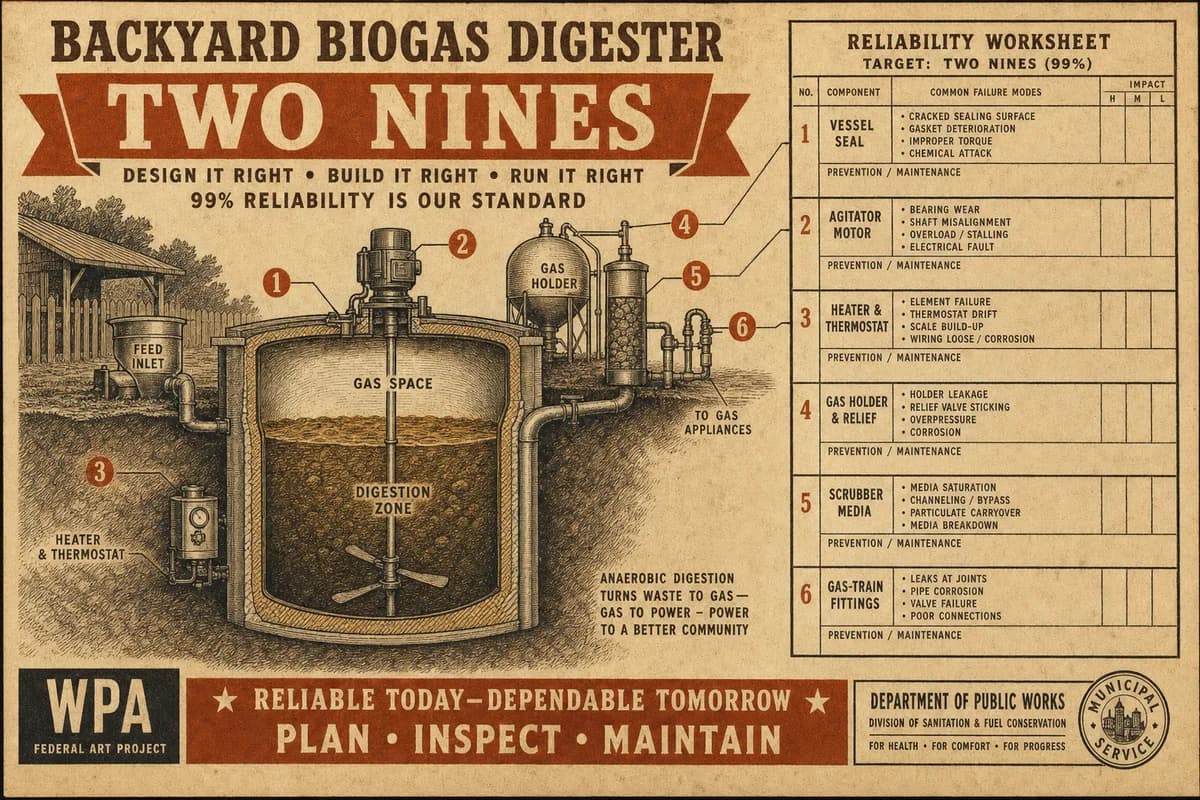
The completed worksheet appears below.
Operational Concerns
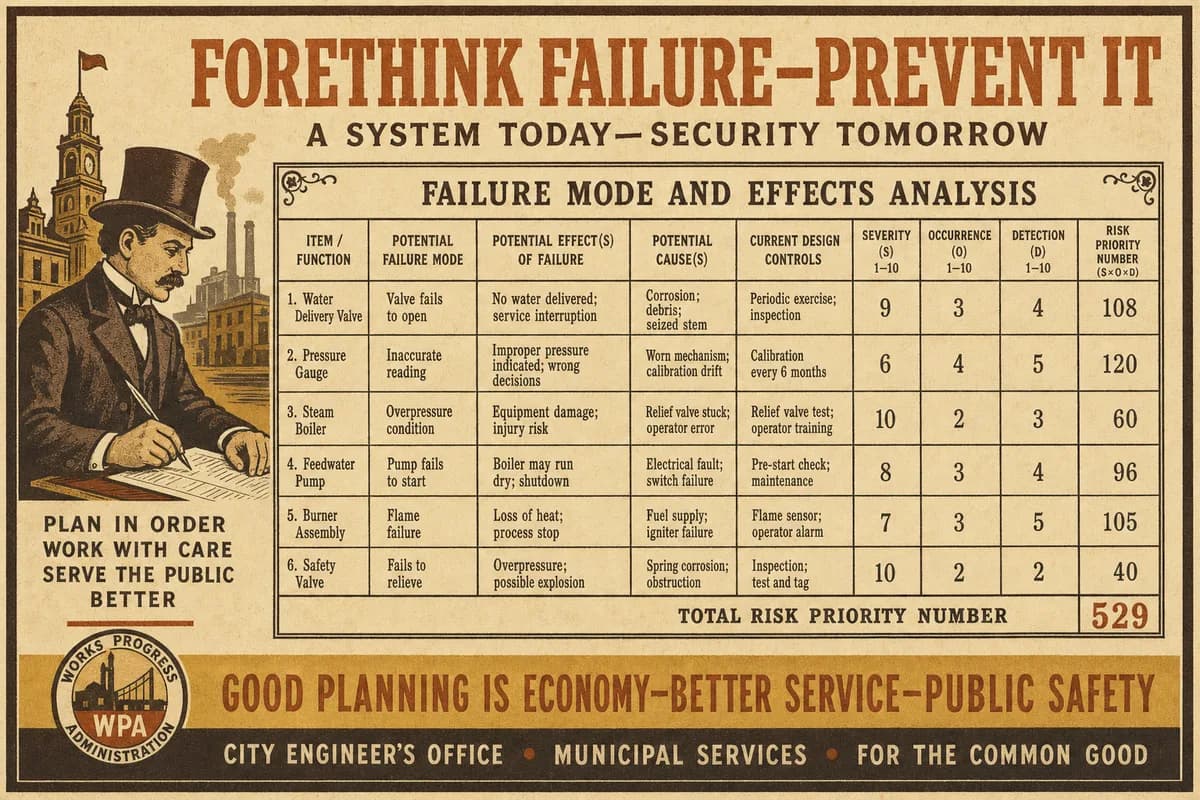
Ranking the failure modes. Availability tells us how often the unit is down; it does not tell us which failure to fund first. For that we compute the Risk Priority Number — Severity × Occurrence × Detection, each rated one to ten — for the dominant modes:
| Failure mode | Sev | Occ | Det | RPN |
|---|---|---|---|---|
| Hydrogen-sulfide breakthrough (scrubber media spent) | 9 | 7 | 3 | 189 |
| Gas leak at a train fitting | 9 | 3 | 7 | 189 |
| Agitator seizure | 5 | 6 | 6 | 180 |
| Mesophilic temperature crash (heater fault) | 7 | 6 | 4 | 168 |
| Overpressure and relief-valve lift | 10 | 2 | 5 | 100 |
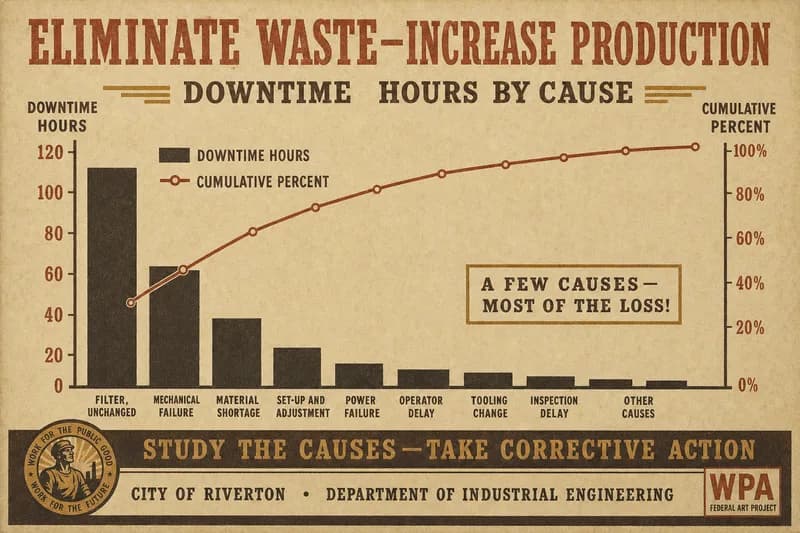
Two modes tie at the top. The gas leak scores high on the strength of poor detectability — a slow fitting weep is nearly invisible until it is not — but it is rare. Hydrogen-sulfide breakthrough is the more actionable one: it scores high because it is frequent and predictable. The Fart Scrubber 3000 does not fail at random; it exhausts on a schedule, and a household that runs the media to breakthrough is not experiencing a fault so much as electing one. The entire field service program exists to convert this failure from an occurrence into a maintenance line item.
The re-culturing penalty. Note that the 21-day repair time is not a plumbing figure; a seal or a motor is replaced in an afternoon. The clock runs long because a digester that has gone cold or sour must re-establish its microbial population before it produces usable gas. This is why an ounce of scheduled service is worth three weeks of cold showers.
Ranking the downtime hours by cause yields the following distribution.
Conclusion
The Dungester 5000 is a two-nines appliance whose reliability is dominated by a single consumable and whose worst downtime is biological rather than mechanical. Both facts point to the same intervention: a scheduled service interval, executed before the scrubber reaches breakthrough, performed by a technician trained to read the gas rather than the calendar. A household that services on schedule converts the 39% annual failure probability into a planned maintenance event and keeps the two nines. A household that rides the scrubber discovers that the difference between an appliance and an ornament is one filter change, administered on time.