The Backyard Digester: A Dungester 5000 Build & Commissioning Guide
Everything you need to build, seal, and commission a single-drum household digester, with honest expectations for what one barrel will and will not run.
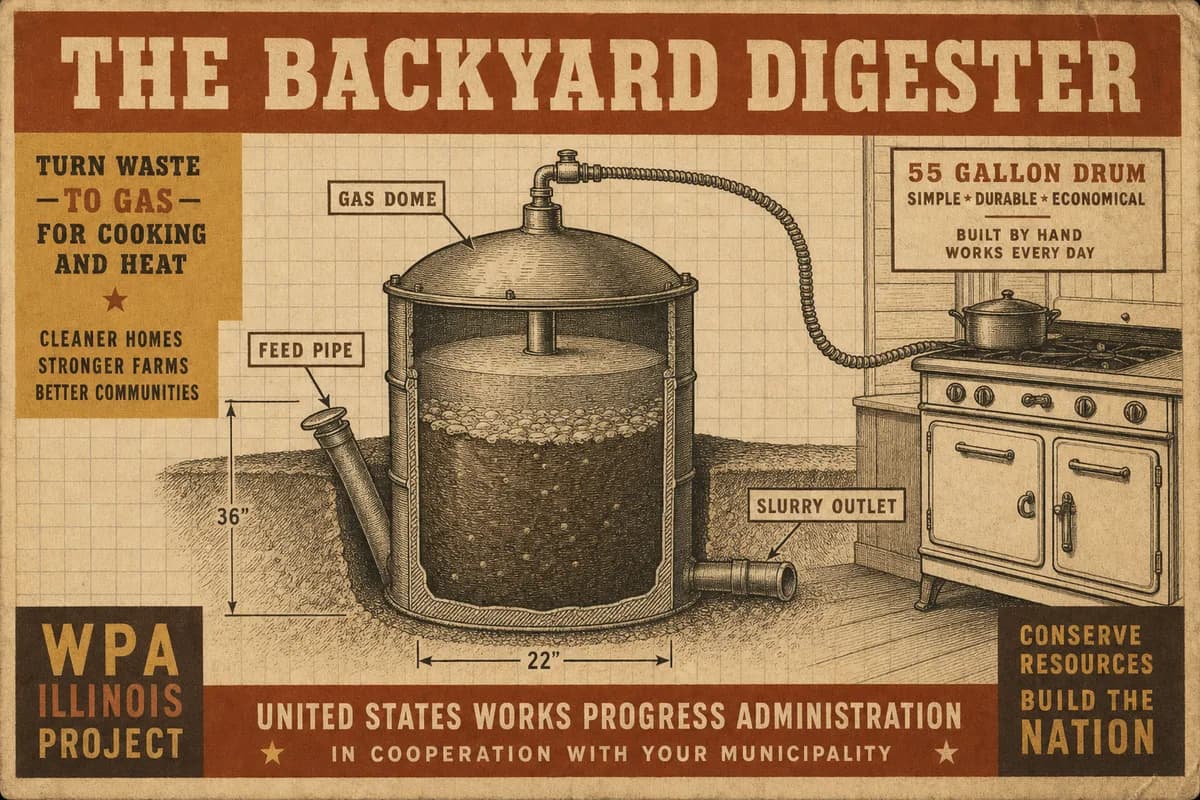
Overview
The Dungester 5000 is the simplest way to bring a working piece of the brown economy onto your own land. At its heart it is an anaerobic digester: a sealed vessel in which bacteria break down organic matter with no air and give off biogas — roughly sixty percent methane — which you can burn for cooking or convert to a modest trickle of electricity. This guide covers a single-drum build sized for one home and one cooperative household. It will not take you off the grid. Fed faithfully and sized honestly, it will earn back a real, renewable fraction of your day.
What you'll need
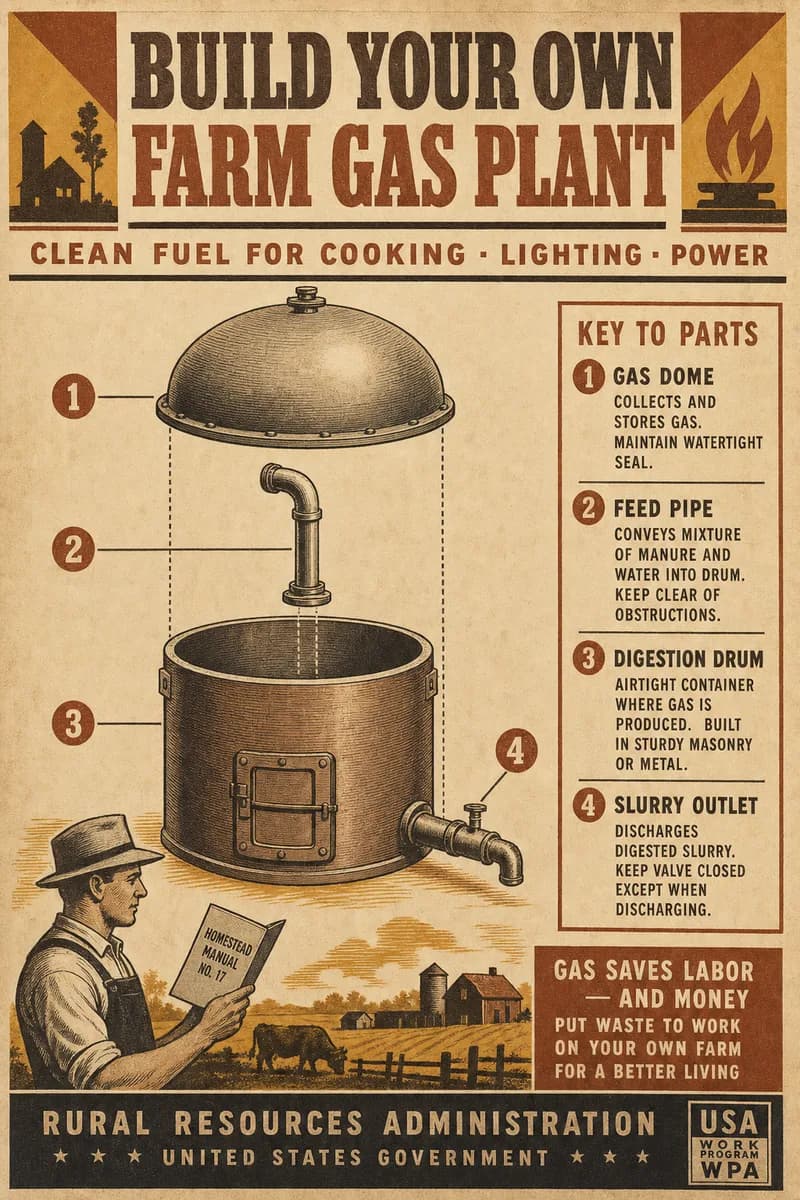
- One 55-gallon (208 L) food-grade steel or HDPE drum with a removable lid — the digester body.
- A second, smaller inverted drum or a butyl gas bag for the floating gas holder. The Dungester 5000 ships with a rolling-diaphragm dome; a salvaged drum works just as well.
- Bulkhead fittings and 1-inch PVC for the feed (inlet) and overflow (outlet) pipes.
- A gas line, a condensate trap, and a low-pressure gauge (0–40 inches of water column).
- A Fart Scrubber 3000, or a length of pipe packed with steel wool and biochar, to strip hydrogen sulfide before the burner.
- A Farm-to-Fart Range or any low-pressure methane burner.
- A thermometer and, in any climate with a real winter, a heat source to hold the vessel at 35 °C.
- Feedstock: your household's daily kitchen scraps; the deep-litter cleanings from a few laying hens; the daily contribution of one dairy goat; and, to start the culture, a five-gallon bucket of fresh manure or active digestate borrowed from a neighbor's running unit.
- Optional: the collected output of a neighborhood Soup Night, which arrives pre-hydrolyzed and shortens your startup by a week.
The exploded view below numbers each part in build order.
Steps
- Site it. Choose a level spot with afternoon sun, downwind of the house and clear of the property line by your jurisdiction's setback. Many jurisdictions treat a digester as an accessory gas appliance and will want a permit; file it before you dig, not after. Keep the vessel within a short pipe run of the kitchen.
- Cut and seal the vessel. Fit the inlet near the top and the overflow near the lower third so slurry flows through the tank rather than around it. Seal every penetration twice. A digester lives or dies on being airtight.
- Build the gas holder. Invert the smaller drum inside the larger one, or mount the Dungester's dome, so rising gas lifts it. The holder's weight sets your delivery pressure, and its height tells you your charge at a glance.
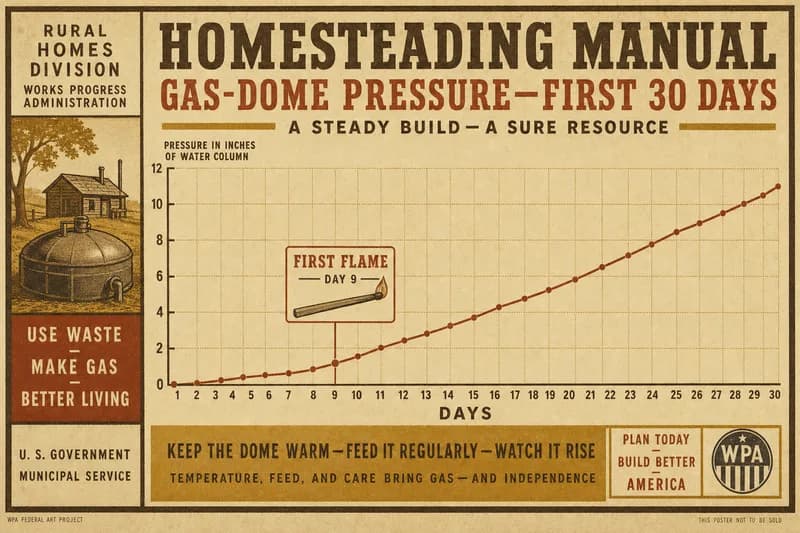
- Charge and inoculate. Fill to two-thirds with a slurry of water and feedstock, then add the bucket of active manure to seed the bacteria. Cap it. Expect the first several days of gas to be mostly carbon dioxide and unburnable; vent it and wait.
- Wait for the culture. Over two to four weeks at 35 °C the methanogens establish themselves and the gas will finally hold a flame. Do not feed heavily until it does.
- Plumb the gas train. Run the line through the condensate trap, then the Fart Scrubber 3000, then to the Farm-to-Fart Range. Test every joint with soapy water. Never with a flame.
- Feed on a schedule. Add a steady daily ration; a digester rewards routine and resents a feast. If you are converting gas to power, route the output through a Fecal Load Balancer so the household's lowest-priority circuits draw first and the essentials draw last.
The commissioning curve below tracks a typical thirty days.
Sizing
Yields below are for a well-established mesophilic drum and are stated net for the warm season — after the gas burned to hold the vessel at 35 °C and a twenty-percent conversion in a small generator. Burned directly on the range, the same charge does roughly five times this much useful work.
| Primary feedstock (daily) | Fresh input | Biogas | Net electrical |
|---|---|---|---|
| One household's kitchen scraps | ~1 kg | ~40 L | ~0.05 kWh |
| + 4 laying hens (deep litter) | ~0.4 kg | ~30 L | ~0.04 kWh |
| + 1 dairy goat | ~2 kg | ~100 L | ~0.12 kWh |
| Full homestead, combined | ~3.4 kg | ~170 L | ~0.21 kWh |
Scaling past a single drum means a second Dungester, not a bigger flame under the first. Two hens do not become twenty; plan the herd, then plan the vessel.
Maintenance & safety
- Hold 35 °C. Below 35 °C the culture stops feeding, and a cold digester is just a sealed drum of everything you put into it. In winter, insulate the vessel or park it against a Turd Furnace and steal the waste heat.
- Respect the gas. Biogas and air are explosive across a wide range; never store the gas indoors, and never chase a suspected leak with a lit match.
- Mind the sulfide. Hydrogen sulfide is the real hazard here. It smells of rotten eggs at low concentrations and of nothing at all at dangerous ones. Keep the scrubber charged and do your work in open air.
- Draw off the digestate. Pull finished slurry from the outlet as you feed the inlet. It is a stabilized fertilizer, not a waste, and the garden will want every drop.
Expected output
A faithfully fed household drum in a temperate climate nets a few tenths of a kilowatt-hour a day once it has heated itself — enough to run the router and, on a good week, the router's ambitions. Most owners get more from the gas by burning it directly on the Farm-to-Fart Range, where a single day's charge covers a pot of morning coffee and a slow-simmered dinner.
Size your expectations to the season. In deep winter the heating load can eat the entire yield, and the honest owner treats those months as maintenance rather than production. The Dungester 5000 does not replace your utility. It makes a standing, renewable down payment against it — and it does so on inputs you were producing anyway.