How Many Dachshunds Does It Take to Charge a Phone?
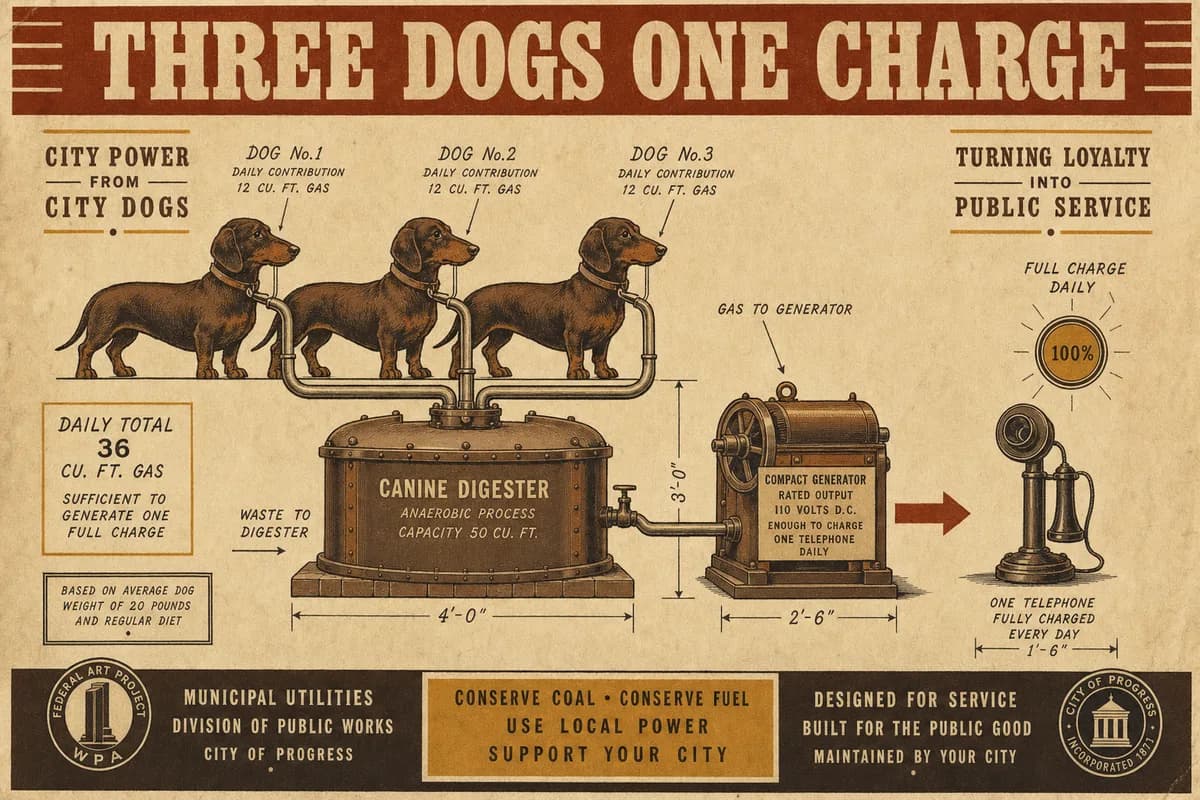
Extending the livestock conversion to the household dog, this study fixes the number of dachshunds whose pooled daily output charges one telephone once a day.
Abstract
This paper extends the standing livestock-to-appliance conversion to its smallest practical keeping animal, the miniature dachshund, and answers the question owners actually ask: how many are required to charge one telephone. We find that three, pooled into a single correctly sized digester and read in fair weather, will return a modern phone to full charge over one day. We also find that the answer is finite only because the dogs are pooled; a single dachshund on its own vessel can, in the wrong season, charge nothing at all.
Assumptions
- The animal. One adult miniature dachshund produces roughly 100 g of fresh waste per day — a household figure, not a kennel one.
- Yield. As an omnivore the dog ferments at about 0.05 m³ of biogas per kg, midway between the coarse herbivores below it on the standing chart and the pig above it.
- Conversion chain. Unchanged from that chart: 6 kWh/m³ gross, 80% surviving digester heating, 20% recovered as electricity — a net of 0.96 kWh per m³ of raw daily gas.
- The load. A modern telephone battery holds about 15 Wh; a full charge, with converter losses, we take as 15 Wh at the wall and do not pad.
The Calculation
One dachshund's 100 g at 0.05 m³/kg is 0.005 m³ of biogas a day. Through the chain that is 0.005 × 0.96 = 4.8 Wh of net electricity per dog per day. A telephone asks 15 Wh. The division is immediate:
15 Wh ÷ 4.8 Wh per dog-day = 3.1 dog-days per charge.
Read across three dogs, that is very nearly a charge a day; read across one dog, it is a charge every three days and change. The headline answer is three dachshunds, and the honest answer carries the same asterisk every small-animal figure on the chart carries, developed below.

Operational Concerns
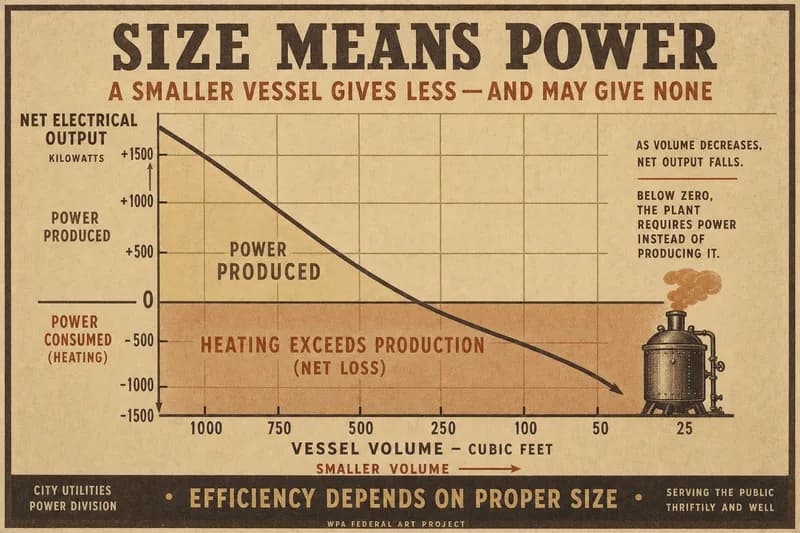
The small-vessel penalty. A digester's heating load scales with its surface; its gas output scales with its volume; and as the vessel shrinks, surface overtakes volume. The 20% heating allowance in the standing chain is a large-tank figure. A vessel sized for one dachshund's five litres of daily gas is nearly all wall, and in cold weather the gas it makes may not cover the gas it burns to stay warm. On its own tank, a single winter dachshund is not a small generator; it is a small, well-fed heater with a pilot light. This is why the answer to the question is three dogs and not one-third of three: the dogs must pool into one properly sized vessel, where the heating penalty is shared, for any of them to net the 4.8 Wh the chart promises.
Diet and consistency. The 0.05 yield assumes an ordinary commercial diet. A dog fed table scraps ferments unpredictably; a dog on a veterinary low-residue diet produces less of everything, gas included. Size the pack to the animals you feed, not the ones on the bag.
Compliance and the neighbors. Three dogs and a warmed digester in a suburban yard fall under the Residential Digestive Contribution Act as an accessory installation, and under the neighbors as a subject of conversation. File the one; there is no form for the other.
Conclusion
The telephone is charged, and the machinery that charges it is grossly disproportionate to the errand: three dogs, a heated tank, a scrubber, a generator, and a permit, all to return fifteen watt-hours by evening — energy a wall socket delivers in the time it takes to read this sentence. The number three is real and the chain behind it is honest, and both exist mainly to locate the exact point on the livestock chart where the animal stops being an energy source and becomes a pet with a byproduct. The dachshund sits just below that point. The Bureau's position is that this is the correct place for it, and that the telephone was never the dog's job.