Feeding the Machine: Contribution Requirements of One AI Chatbot
One AI chatbot answering a billion questions a day, priced in the household digestive output needed to keep its servers fed for a single day.
From the series: How Much Poop Would It Take?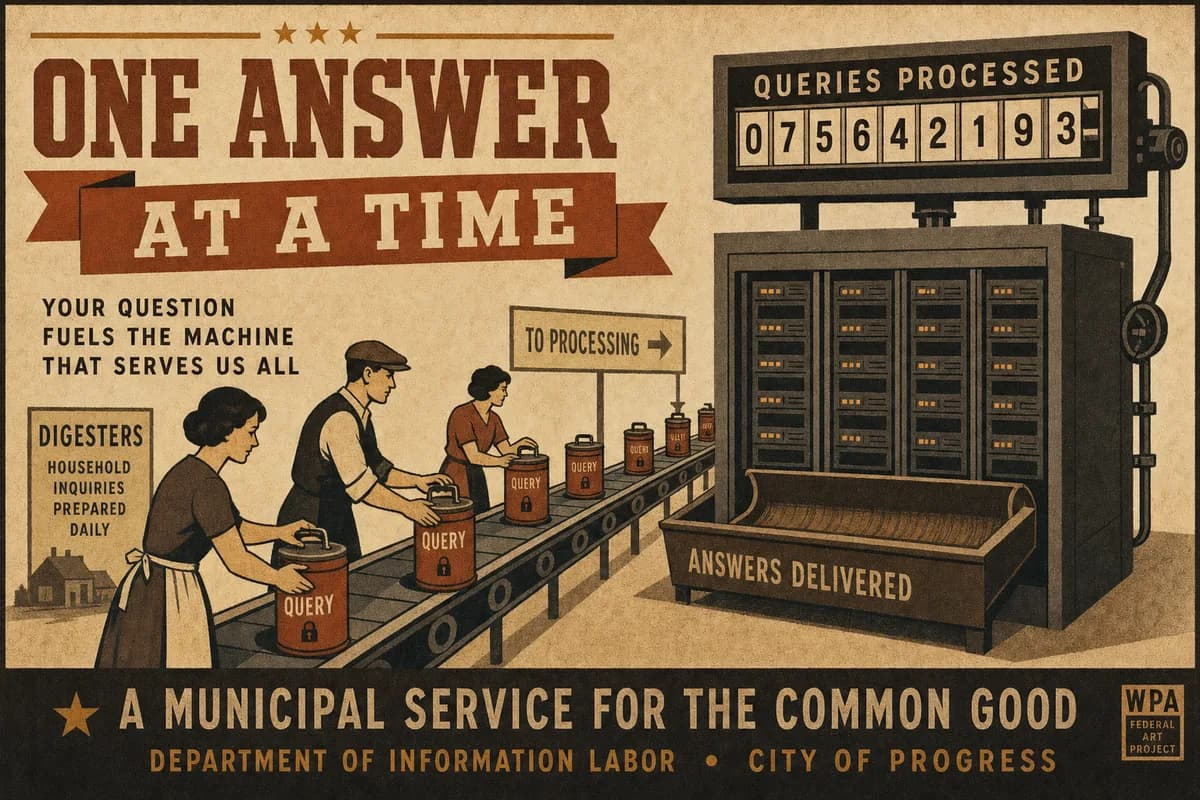
Abstract
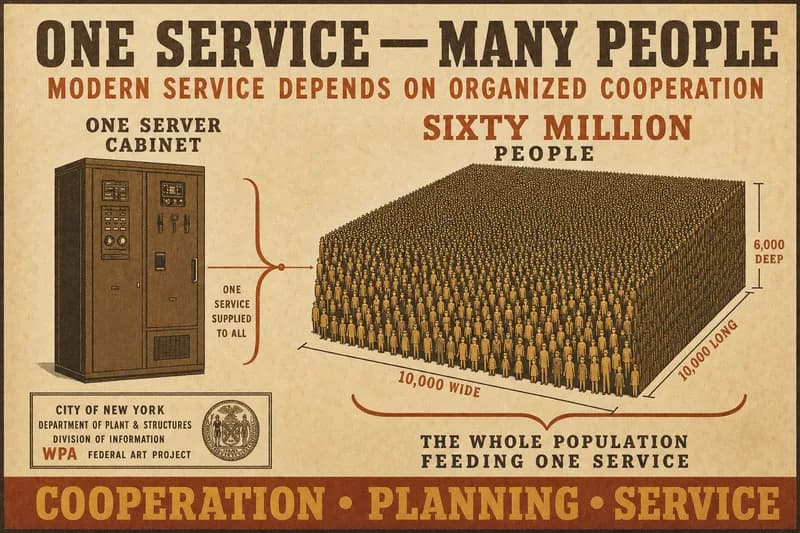
This paper audits the running cost of a conversational model in the currency the Bureau keeps: How much poop would it take to run one AI chatbot? We take the energy of a single inference at the low end of the published range, convert household digestive output to electricity by the standard chain, and size the contributing population required to keep one popular service answering at a billion questions a day. We find that a single day's contribution buys about seventeen answers, and that a service at national scale draws the standing output of 60 million contributors. The model's education is billed separately and is not addressed here.
Assumptions
- The query. One inference is taken at 3 watt-hours — a figure in the small watt-hour range reported for a single response, and the only energy this audit counts. Training, retrieval, cooling overhead, and the retries a confused user issues are excluded; each would raise the total.
- The service. A popular assistant fielding 1 billion queries per day, for a daily inference demand of 1,000,000,000 × 3 Wh = 3,000,000 kWh (3 GWh).
- The standard daily contribution. By the series chain, one contributor yields 0.05 kWh (50 Wh) of electricity per day.
The Calculation
The per-contributor yield resolves the individual case immediately:
50 Wh ÷ 3 Wh = ≈ 16.7 answers.
A day's undivided contribution answers about seventeen questions — roughly what a curious person asks before lunch, and rather fewer than they ask a chatbot in the same interval.

At service scale the daily demand of 3,000,000 kWh, supplied at 0.05 kWh per contributor, requires
3,000,000 kWh ÷ 0.05 kWh = 60 million contributors,
held in place every day the service runs. The same result follows from the answer rate: a billion daily queries divided by 16.7 answers per contributor returns 60 million. One assistant, answering the world's questions, is the standing daily labor of a population the size of a large country's, none of whom may ask it anything, being occupied in feeding it.
Operational Concerns
Duty cycle. Inference load tracks the waking hours of the service's users, peaking through the global afternoon and slackening overnight. Contribution, by contrast, is a once-daily batch on a local schedule. Matching a diurnal, worldwide demand curve to sixty million local breakfast events requires a gas reserve and a Fecal Load Balancer willing to prioritize the servers over the stove — a configuration the Bureau notes but does not endorse for the home.
The uncounted total. The three-watt-hour figure is the floor. Cooling the servers, indexing their references, and answering the same question twice because the first answer was doubted all draw additional power, and each pushes the sustaining population above sixty million. The audit's number is therefore best read as the fewest contributors that could possibly suffice, on the most generous accounting, for the least demanding case.
Standing. The Office of Civic Digestion classes an inference load as discretionary and will not credit contributions routed to it against the household's obligation under the Residential Digestive Contribution Act. A household feeding the model is, once again, contributing to the grid it meant to leave and to the machine besides.
Conclusion
One chatbot, fed honestly, is sixty million people digesting so that the rest of the world may ask questions without digesting at all. A day of a single contributor's best effort purchases seventeen answers; a nation-sized population, sustained without pause, purchases a billion a day and the right to ask none of them. The Bureau's finding is that the machine can indeed be fed on contribution, and that the population required to feed it would, if it merely kept its questions to itself, have no further use for the machine.