Can a Chili Cookoff Stabilize the Grid?
An assessment of the municipal chili cookoff as a dispatchable ancillary service, evaluated against the timing and controllability the grid actually requires.
Abstract
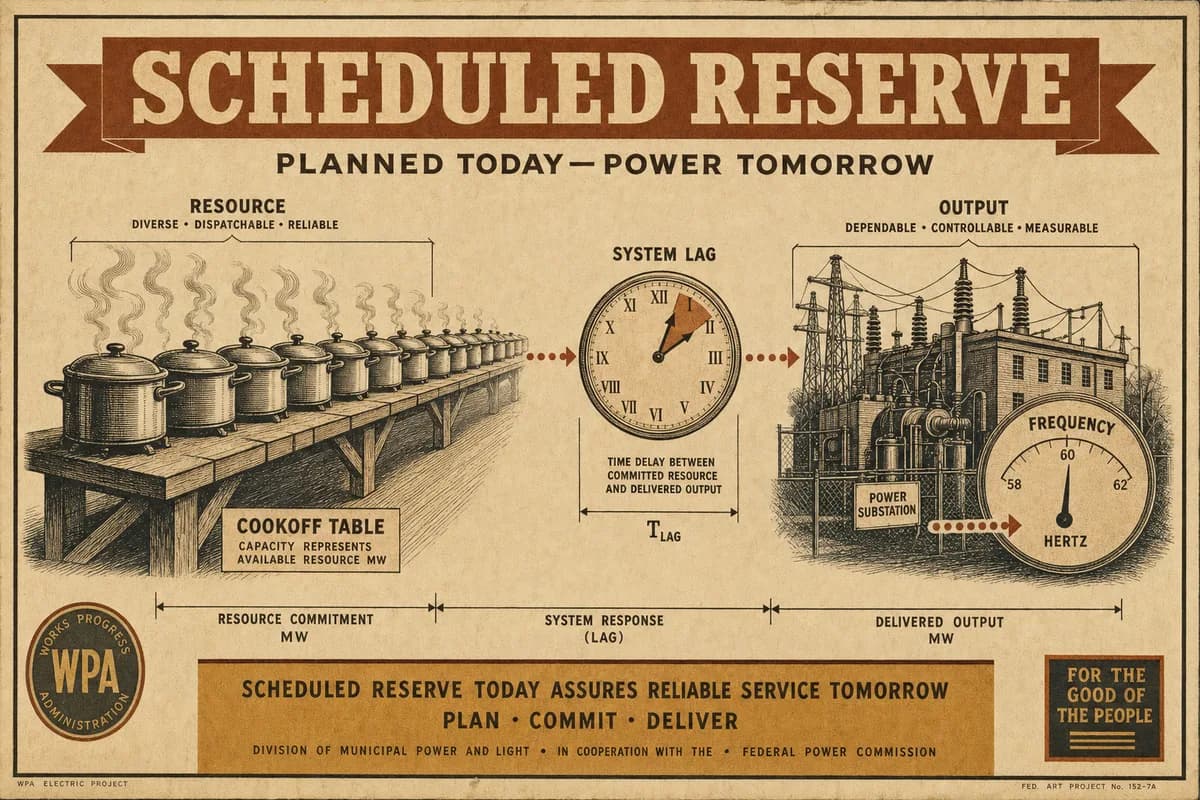
This paper evaluates the municipal chili cookoff as a grid asset. A cookoff produces a large, correlated, and — critically — time-delayed pulse of fermentable feedstock, which the Municipal Fart Grid can convert to biogas. We find that the total energy is negligible, that the delivery timing disqualifies the cookoff for frequency regulation, and that a single large event is not a stabilizing asset but a destabilizing one. A coordinated portfolio of small, phase-offset cookoffs, however, approximates a scheduled peaking reserve.
Assumptions
- Attendance. A well-promoted municipal cookoff draws 400 participants, each consuming one championship bowl.
- Marginal yield. The fermentable load of one bowl produces, over the following 24 hours and through the participant's household digester, an incremental 40 L of biogas.
- Gas quality. Biogas is 60% methane; methane's lower heating value is 35.8 MJ/m³, giving the biogas 21.5 MJ/m³.
- Conversion. A small generator set returns 25% of the fuel's heat as electricity.
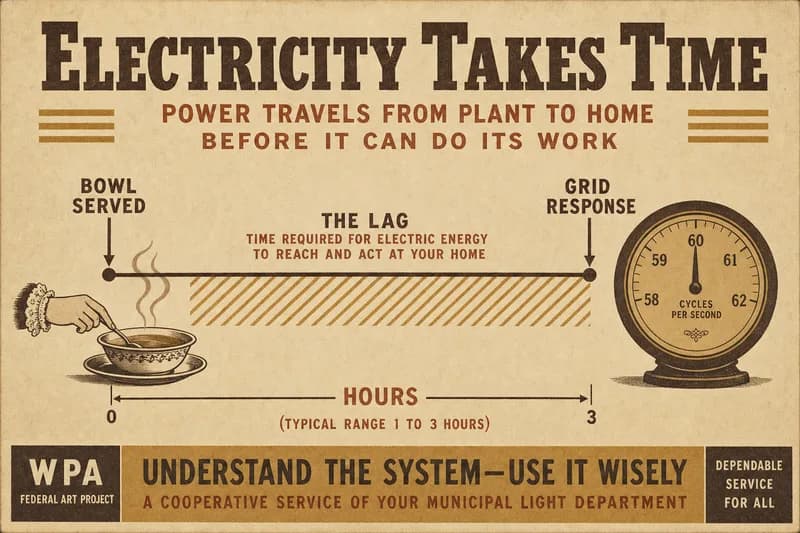
- Delivery timing. Digestive transit spreads the pulse across a window of 6 to 18 hours post-consumption, centered near 12 hours, with a standard deviation of about 3 hours.
The Calculation
Total incremental gas is 400 × 40 L = 16,000 L, or 16 m³. Its heat content is 16 m³ × 21.5 MJ/m³ = 344 MJ. At 25% conversion, the cookoff yields 344 × 0.25 = 86 MJ, or 23.9 kWh of electricity.
For scale, the average household consumes roughly 29 kWh per day. The entire energy output of a 400-person championship cookoff is therefore slightly less than one household-day. Any argument for the cookoff as a grid asset must rest on something other than the size of the number, and it does: it rests on timing.
Figure 1 puts that timing to scale.
Operational Concerns
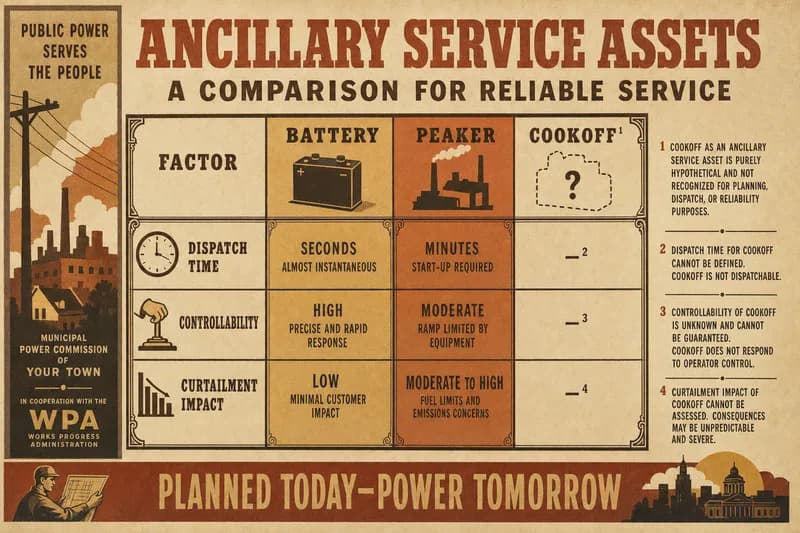
Wrong timescale for regulation. Frequency regulation — holding the grid at 60 Hz within a ±0.05 Hz band — demands a resource that follows the dispatch signal in seconds. The cookoff responds in 6 to 18 hours. It is a ballistic asset: once the participant is served, delivery is governed by physiology, not by the operator, and no automatic generation-control signal can reach it. As a regulation resource the cookoff fails outright.
Right timescale for peaking, wrong controllability. Scheduled peaking is more forgiving. If demand reliably peaks at 6 p.m., an operator can dispatch the cookoff roughly 12 hours prior — that is, hold the event at 6 a.m. — so that output lands on the evening peak. The breakfast cookoff is, on paper, a scheduled reserve. But once served, a bowl of championship chili is a non-dispatchable, non-curtailable, single-shot generator. If the peak passes early, the pulse still arrives; if the peak is deferred, the pulse cannot be held. The operator has a resource he can arm but cannot recall.
The correlation hazard. The gravest problem is that the cookoff works too well. Four hundred participants fed at one sitting produce a single tightly correlated pulse 12 hours later. A pulse of that shape does not flatten the load curve; it adds a new spike to it. This is the failure mode the Office of Civic Digestion already documents under Soup Night, which is formally a grid event for exactly this reason. A large synchronized meal is a supply-side transient, and transients are what the grid pays to avoid.
Figure 2 sets the cookoff beside its rivals.
Conclusion
A single chili cookoff cannot stabilize the grid. Its energy is trivial, its timing is uncontrollable, and at the scale where its output would matter, its correlation makes it a liability. Stability is recovered only by breaking the correlation: a portfolio of small cookoffs, staggered in start time and dispatched against a published calendar, sums to a smooth and predictable ramp — a genuine slow reserve — where any one event would be a spike. We therefore recommend that the Office of Civic Digestion administer cookoff scheduling as an ancillary-services market, phase-offsetting neighborhoods so that the aggregate output is flat. The stabilizing asset is not the chili. It is the calendar.