The Child Who Could Hear the Sewer Thinking
Mireille Aldous heard the district mains deliberating under the streets before she had words for it, and assumed, as children do, that everyone else did too.

The gift, if it was a gift, came to Mireille Aldous before language did, so that for the first years of her life she took the sound of the mains for one of the plain furnishings of the world, like weather, or the color of her mother's voice, and never thought to remark on it any more than she would have remarked on the fact of the ground.
She was four the first time she understood that her hearing set her apart. The family lived on Renwick Court in District 4, an old street where the contribution mains ran close under the stones, and one evening at supper she said, without looking up from her plate, that the north line was thinking about the cold. Her father asked her what she meant, kindly, in the voice a man uses when he has decided in advance that the answer will be charming. She could not tell him what she meant. She only knew that under the street the great slow body of the district's flow was gathering itself the way a person gathers himself in a doorway before going out into bad weather, and that the gathering had a mood, and the mood tonight was reluctance. Two days later the frost came hard and the Renwick pumping station tripped its low-flow alarm, and her father, who had laughed gently at the supper table, did not laugh.
Her mother worried, in the beginning, in the ordinary way of mothers, and took her to a physician who looked in her ears and found them unremarkable, and then to a second who listened longer and said, choosing his words, that the child seemed to be hearing something real and simply hearing it better than the instruments did. He advised against making a great deal of it. Children who are made much of, he said, learn to perform, and then you can no longer trust what they tell you.
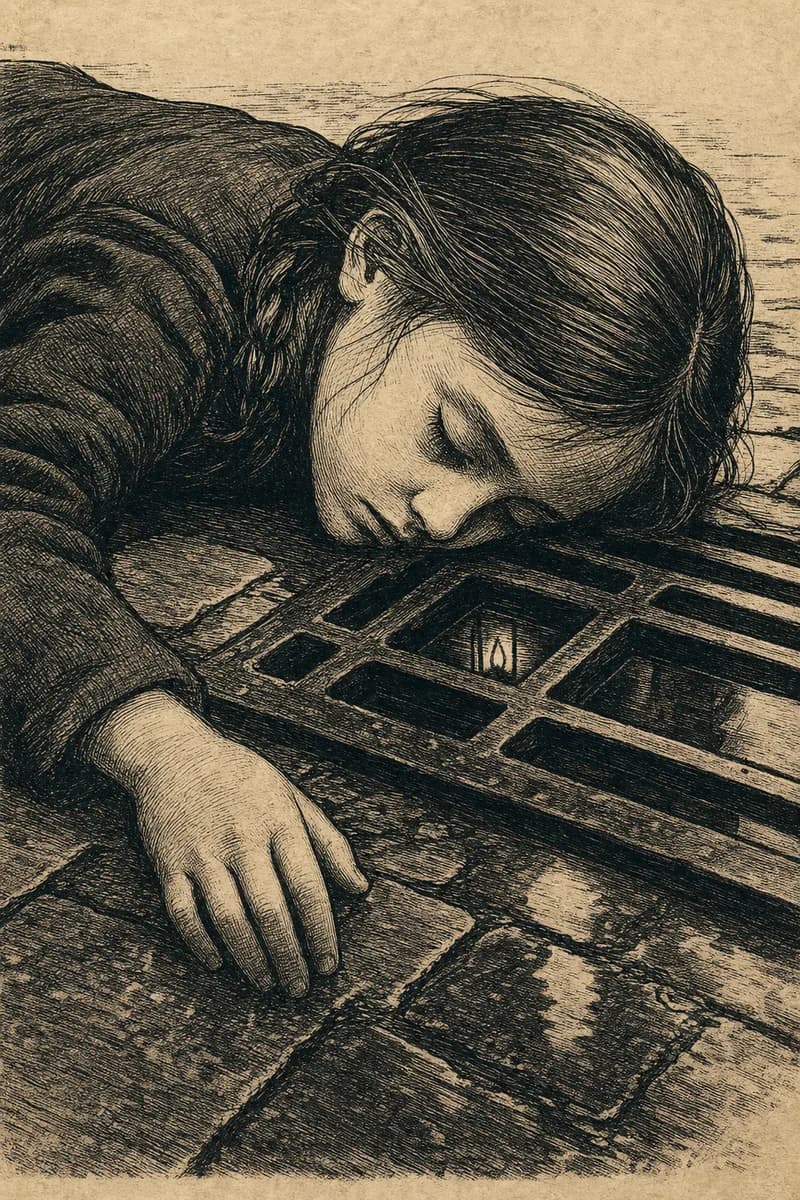
So they did not make much of it, and Mireille grew up believing, for a while longer, that all children lay in the street with their ears to the grates and heard the district deliberating below. She learned only slowly, and with the particular loneliness of that kind of learning, that they did not. Her friends heard, at most, a rushing — the flat unmeaning sound of matter in motion. Mireille heard the reasoning inside the rushing. She heard the mains take a heavy load from the terraces at the top of the district and weigh it against the narrow old pipe under the market and decide, in the long deliberative way she had no other word for, to hold some of it back a while at the Renwick junction rather than force the market line past its patience. She was not describing what the mains did. She was describing what they were about to decide.
The district engineer came to the house when she was eleven. His name was Osei, and he had heard of the Aldous girl the way a working man hears of a useful thing, sideways, over years, discounting it until the day he could not afford to. He was losing a pipe somewhere under the eastern blocks — the telemetry showed a slow rise in back-pressure that his instruments could locate only to within four streets, and four streets is a great deal of digging. He sat at the kitchen table and asked Mireille, without condescension, whether she would walk the eastern blocks with him and tell him what she heard.
She walked them. She was a grave child by then, unhurried, and she knelt at grate after grate the way a doctor moves from bed to bed, and at the corner of Loom and Pell she stayed a long time with her cheek against the iron, and then she stood and told him that the trouble was not a blockage at all. The main under Loom Street was sound. It was the main it fed into, two junctions on, that had begun to fail, and the Loom main knew it — she said knew, and Osei did not correct her — and had been quietly carrying more than its share for weeks to spare the failing line, the way you take a limping man's arm without saying anything about the limp. Dig at the second junction, she said, not the first. He dug at the second junction. She was right.
After that the load center kept a place for her, unofficially at first and then as a plain fact of the district's operation, the way a port keeps a pilot who knows the channel the charts cannot quite express. She was never on any roster. But when the instruments disagreed with themselves, or when a season did something the models had not been built to imagine, someone would telephone the Aldous house, and Mireille would put on her coat.
She never learned to explain it, and stopped, in time, wanting to. The engineers spoke of flow and head and residence time, and she did not dispute a word of it; their language described the district truly, the way anatomy describes a person truly. It only left out the part she could hear. She grew up and grew older and walked the district at night with her lantern and her unremarkable ears, and she came to think of the mains not as a machine that she happened to understand but as an old, patient, deliberating neighbor, one who bore the whole weight of the district's daily life without complaint and asked, in return, only that once in a while someone kneel down in the cold and actually listen to what it was trying to decide. She did not think this made her special. She thought only that it was rude, in a city, to be the one person who could hear a thing and to walk past it every night saying nothing.