The Brownwall Powerwall: Thermal Storage in a Pile of Warm Compost
How to build a wall of warm compost that stores low-grade heat in water coils, with honest figures for how much warmth one pile will give and for how long.
Overview
The Brownwall Powerwall is the simplest storage you can add to a Brown Home™, because it stores the one form of energy your homestead is best at making by accident: heat. It is a wall of coarse, actively composting material — wood chips, manure, and green trimmings — wrapped in water coils. As the pile decomposes aerobically it climbs to 55–65 °C and holds there for weeks, and the coils carry that warmth into a buffer tank, a radiant floor, or the incoming cold water it is your job to preheat.
It stores heat, not charge. There is no inverter, no cell chemistry, and no meaningful round-trip efficiency, because you cannot put the heat back once it is spent — you rebuild the pile. What you get instead is a battery that costs almost nothing, asks for no rare metals, and retires into finished compost for the garden. This guide covers a single household-scale wall and states honestly how much warmth one pile will give, and for how long.
What you'll need
- A wood-framed bin, roughly 2 m³ to 4 m³, sited against a north or windward wall and lined on every outside face with rigid foam or straw — an uninsulated Brownwall heats the weather.
- 150–200 m of ½-inch PEX or black poly coil, to be laid in loops between the compost lifts.
- A small circulation pump, or a thermosiphon rise to a buffer tank mounted above the wall.
- A buffer tank and, ideally, a radiant loop or a preheat coil on your domestic cold-water line — the Brownwall makes warm, not hot, and it wants a low-temperature load to feed.
- A 36-inch compost thermometer to read the core, which is your only state-of-charge gauge.
- Feedstock: coarse woody bulking material at roughly a 30:1 carbon-to-nitrogen ratio — a season's coop deep-litter, the woody trimmings of one hedge, and the fibrous digestate the Dungester 5000 could not break down further.
- Optional: a neighborhood's Fiber Week bulking collection, which arrives pre-shredded and builds a hotter pile a week faster.
Steps
- Frame and insulate the bin. Build it tall and narrow rather than low and wide; a compact core holds temperature, and a thin spread-out pile is just a slow, cold mess. Insulate every outside face. Every degree you keep in the pile is a degree the coils get to deliver.
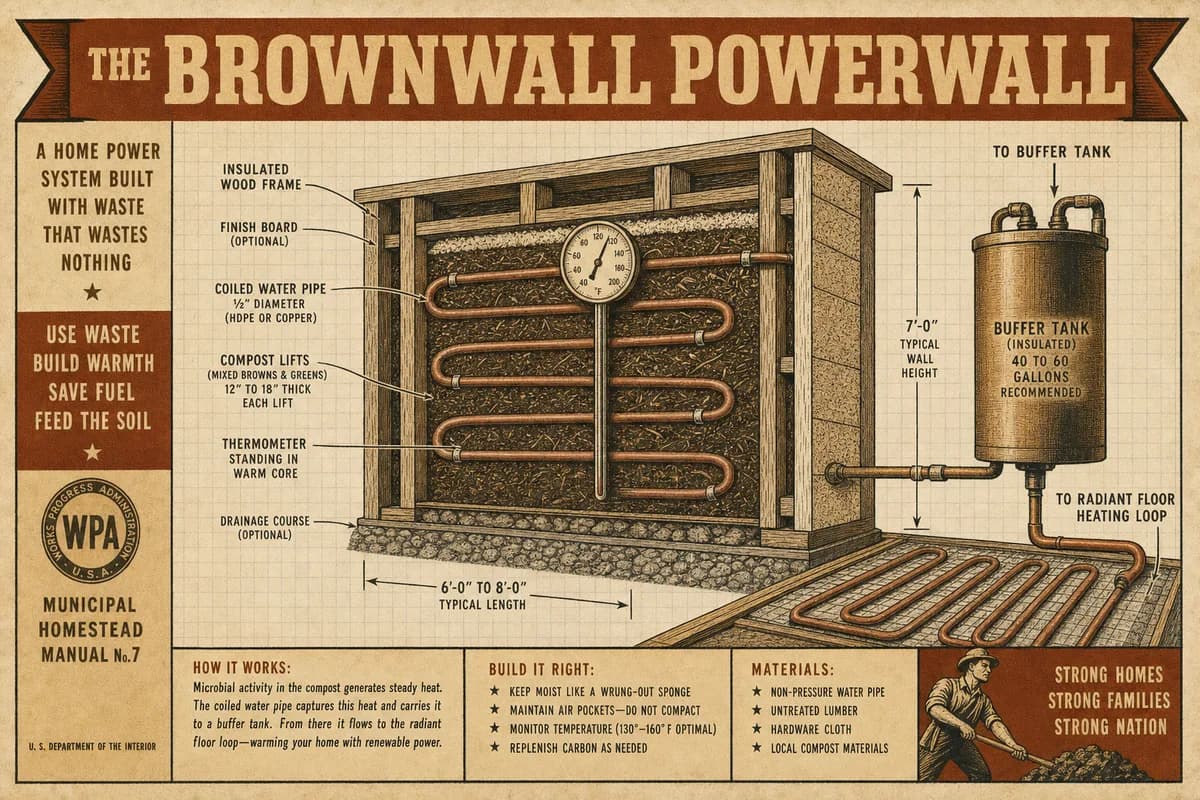
- Build the pile in lifts, laying coil as you go. Add compost in 20 cm layers, wetting each to the dampness of a wrung sponge, and snake a loop of coil across every second lift so the water threads the whole warm mass. Keep the coil clear of the outer 15 cm, where the pile runs cool.
- Charge it. Cap the wall loosely and let it work. Over four to seven days an aerobic pile will climb past 55 °C on its own; if it stalls below 40 °C it is too wet, too dry, or short on nitrogen. A Brownwall that will not heat is not a battery, only a woodpile.
- Plumb the coils to the load. Run the coil to the buffer tank and circulate slowly. Draw the warmth into a radiant floor, a preheat tank, or — in a full Brown Home™ — the return side of the Sewer-Source Heat Pump, which is glad of any water arriving warmer than the drain.
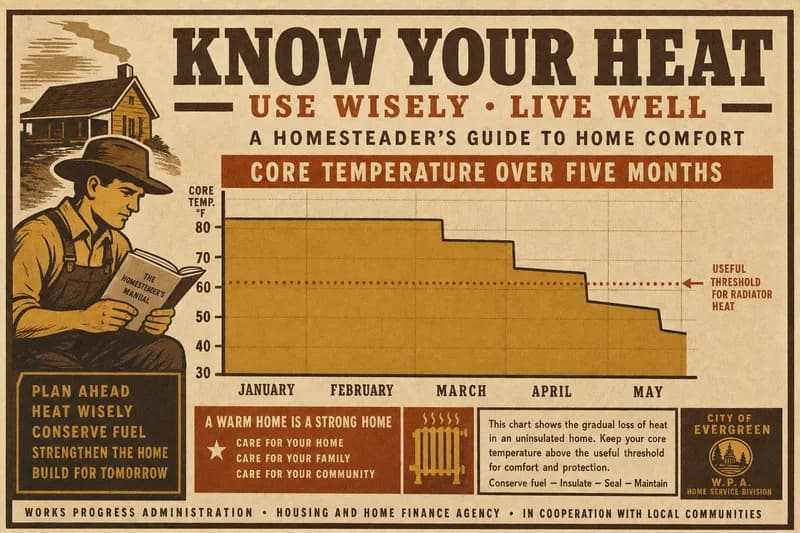
- Read the core and draw within budget. The core temperature is your charge. Pull heat faster than the pile makes it and you will watch the reading fall in real time; pull within the pile's output and it will hold for weeks. Log the build date, the core temperature, and the coil pressure on a card kept on the bin.
- Rebuild when it's spent. When the core settles below about 40 °C and will not recover on turning, the pile is finished as a battery. It is also, at that point, finished compost. Empty it to the garden and build the next wall.
Figure 1 sections a single lift and its coil.

Sizing
Figures below are for a well-built aerobic pile of coarse woody feedstock, holding a warm core in a temperate season. Delivery temperature is the water the coils actually give you, which is always well below the core; a Brownwall is a low-grade heat source and rewards a low-grade load.
| Pile volume | Core held | Coil delivery | Sustained draw | Service life per charge |
|---|---|---|---|---|
| 1 m³ | ~55 °C | ~40 °C | ~1–2 kWh(th)/day | ~3 weeks |
| 2 m³ | ~60 °C | ~45 °C | ~3 kWh(th)/day | ~5 weeks |
| 4 m³ | ~60–65 °C | ~48 °C | ~4–5 kWh(th)/day | ~8 weeks |
| 6 m³ | ~65 °C | ~50 °C | ~6 kWh(th)/day | ~10–12 weeks |
Scaling a Brownwall means building it bigger at the start, not feeding it later. Unlike the Dungester 5000, you do not top a compost battery up; you spend the charge it was born with and then you build another. Plan the wall for the coldest load you mean to carry.
Maintenance & safety
- A Brownwall never idles. Draw the heat into your floor or lose it to the sky, but the pile cooks itself out on the same schedule either way. The only decision the wall leaves you is whether the warmth it was always going to release ends up somewhere useful.
- Keep it aerobic. A Brownwall should smell of warm forest floor. If it starts to smell of the Dungester 5000, it has gone anaerobic in the middle and stalled; turn it and add coarse bulking to open the pile back up. This is a thermal battery, not a second digester.
- Mind the water, both ways. A pile dried out will quit; a pile drowned will pack down, turn septic, and stop being your battery. Wrung-sponge damp is the whole target.
- Watch the coil, not just the core. Slow, low-temperature circulation pulls the most total heat; blasting cold water through fast only chills the pile and shortens its life.
Expected output
A 4 m³ Brownwall Powerwall will keep the loop of a small radiant floor warm, or take the first cold shock off your incoming water, for the better part of two months before it asks to be rebuilt — call it four to five kilowatt-hours of low-grade heat a day, for as long as the pile is willing. It will not make a room hot on a design-cold night, and this guide will never tell you it does. It makes a standing, renewable puddle of warmth from material you were going to compost anyway.
Size the wall to a modest, patient load and it will be the warmest thing in the house that you never plugged in. Size it to your ambitions and it will disappoint you politely, then turn into fertilizer. That second outcome, at least, is one no other battery you own can offer.
Figure 2 traces that drawdown across a season.