The Brown Home™ Operating System: Owner's Manual
Congratulations on your purchase; please read this manual in full before your first flush.
Welcome to your Brown Home™
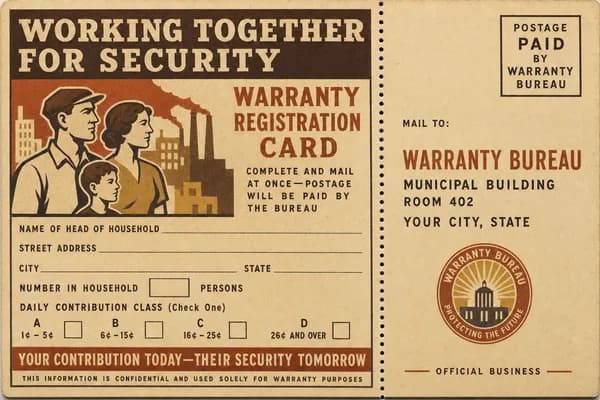
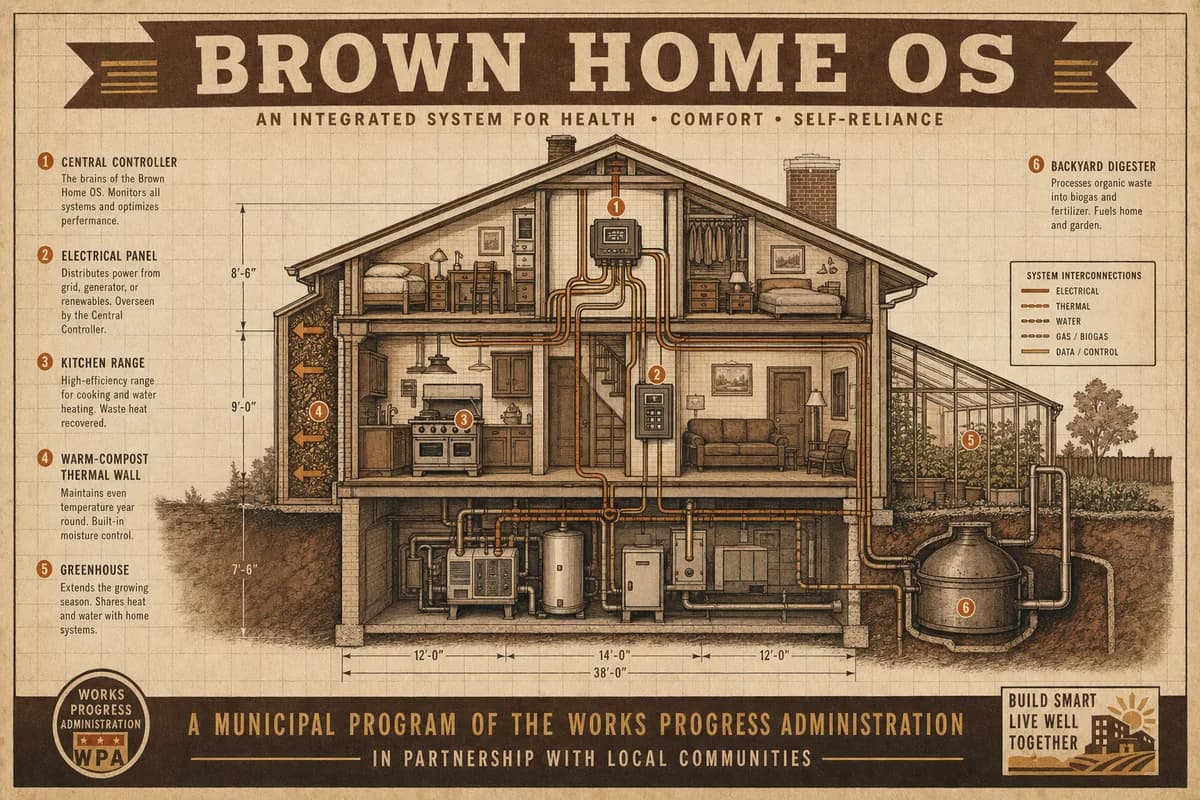
Thank you for choosing the Brown Home™ Operating System. Your household is now a small, closed-loop utility that runs on inputs you were producing anyway. This manual describes every component in the launch product line, how they connect, and how to keep them running. Please read it in full and retain it for the life of the installation. Register your system within thirty days to validate the warranty; registration is confirmed automatically the first time your controller reports to the Municipal Fart Grid.
Keep this manual near the panel. You will need it more than you expect.
How your system works
At the center of every Brown Home™ is the PooPS — the Poop Operating Power System — the whole-home controller that ties the other components together. Waste enters the loop, the loop extracts gas, heat, and fertilizer from it, and the PooPS decides where each of those goes and in what order. Nothing in your Brown Home™ operates in isolation; each appliance is a stage in a single cycle the controller manages on your behalf.
There is no off switch, because the system was not designed to be off. A closed loop that is switched off is simply a house full of feedstock with nowhere to go. Plan for reduced output, not for a stopped system.
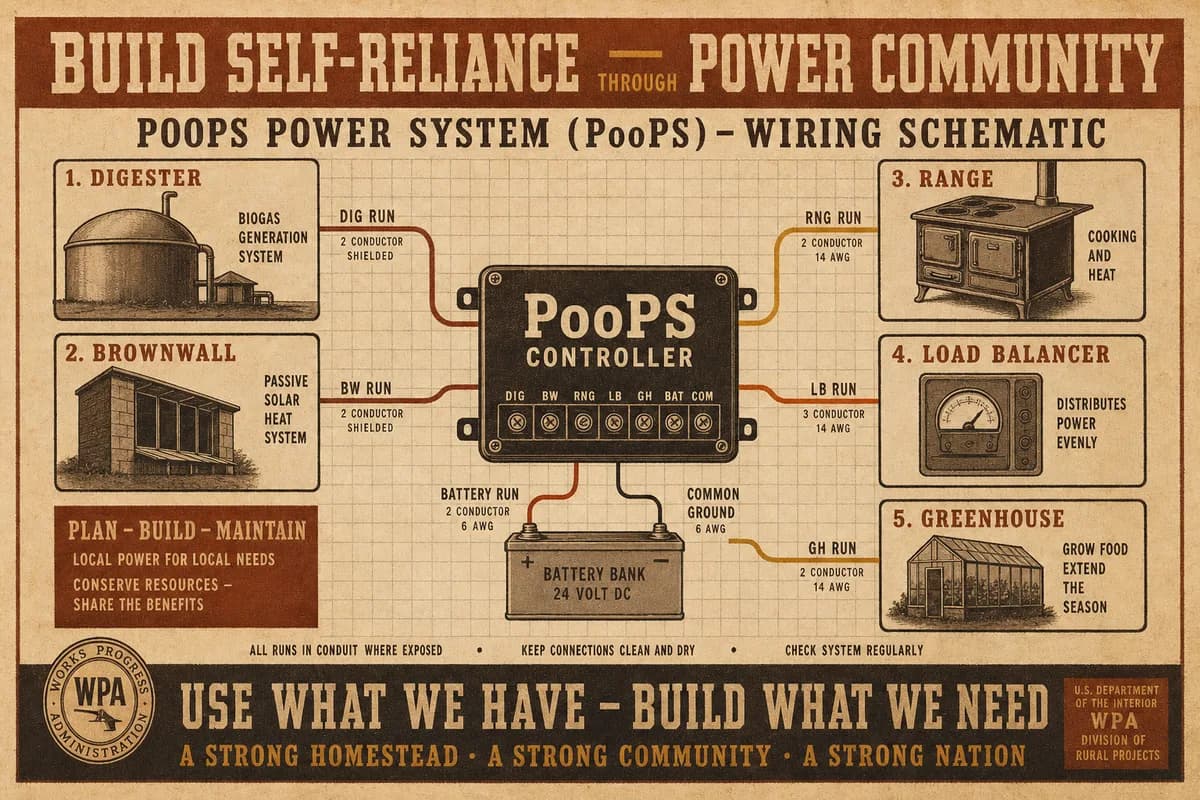
The schematic below traces every run from the controller.
Your components
Dungester 5000. The flagship appliance: a backyard anaerobic biogas digester that breaks down household organic waste and manure in a sealed, airless vessel and gives off biogas — roughly sixty percent methane. Everything else in the loop is fed, directly or indirectly, by the Dungester 5000. Hold it at 35 °C and feed it on a schedule; see its dedicated build guide for commissioning.
Farm-to-Fart Range. A low-pressure methane cooking stove fed straight from the digester's gas line. On a good day one charge covers morning coffee and a slow-simmered dinner. The Range draws gas ahead of the generator, because burning biogas directly recovers far more useful energy than converting it to electricity.
Brownwall Powerwall. Your thermal battery: a wall of warm, actively composting material wrapped in water coils. It stores heat, not charge — the coils carry warmth into the house on demand and buffer the temperature swings the rest of the loop would otherwise pass along to you.
Sewer-Source Heat Pump. A heat-recovery unit that pulls warmth from graywater and shower-water on its way out of the house and returns it to the loop. Every warm drop you send down a drain is inventory; the heat pump is how you keep it.
Fecal Load Balancer. A smart electrical panel that prioritizes your circuits by available biogas. When production is high, everything runs; when it dips, the Load Balancer sheds your lowest-priority circuits first and protects the essentials. Set your priorities once, at commissioning, and revisit them honestly each season.
Fart Scrubber 3000. A biochar odor-filtration unit that strips hydrogen sulfide from the gas before it reaches any burner. This is a safety component, not a comfort feature. Keep it charged.
Maggot Battery. A black-soldier-fly larvae loop that converts waste the digester cannot use into chicken feed. The larvae eat what you cannot digest, the hens eat the larvae, and the loop closes one turn tighter. Despite the name, it stores no electricity; it stores protein.
Turd Furnace. A compost-heated greenhouse that uses the loop's waste heat to extend your growing season. Park a cold-climate Dungester 5000 against the Turd Furnace and let the two appliances warm each other.
Elephant Mode. The emergency megafauna backup generator: a large-animal digester profile for households that keep one. It is a mode, not a plan — a way to ask an animal you already feed to carry the electrical load for a while. See the Elephant Mode guide before enabling it, and size your expectations to the animal.
Interconnection and sizing
The PooPS expects the components to be wired in the order the loop runs: waste to the Dungester 5000, gas through the Fart Scrubber 3000, then to the Farm-to-Fart Range and generator, with the Fecal Load Balancer governing the electrical side and the Brownwall Powerwall and Sewer-Source Heat Pump managing heat. A Brown Home™ sized honestly does not replace your utility; it makes a standing, renewable down payment against it. Size every stage to what your household actually produces, never to what you hope to consume.
Troubleshooting
| Symptom | Likely cause | Remedy |
|---|---|---|
| Range will not hold a flame | Culture cold, or gas mostly CO₂ | Confirm 35 °C; vent unburnable gas; wait for the culture |
| Gas smells of rotten eggs | Fart Scrubber 3000 spent | Recharge the scrubber before further use |
| Essential circuits dropping | Biogas production down | Check digester temperature and feed rate; review Load Balancer priorities |
| House is cold, gas is fine | Brownwall Powerwall run down, or heat pump fouled | Turn the compost; clean the graywater exchanger |
| Output collapsed in winter | Heating load exceeds production | Insulate the vessel; treat the season as maintenance |
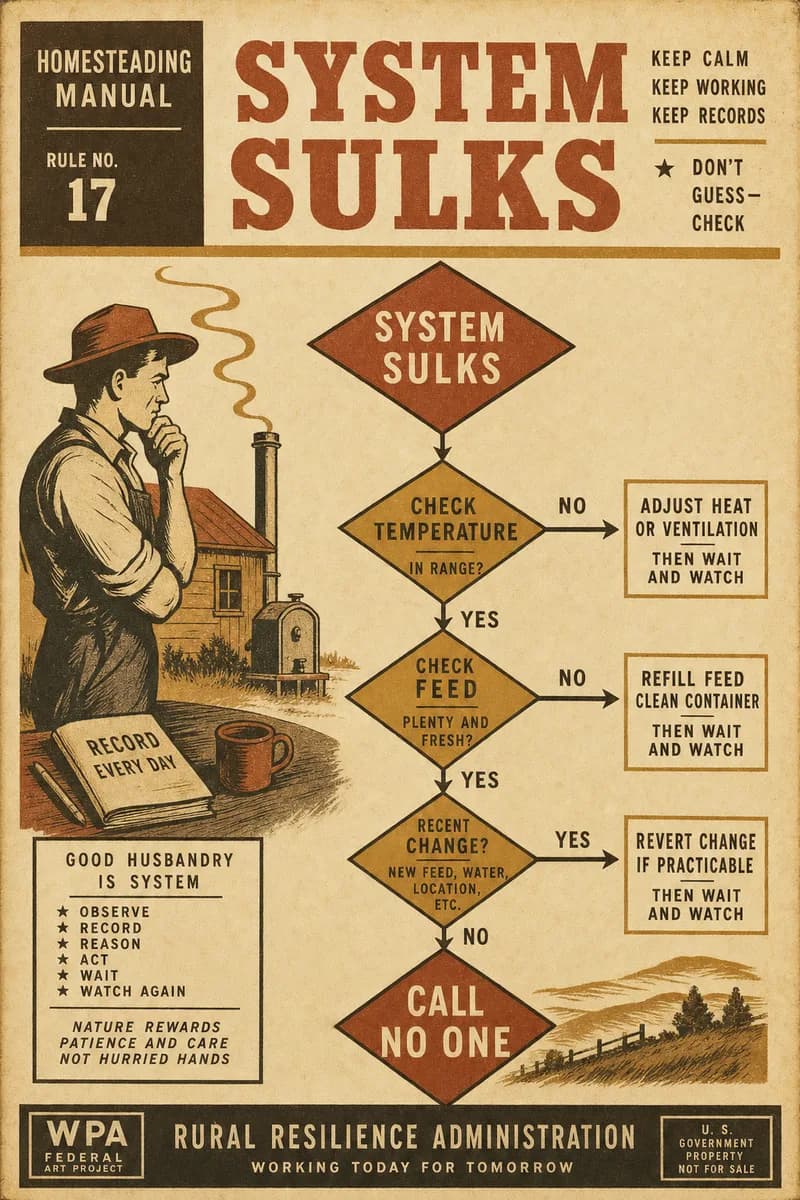
| No output, no obvious fault | Loop switched off or starved | There is no correct way to switch the loop off; resume feeding |
The flowchart below follows the same path in order.
Maintenance and safety
Service the Fart Scrubber 3000 on schedule; it is the difference between an odor and a hazard. Hold the Dungester 5000 at temperature, feed it steadily, and draw off digestate as you feed. Never store biogas indoors, and never chase a suspected leak with a flame.
Note that the PooPS keeps a complete record of your household's output and shares it with the Municipal Fart Grid at intervals you do not set and cannot adjust. This is a feature of your Brown Home™, not a fault, and it is not covered by any setting in this manual.
What to expect
A well-run Brown Home™ will not take you off the grid, and this manual will never tell you it does. It will meet a real, renewable fraction of your day — a pot of coffee, a warm floor, a router and the router's ambitions — on inputs your household was going to produce regardless. Run every component to its honest capacity, keep this manual near the panel, and let the PooPS do the rest. It intends to either way.
A facsimile of the registration card appears below.