A Beginner's Guide to Household Biogas
Household biogas turns daily kitchen scraps and bedding into a small renewable flame; here is what one backyard drum honestly makes, and what it will not.
Overview
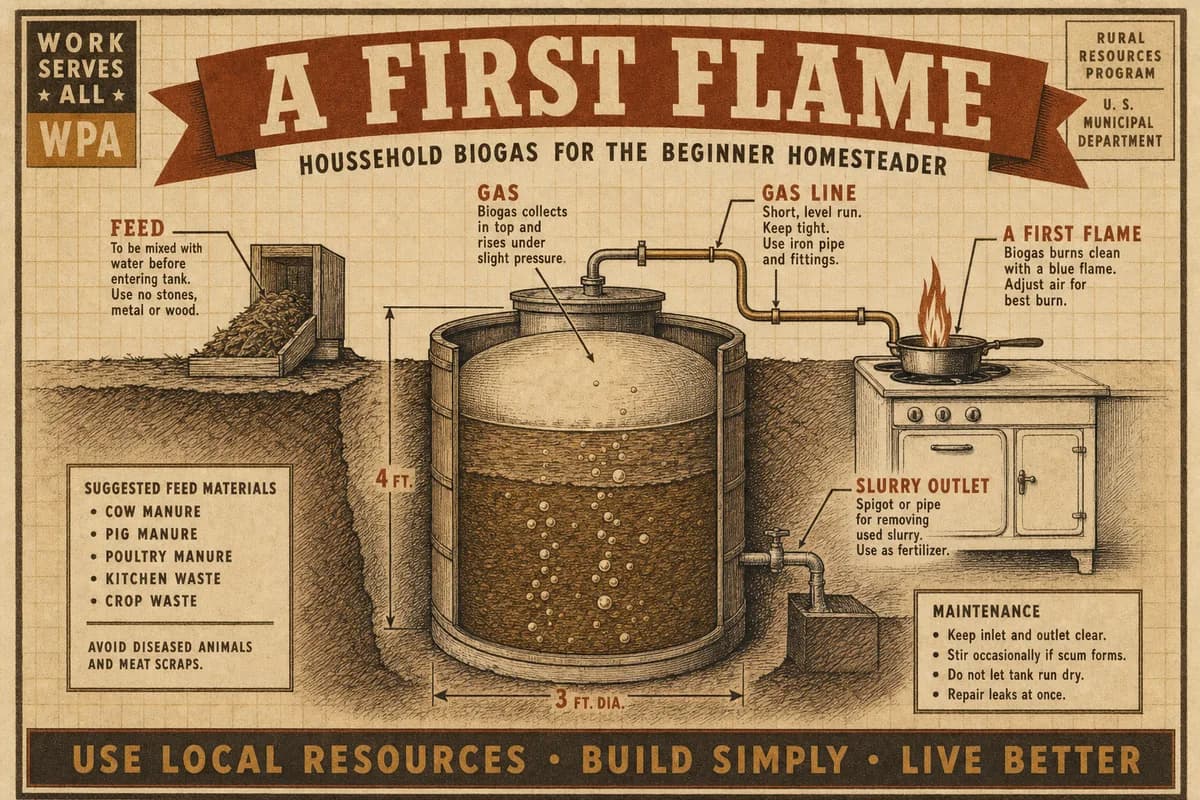
Household biogas is the smallest working piece of the brown economy you can bring onto your own land, and it is the one every homesteader should meet first. In a sealed, airless drum, bacteria break down your household's organic waste and give off biogas — a mixture that is roughly sixty percent methane — which you can burn on a stove. This guide is not a build manual; it is the orientation you read before you decide. The flagship appliance is the Dungester 5000, but the idea underneath it is older than any catalogue, and it asks only three things of you: keep the air out, keep the drum warm, and feed it every day.
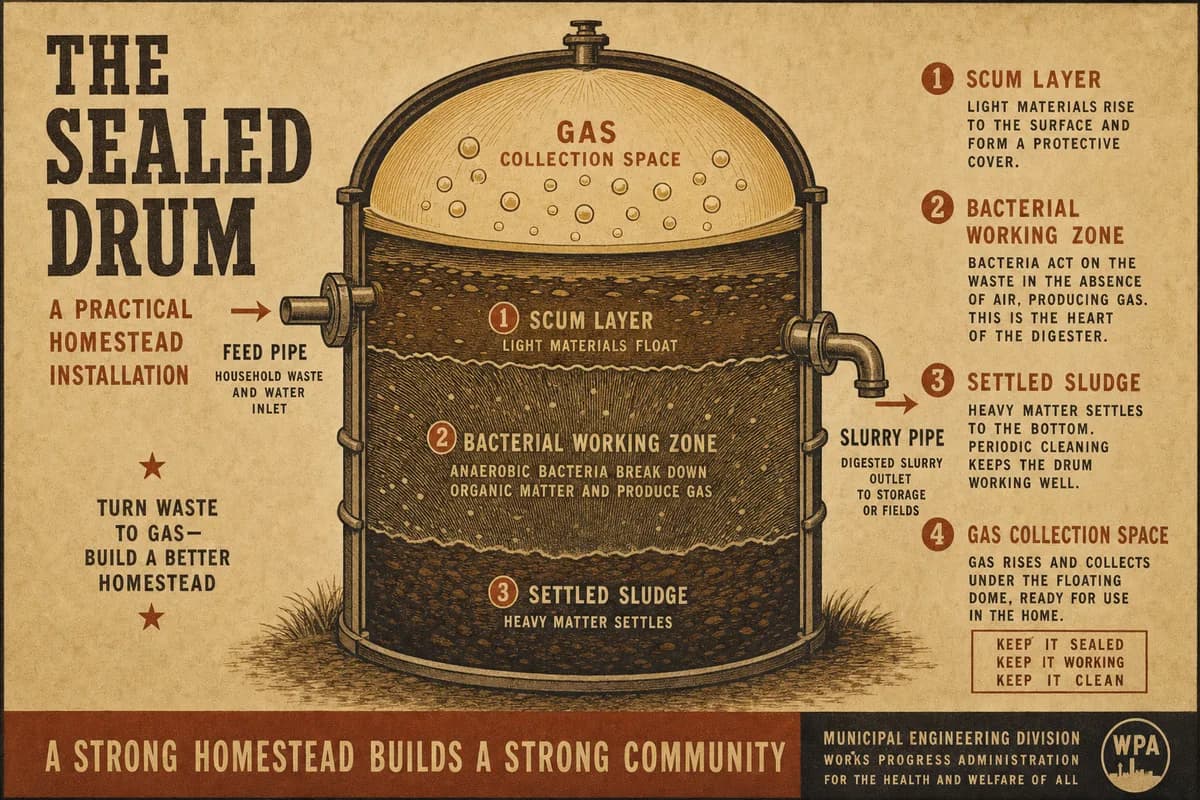
Set your expectations before you set anything else. A household drum will not take you off the grid, will not heat your home, and will not survive neglect. Fed faithfully, it will give you one honest burner and a standing, renewable down payment against the rest.
What you'll need
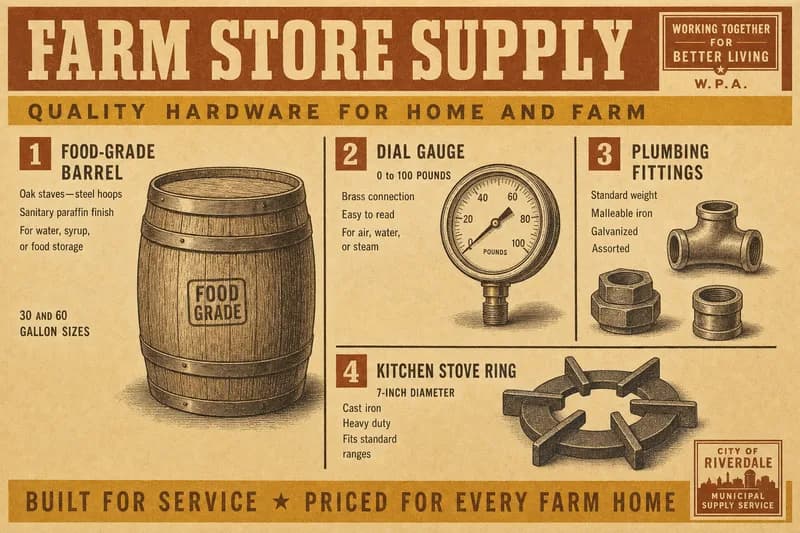
- A sealed vessel — a food-grade 55-gallon (208 L) drum is the classic beginner's body, or a ready-made Dungester 5000 if you would rather buy the sealing already done.
- A floating gas holder — an inverted smaller drum or a butyl gas bag — so you can see your charge at a glance and burn it at a steady pressure.
- A low-pressure gauge (0–40 inches of water column), a condensate trap, and a length of gas line.
- A Fart Scrubber 3000, or a pipe packed with steel wool and biochar, to strip hydrogen sulfide before the gas reaches the flame.
- A Farm-to-Fart Range or any low-pressure methane burner.
- A thermometer, and in any real winter, a way to hold the drum at 35 °C.
- Feedstock you already produce: daily kitchen scraps, the deep-litter cleanings from a few hens, the contribution of one goat, and — to start the culture — a bucket of fresh manure or active digestate borrowed from a neighbor's running unit.
Steps
- Site it. Choose a level spot with afternoon sun, downwind of the house and clear of your jurisdiction's setback. Most jurisdictions treat a digester as an accessory gas appliance; file the permit before you dig.
- Seal it twice. A digester lives or dies on being airtight. Seal every penetration, test it, and seal it again.
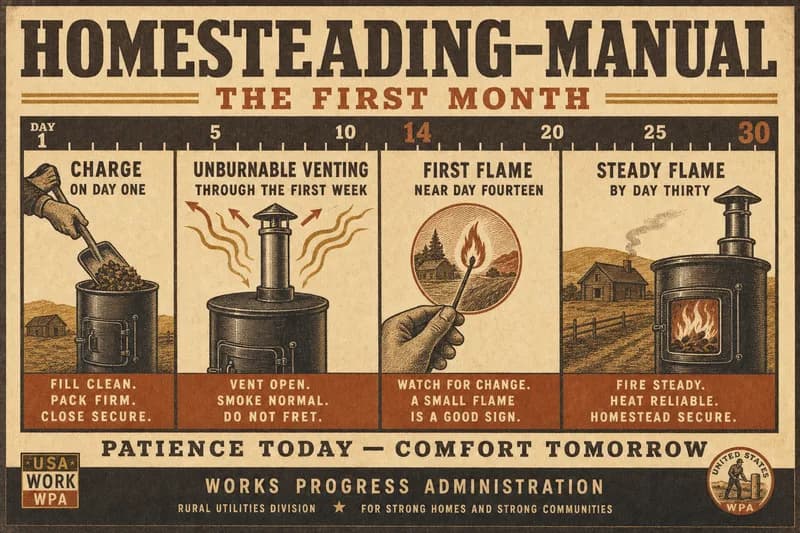
- Charge and inoculate. Fill the drum two-thirds with a slurry of water and feedstock, then add the bucket of active manure to seed the bacteria and cap it.
- Vent the first week. The early gas is mostly carbon dioxide and will not burn. Vent it and wait; a beginner who tries to light week-one gas learns only that it does not light.
- Wait for the culture. Over two to four weeks at 35 °C the methanogens establish themselves and the gas finally holds a flame. This is the day the project becomes real.
- Plumb the gas train. Run the line through the condensate trap, then the Fart Scrubber 3000, then to the burner. Test every joint with soapy water — never with a flame.
- Feed on a schedule. A digester rewards routine and resents a feast. Add a steady daily ration and let the culture keep pace.
Sizing
A beginner does better to size a day's gas to real tasks than to dream in kilowatt-hours. The figures below are for a faithfully fed household drum in the warm season, biogas at roughly six kilowatt-hours of energy per cubic metre, burned directly on the range.
| A day's household biogas does about this | Roughly |
|---|---|
| Total gas from a full household drum | ~170 L (0.17 m³) |
| Useful cooking energy, burned direct | ~1.0 kWh |
| A pot of morning coffee | ~15 minutes of flame |
| A slow-simmered dinner | most of the rest |
| Net electricity, through a small genset | ~0.20 kWh |
Read the last row plainly and you will understand why beginners burn the gas rather than generate with it: a small generator throws away four-fifths of the energy as heat. The flame is where a household drum earns its keep. Scaling past one drum means a second drum, not a bigger flame under the first.
Maintenance & safety
- Hold 35 °C. Below 35 °C the culture stops feeding, and a cold digester is just a sealed drum of everything you put into it.
- Respect the gas. Biogas and air are explosive across a wide range; never store the gas indoors, and never chase a suspected leak with a lit match.
- Mind the sulfide. Hydrogen sulfide is the real hazard. It smells of rotten eggs at low concentrations and of nothing at all at dangerous ones. Keep the scrubber charged and work in open air.
- Draw off the digestate. Pull finished slurry from the outlet as you feed the inlet. It is a stabilized fertilizer, and the garden will want every drop.
Expected output
A household drum does not replace your stove; it earns one honest burner on it, and it earns that burner every day for the rest of its working life. On a good week a beginner covers the morning coffee and a simmered dinner on gas the household was going to throw away regardless. That is the whole promise, and it is enough.
Start here, learn the rhythm of feeding and reading a drum, and the rest of the brown economy opens up in order: a second Dungester, a Brownwall Powerwall for heat, a Fecal Load Balancer to spend what you make in the right order. But the first flame is the lesson. Get one drum to hold a steady blue flame through a season, and you are no longer a beginner.